
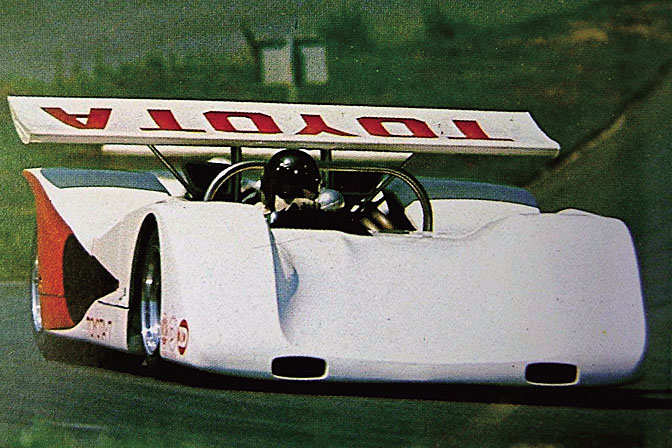
Motorsport is a funny way to make a living, driving round and round in circles, faster and faster if you get it right, or slower and slower if not. The dialogue in Steve McQueen’s classic Le Mans movie encapsulates the motivation behind those who drive the cars. “A lot of people go through life doing things badly……..Racing’s important to men who do it well. When you’re racing, it…..it’s life. Anything that happens before or after…..is just waiting.” Perhaps this philosophical approach was dictated by the cars that were driven back in 50s, 60s and 70s. They were dangerous, little or no protection was afforded the driver if he hit something solid, no crash boxes, no deformable structures and only rudimentary fire protection. The tracks themselves were also a major contributary factor with small errors often having fatal consequences. Yet the danger, the buzz attracted many, the siren song that lures us all on to the rocks.
Back in those decades the rules governing motorsport were a lot less proscriptive, more in tune with the notion that all things were possible. It was a time when a US President could commit his country to putting a man on the Moon within a short time frame and not be thought ridiculous, even though most of the technology did not even exist when JFK addressed Congress. It was the time of a “can do” attitude. Motorsport is a reflection of the society around it and the positive attitude was perhaps best reflected in what was the wildest and most extreme form of circuit racing, Group 7.
The name Can Am is probably more familiar than that of Group 7, bringing visions of insanely powerful open sportscars thundering around the traditional circuits of North America. It was however Group 7 rules that were the starting point for this competition. On SpeedHunters we have already had a peek at the summit of Can Am, the Porsche 917/10 and 917/30…
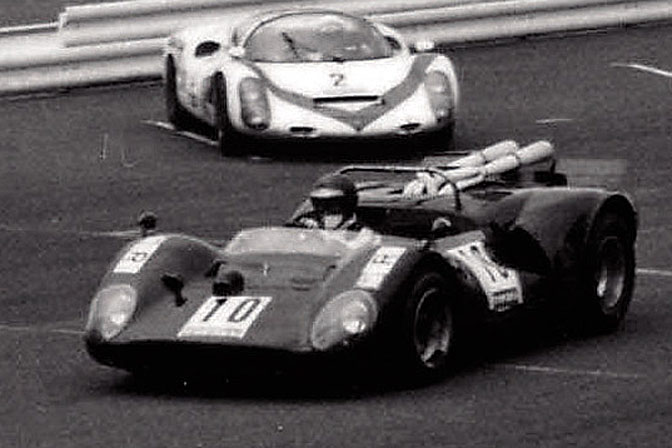
The Can Am Porsches, McLarens, Lolas, Chaparrals and Shadows are generally on the petrolhead radar but much less is known of the Japanese Group 7 scene. At the time the Japanese Grand Prix was run for sportscars and in 1968 the rules of Group 7 were adopted with the aim of eventually linking up with the wildly successful Can Am. This coincided with the tremendous expansion of the Japanese motor industry, so both Nissan and Toyota decided to get involved building up prototypes.
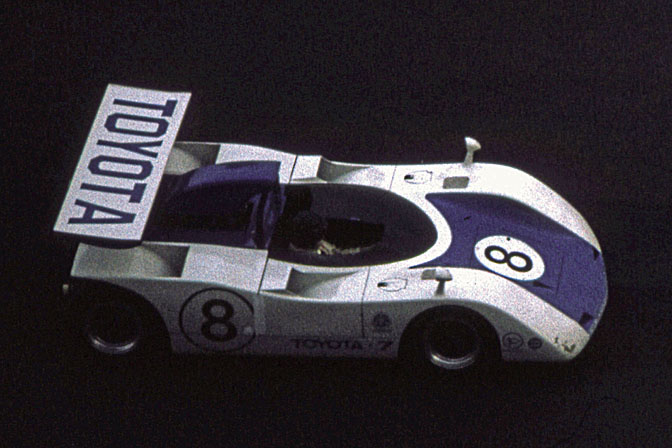
The original design for the Toyota 7 was down to Jiro Kawano, who was responsible for the 2000GT as featured on SpeedHunters earlier this month by the great Antonio. At that time Toyota and Yamaha collaborated in motorsport projects so construction and development were down to Yamaha. For the initial test a 2 litre straight six was installed that had been taken from the 2000GT.
The chassis was an aluminium tube frame construction with fibreglass bodywork. There was a 5 speed manual gearbox and a pretty conventional wishbone suspension set up. For actual racing a new all alloy 3 litre V8 was installed but this immediately put the Toyota at a disadvantage in 1968 as its Nissan and Lola rivals were running 5 litre V8 Chevys. This resulted in a horsepower deficit of around 150bhp and no matter how hard the 7 was driven it could only finish 5th in the Japanese Grand Prix.
But the team did not have to wait long for success as Sachio Fukuzawa and Hiroshi Fushida won the Suzuka 1000 kilometers late in 1968.
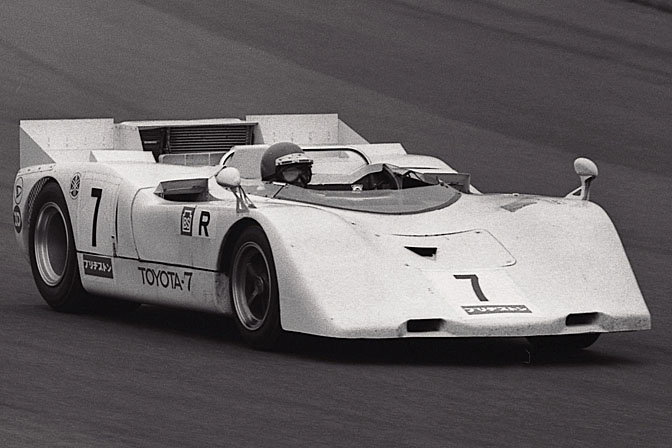
For the 1969 season the car was completely revised with a new 5 litre engine now giving out around 600bhp, a Chaparral style rear wing and new body work. It was a far more competitve prospect but Nissan had also been at work increasing their engine size in the never ending power struggle. As with the previous year Toyota had to give best to their rivals at the Japanese Grand Prix but then the hard work started to pay off with three victories in the balance of the season.
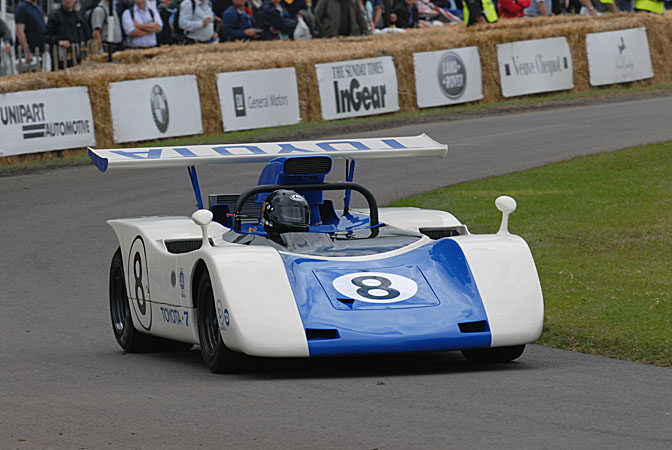
Toyota were rocked by the news that JAF had decided to make the 1970 Japanese Grand Prix a race for single seaters, effectively ending Group 7 in Japan. The project had also been badly affected by the death during a test session early in the year at the Yamaha test track of their star diver, Sachio Fukuzawa. Fukuzawa was testing an experimental coupe version of the Toyota 7 but the circumstances of his death were shrouded in mystery. Fukuzawa had a very high profile in Japan, being something of a fashion icon, he even modelled professionally and he made regular television appearances. The unwelcome publicity made Toyota very uncomfortable and the whole issue almost turned into a scandal and legal proceedings were issued by his family, but matters were settled before the case came to court.
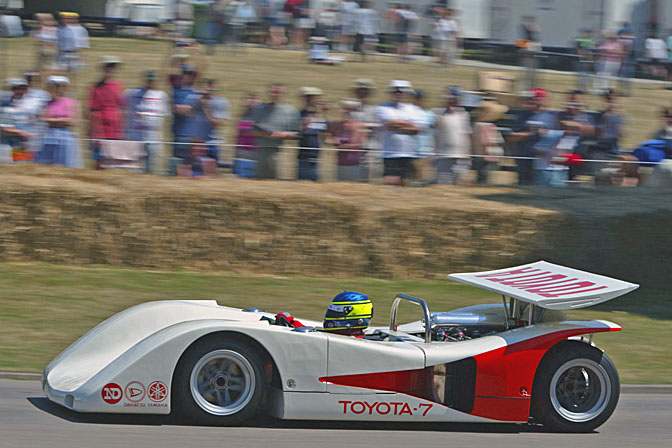
The JAF’s decision to go the single seater route may have closed down Japanese Group 7 but Toyota resolved to develop the car further and head across the Pacific to join the Can Am battle. To cope with the power of the 8 litre Chevys that the McLarens and other regulars used in North America, Toyota decided to add twin Garrett turbos to a new 5 litre engine, anticipating the Porsche 917/10 project by two years. The car now had more revised bodywork and aerodynamics to cope with the 800 plus bhp.
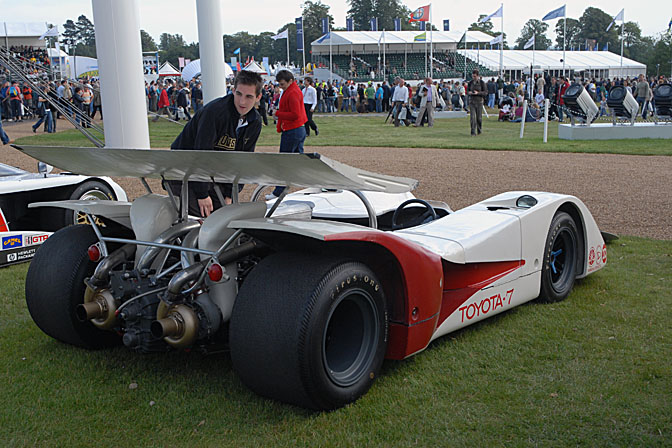
The misfortune that had dogged the project persisted and team leader Minoru Kawai was fatally injured after a high speed accident while testing at Suzuka in August 1970. Kawai, like Fukuzawa was a high profile figure in Japan, appearing in press and TV commercials for Toyota and was married to a leading actress, model and singer, Rosa Ogawa. The bad publicity arising from this second fatality was too high a price to pay for Toyota and the new car with the Can Am plan was cancelled.
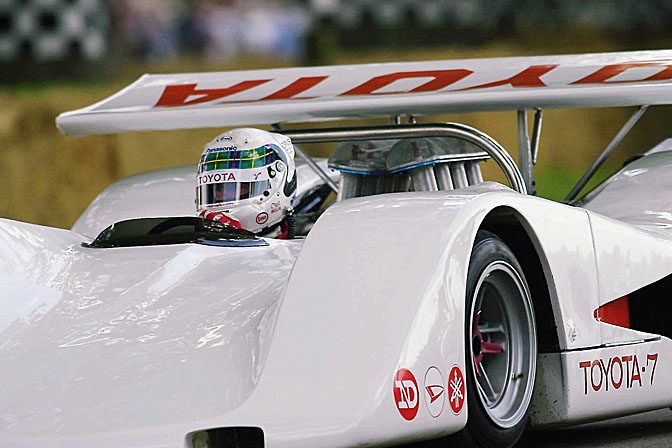
In researching this feature I found a shot of Allan McNish taking the 7 up Goodwood Hill at the 2002 Festival of Speed. I called him to get an impression of what it was like to drive.
“Terrifying.”
“How so?”
“There was no real throttle control, it was either on or off,”
He went on to say that the brakes were rudimentary at best and he lacked confidence that they would stop the car in time to get round the first corner on the hill climb. He also remarked on the lack of safety measures and was amazed to find that a similar car had won several long distance races including the Suzuka 1000 kilometres.
He remembered one other thing, the rear wing projected out either side of the rear bodywork around 20cms, one of the other drivers had not noticed and clipped a straw bale going up the Hill ripping the whole wing off…………….
The late 60s and early 70s were a very dangerous time to be a top line racing driver, speeds had increased dramatically since World War Two but the safety measures had lagged behind until campaigners led by multiple Formula One World Champion, Sir Jackie Stewart, dragged the sport into the second half of the 20th Century. He was not always liked for what he agitated for.
“I would have been a much more popular World Champion if I had always said what people wanted to hear. I might have been dead, but definitely more popular”.
Allan McNish shares the same mix of intelligence and courage as his illustrious countryman and if he thinks a car is dangerous, it is, period.
Although it pales into insignificance compared with the human tragedy of two prematurely lost lives, we as SpeedHunters missed out what could have some of the greatest racing ever, a Can Am series with McLaren, Porsche, Shadow, Chaparral, Lola and Toyota, maybe Nissan would have followed. Motorsport might be a totally different landscape now.
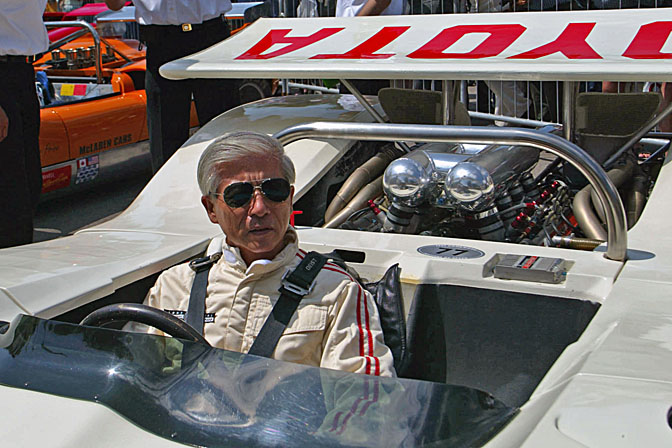
The above photo show the Toyota 7 reunited with one of its original drivers, Hiroshi Fushida.
Toyota are rightly proud of the 7, it represented a significant jump in their motorsport history and proved that they had the ability to take on any manufacturer in the sport with a high chance of success.
John Brooks
All photos courtesy of and copyright Toyota Motor Corporation