
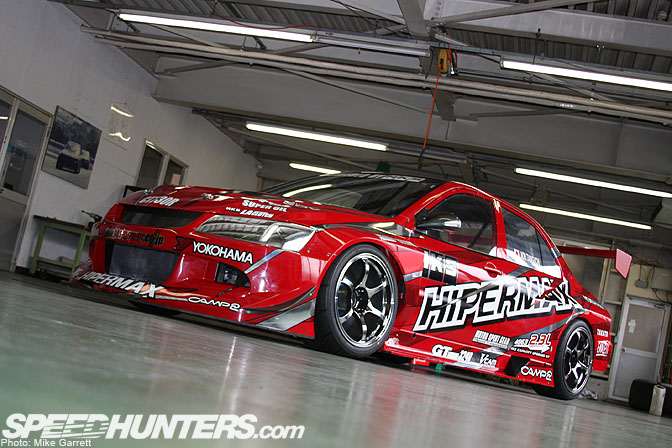
What’s better? Saving the best for last, or starting things off with a bang? Right now I’m going to choose the latter. To kick off Speedhunters AWD month, I’m going to feature what just might be the greatest tuner car of all time. To even call the HKS CT230R a tuner car is a bit of a stretch, but since the car is built and campaigned by one of the world’s biggest tuning companies I’d say the name fits. I got to spend some time inspecting every surface of this monster when I visited the HKS factory in Japan last winter, and have been patiently waiting until now to post this feature.

The CT230R has been around for several years now. Perhaps you remember the video clip of NOB Taniguchi crashing the car in the Tsukuba infield back in 2003 or 2004 when it was known as the TRB-02 and its body was unpainted dry carbon. My first personal encounter with the car came at the 2007 Super Lap Battle event at Buttonwillow Raceway. HKS shipped the car all the way to the United States so it could leave its mark on the American time attack record books. During that event, the CT230R absolutely dominated, setting a record time of 1:43.523 which was around five seconds quicker than the previous record holder.
Earlier in 2007, the CT230R had set the Tsukuba time attack record with a scorching 53.589 lap time – one that has yet to be beaten by other tuners in Japan. Besides Tsukuba Circuit, HKS and NOB have also toured around Japan’s great race tracks, setting records at places like Autopolis, Suzuka Circuit, and Fuji Speedway. The car even took a trip to Malaysia to run at the famous Sepang Circuit.
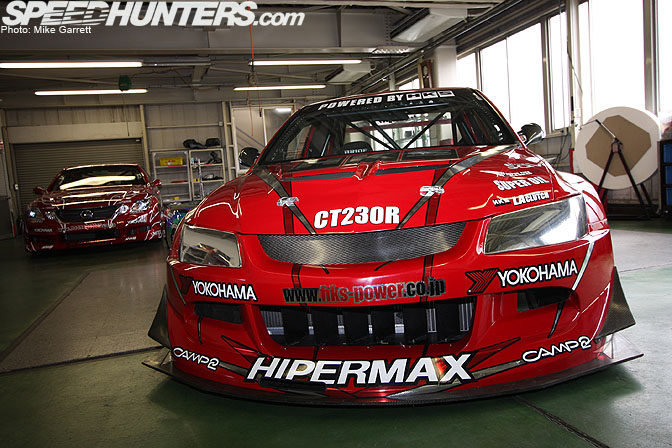
With its grip on the record books secure (for now), the newest duty for the CT230R is challenging Super GT race cars during the HKS special events at Fuji Speedway. When I shot the car back in February, the car had just returned from its match against the WedSport IS350 and GT300 BMW Z4 at the HKS Premium Day. I had just seen the CT230R at Fuji a couple weeks earlier, but when Saitou-san opened the garage and I saw the car sitting quietly under the lights I felt the automotive equivalent of being star struck. I was looking at what might be the best known Evo in the world.
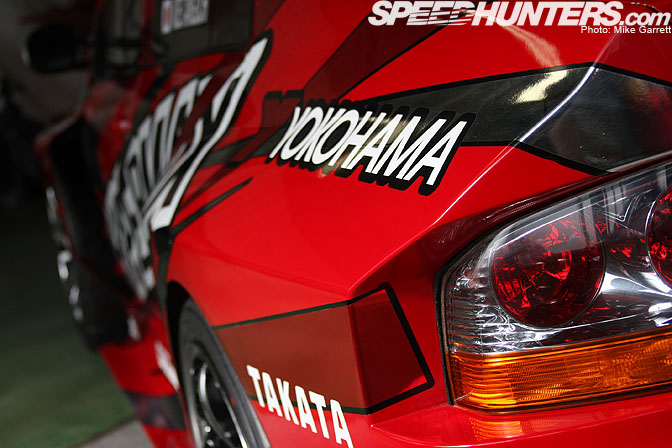
Just like the Lamborghini Reventon that Rod and Dino featured, you can spend a lot of time studying all the visual details of the CT230R. From certain angles it looks a bit like other Evo time attack cars, but from others the work that HKS has put in to perfect this car becomes strikingly clear. Again, this is more like a Super GT race car than a typical tuner-built demo car.
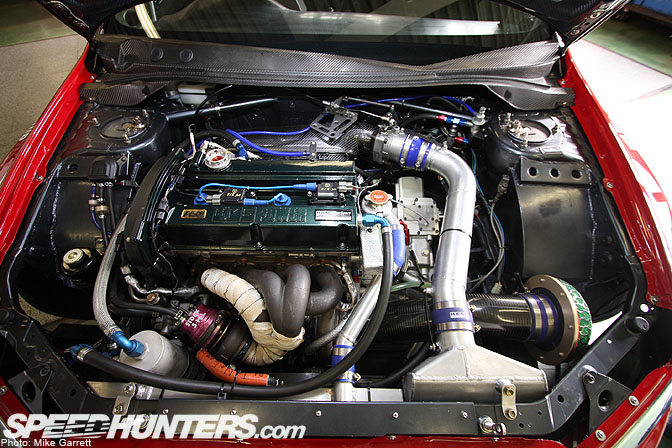
Although the engine is just one small part of what makes the CT230R so capable, it’s a good place to start our look at the car.
Naturally, the Evo’s 4G63 has been loaded up almost exclusively with HKS-produced parts. Some of them are one-off racing components specific to this car, while others are off-the-shelf HKS parts that can be found on customer cars all over the world. The engine internals are all beefy HKS products, including the pistons, rods, and crank which bring the displacement of the 4G63 up to 2.3 liters. The 820cc injectors are prototype parts and an HKS 1.2mm head gasket toughens up things a little. The HKS 272 cams help the give the CT230R that lovely, lopey race car sound. It’s no surprise that everything is controlled by one of HKS’ F Con V Pro systems.
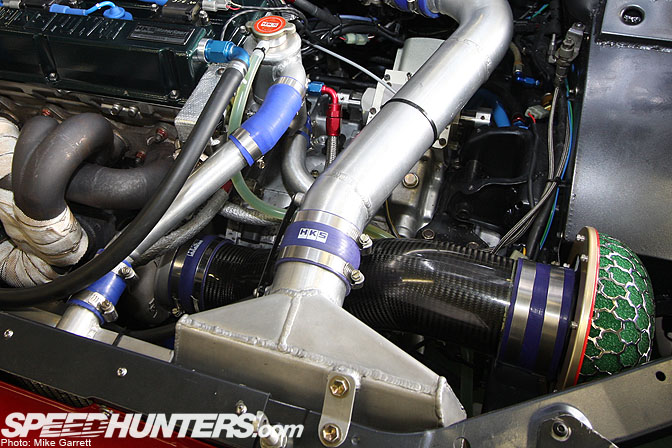
The engine is fed by an HKS GT3240 turbine kit, which is barley visible there under the one-off exhaust manifold. Wastegate is an HKS GTII. Note the carbon fiber intake pipe which is topped off with one of HKS’ famous mushroom air filters. The HKS racing intercooler can be seen through the hole in the front bumper. All together the CT230R’s engine setup is good for about 550hp. That’s not a mindblowing number for an Evo, but horsepower is just one part of what makes a fast time attack car, well, fast…
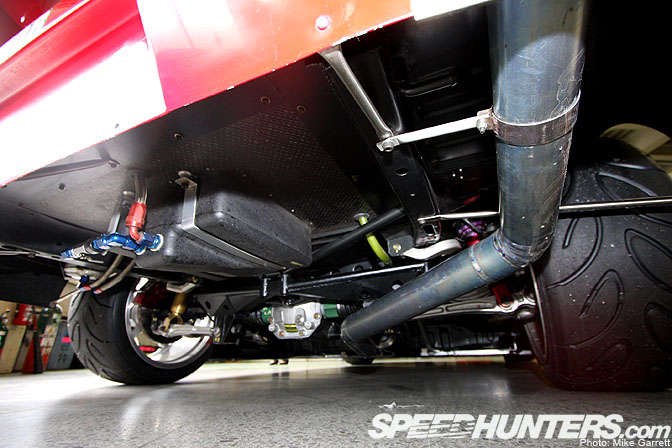
A quick look under the rear of the car shows the bottom of the trunk-mounted fuel cell, some of the added chassis bracing, and the large diameter one-off HKS racing exhaust system. If you look closely you can see the Hipermax II SS coilovers which have been custom-designed just for the CT230R. Those big tires are Advan A050’s sized 265/35/18 all around…
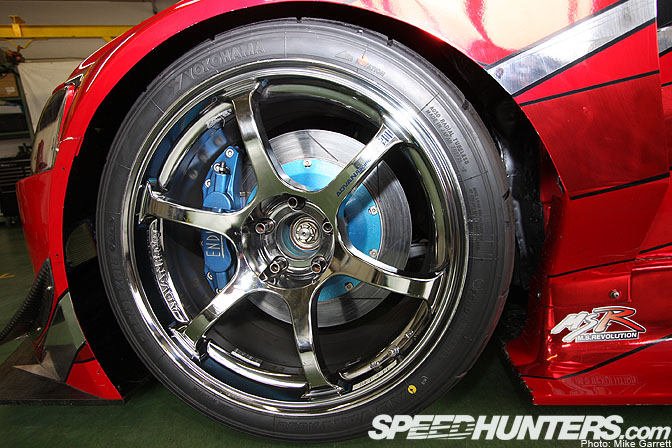
…which are wrapped around these 18″x10J Advan RGII wheels. The Endless brake system is likely the biggest non-HKS component on the car. The six pot calipers in the front and four pot calipers in the rear with MA22B pads give the CT230R all the stopping power it needs while slowing after Fuji’s long front straight or diving into one of Tsukuba’s tight corners.
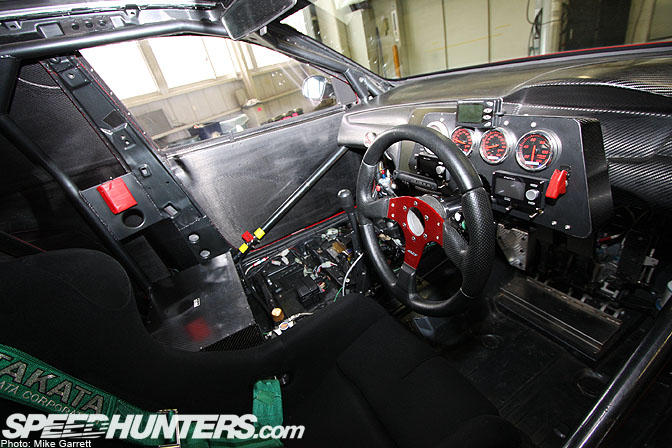
The interior of the CT230R is full of weight-saving and rigidity-increasing modifications, with little evidence left of the car’s humble Mitsubishi origins. You can see a bit of Evo left in the shape of the carbon dash shell, but that’s about it. The full roll cage protects NOB as he sits in the carbon fiber bathtub piloting the car. The cage also helps reinforce the already-stiff CT230R chassis. As you can see, the driving position has been pushed rearwards for better weight distribution. I wonder if HKS also keeps tabs on NOB’s diet?
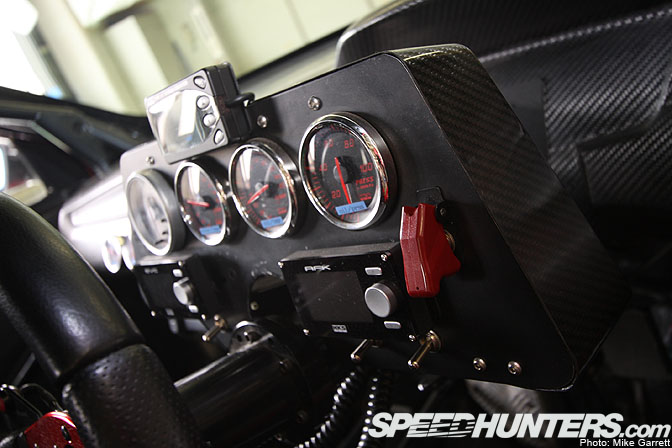
The car is loaded up with HKS electronics, including an EVC boost controller, a few DB gauges, and the often-used HKS Circuit Attack Counter. All of the electronic tools on the car keep the HKS crew very busy when the CT230R is running. While shooting the inside of the car, I was a bit overwhelmed by all these gadgets.
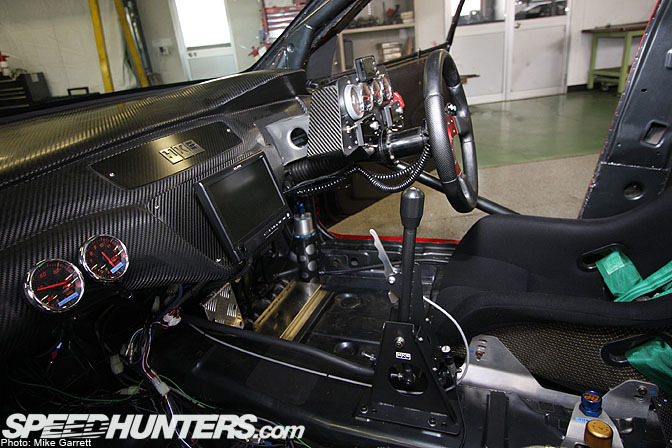
That big shift lever is connected to an HKS MS Gear 5-speed sequential transmission (with an HKS LA-type clutch). The Eclipse screen in the center of the dash isn’t for watching DVD’s or a navigation system, but for the car’s HKS Camp2 system. Seating consists of a lone carbon Bride Zeta III bucket. Unlike drift cars or demo cars, there’s no room for passengers here…

Back outside, the car looks stunning with its “stinger red” -painted dry carbon body and graphics, which were designed by MSR. Although HKS has poured tons of hours into making the body as functional and aerodynamic as possible, I like how the car still has a nice shine to it – especially when equipped with the black chrome Advan RG II’s.

If you were looking for this same dry carbon HKS Racing aero kit for your Evo, good luck. This a one-off, race-only design for this car. Even if you could purchase it, it’d likely cost a lot more than than a brand new Evo itself. From a visual standpoint, I’d say it’s the fenders that are the most impressive part of the exterior, although I also like the chrome covers that occupy the holes where the headlights once were.
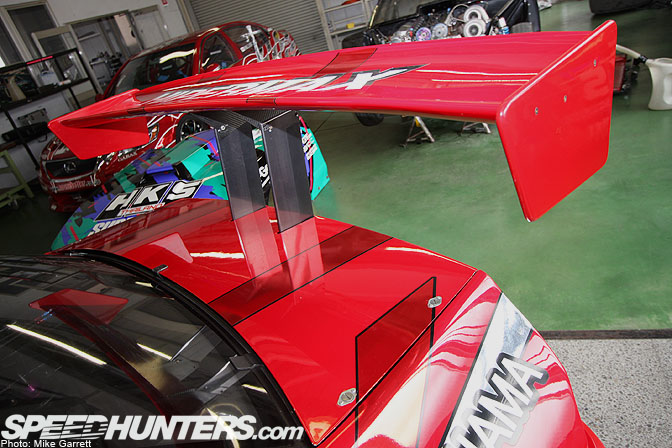
The car’s GT wing is equally impressive, mounted directly to the chassis and not just to the body. The trunk is of course dry carbon, as is every other body panel on the car. By now I’m pretty used to it, but I still get a little nervous when moving around all this ultra-expensive carbon fiber during photoshoots…
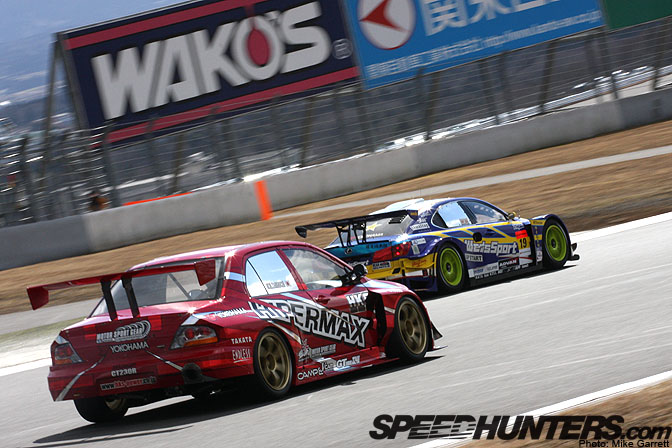
The CT230R looks right at home alongside the WedsSport Super GT car at Fuji Speedway. Unfortunately snow caused this year’s race between the Evo and the Super GT cars to be called off before a winner was determined. I guess we’ll have to wait until the next HKS Premium Day to see how the battle turns out.

In the time since the car set its records the competition has been edging closer, but hasn’t yet been able to catch the lap times recorded by the CT230R. Should they get close enough, NOB and the Evo will likely back to set things straight. Whether its traveling around the world shattering time attack records, or going head to head with GT race cars, the CT230R is a testament to what HKS is capable of after its 36+ years of experience tweaking cars and engines of all types. With its dominant track record, there’s only question that remains about this car.
Is this the world’s ultimate tuner car?
-Mike Garrett
(If you missed some of my HKS features from this spring you can check them out here)