
Most of you will know of Carl Jarrett and I through our Speedhunters contributions, however our day jobs are as part of Need for Speed's car team. Carl is NFS's Vehicle Art Director while I'm the Vehicle Styling Director and, together with our talented team, we take real world cars and transform them into virtual replicas. If you've ever wondered how cars are modeled into games, read on.
AB: As the Need for Speed franchise has a global following of both diehard and casual gamers alike, it's really important to have a balanced, well rounded car list. Last year, Carl, Rod, the producers and myself worked on the car list for Need for Speed The Run. As you'll see in the game, one of our changes saw the inclusion of more classics from around the world. This was partly influenced by Speedhunters.
We work closely with various car manufacturers to obtain a library of photo references and CAD data. We were one of the first developers to use CAD data many years ago, and have strong relationships with the manufacturers. This last point is vital, as we are often entrusted with data on vehices before they have been released or even seen by the general public. Having this sort of access ensures we can accurately portray their vehicles in game. During this stage, other members of the car team work on the various pipelines required to build the cars. As we were using the FrostBite engine – which also powers Battlefield 3 – we had the opportunity to develop a more efficient and flexible workflow. One of our technical artists, Darren Housden worked on the ‘Car Bible’ which covers every element of the build process. When printed out it's almost 200 pages!
Once we have the CAD data and reference photos, two of our colleagues, Frankie Yip and Alex Tse, manage the production of the car. This includes getting them 'polished' and integrated into the game engine. Most CAD includes all the parts to build the car, right down to hidden rivets, nuts, bolts and so on.
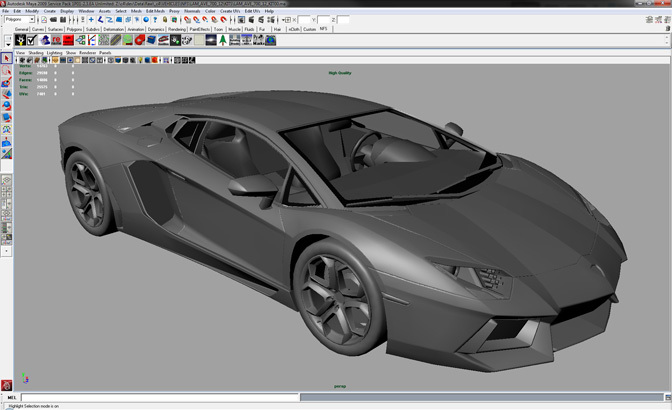
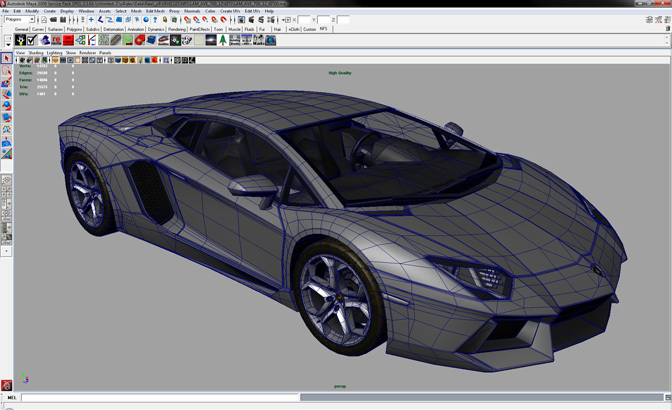
CJ: Here is the Aventador, which was built by modeller Vinod Raju. For such a low poly count, the surfaces are extremely smooth and accurate. The structure of the triangles and polygons needs to be very tidy; car modellers need to be efficient artists who can tweak the vertices and polygons to perfection.
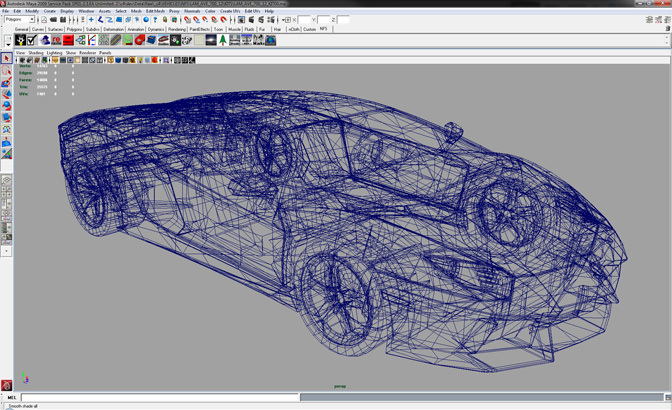
CJ: Each of our cars has approximately 25,000 triangles including the four wheels and driver.
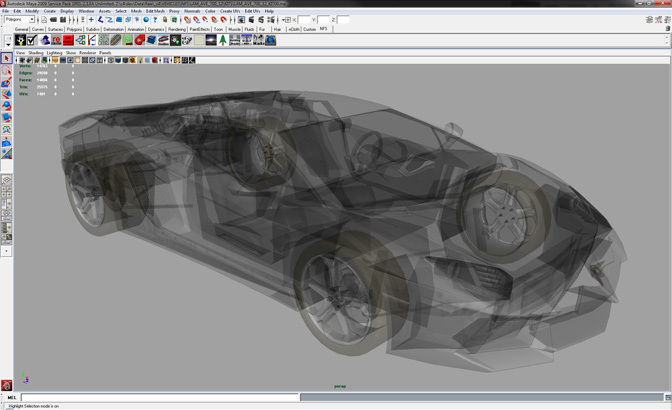
CJ: We model many of the parts on each car. Here you can actually see the Aventador's rear push rod suspension!
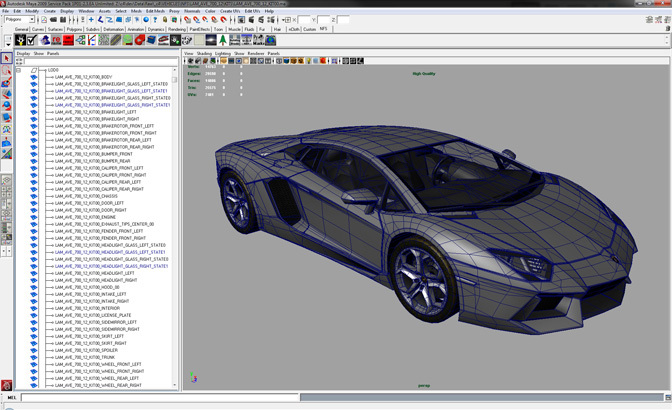
CJ: In the panel on the left are the parts breakdown in Maya. As we have a lot of parts for each car, we rely heavily on standardized naming conventions.
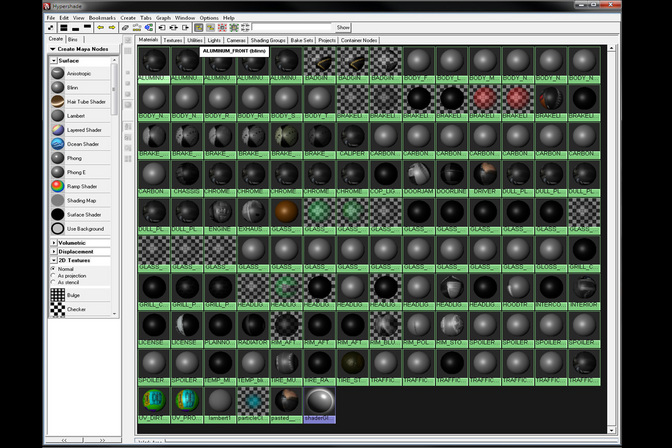
CJ: This is the material layout in Maya. We use materials for more than just the basics; we also use them to split up groups of polys so our proprietary tools can work theer magic only where they need to.
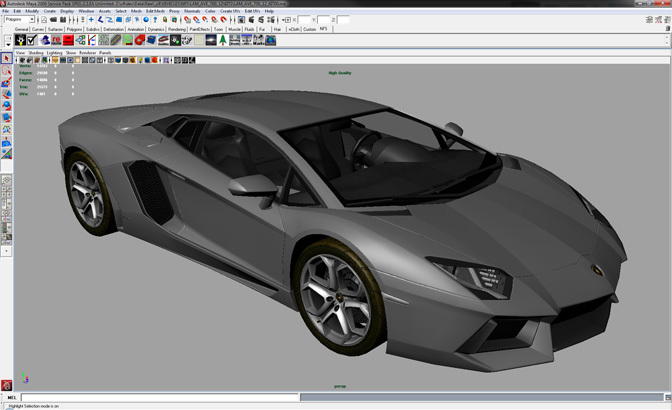
CJ: This is the final product, ready to make its way into FrostEd and then the game. We rely on normal maps for the tires and the emblems on the cars to reduce poly count.
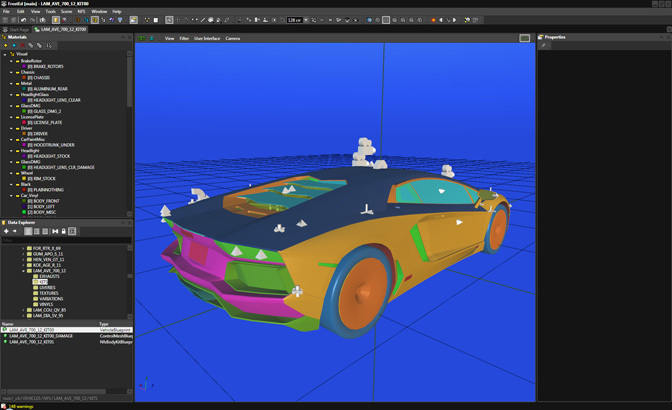
CJ: On the left is FrostEd's material breakdown; each of these groups is a Surface Shader with Maya materials assigned to it. Each group gets its own set of parameters.
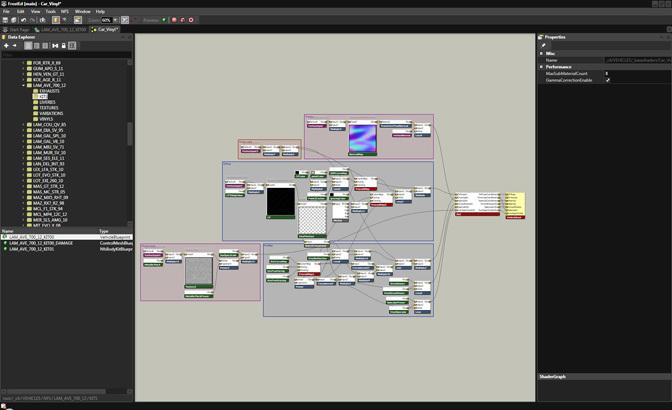
CJ: This is the Shader graph we use in FrostEd for the car paints. It looks pretty convoluted, but in reality it uses very basic math and achieves the look we want.
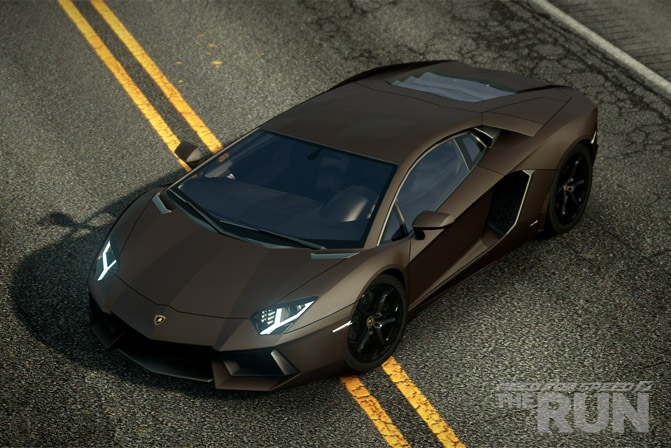
AB: We can replicate a variety of finishes including gloss, matte, satin, chrome and even carbon fibre. In many cases we use the manufacturer colours on the stock cars including this matte 'Maroone Apus'.
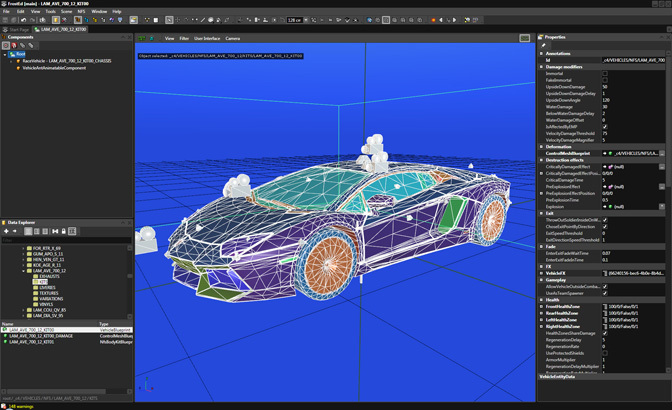
CJ: Here is the completed car in FrostEd. The tool colour-codes each material in the editor so you can easily see what is assigned to what.
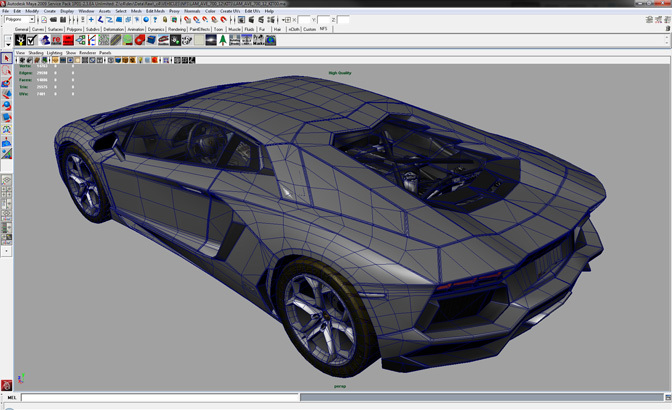
CJ: Again, you can see how tidy the artists are with the layout of the polygons. Everything is evenly spaced and aligned well in curves. This is what separates great 3D game models from the not so good ones.
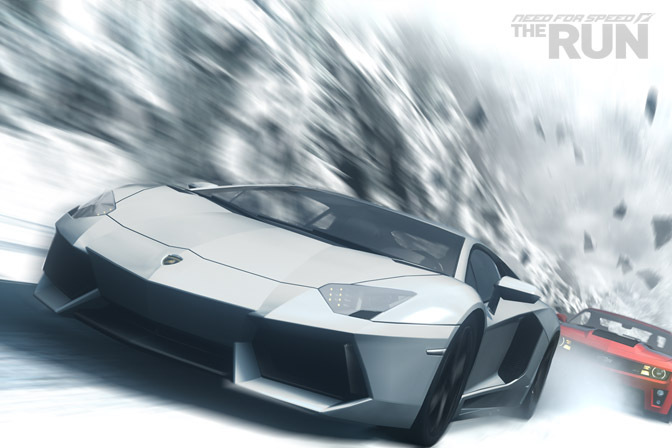
AB: Once this is complete, we add animation, damage states and import the stock car into the game. This is where the physics team takes over. The car team then moves on to producing LOD (level of detail) models. These have lower poly counts and are used when vehicles move into the distance.
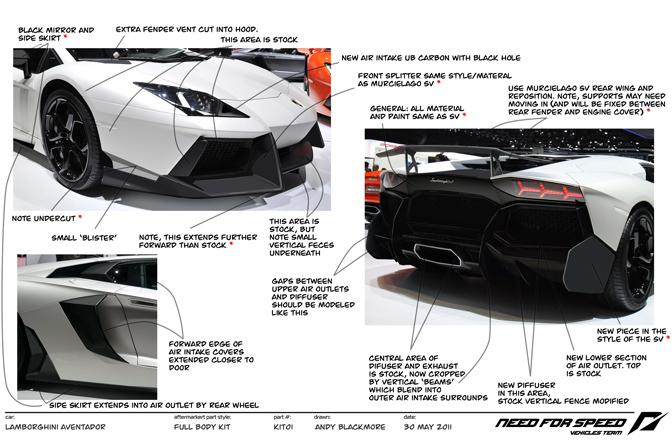
AB: In the meantime, I work on the designs for any new parts. We have different classes of car, so compacts and tuner cars have more options than supercars, just like in the real world. In this instance the Aventador has two options, a lowered package with wheels and a full bodykit with different wheels. Our concept sheets sometimes consist of illustrations or, in this case, a simple 'Chop with detailed annotations.
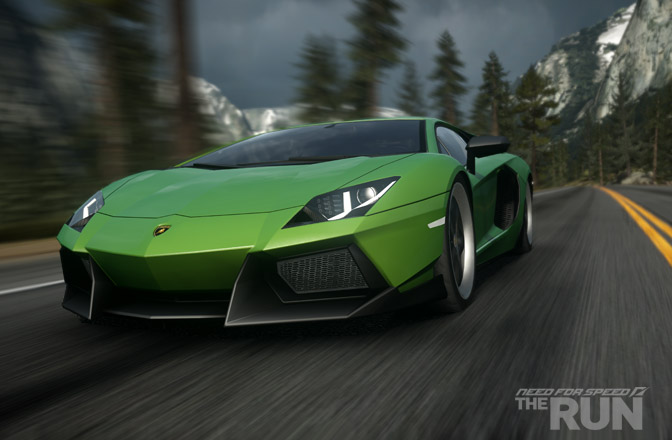
AB: As the Aventador was a new car, I thought I’d do my own take on a performance model, influenced by Superleggera and Super Veloce variants of recent Lamborghinis.
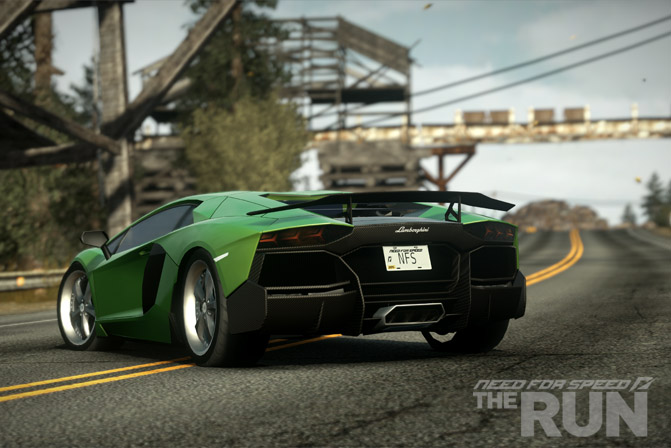
AB: The Aventador is a very striking car so I wanted to keep the look subtle.
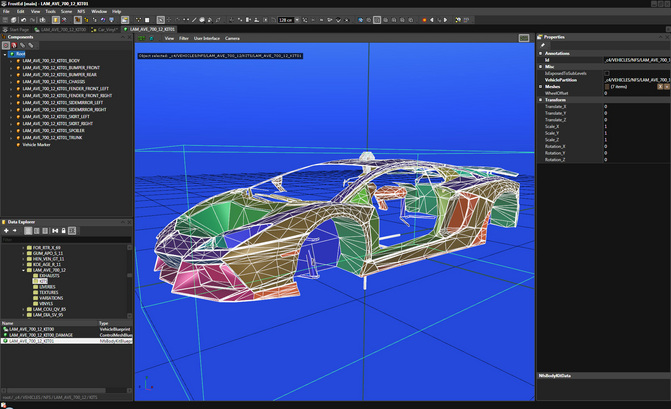
CJ: Here you can see what a customized car requires when adding a bodykit. Kits typically include side skirts, front and rear bumpers, and can also include things such as hoods, trunks, or spoilers.
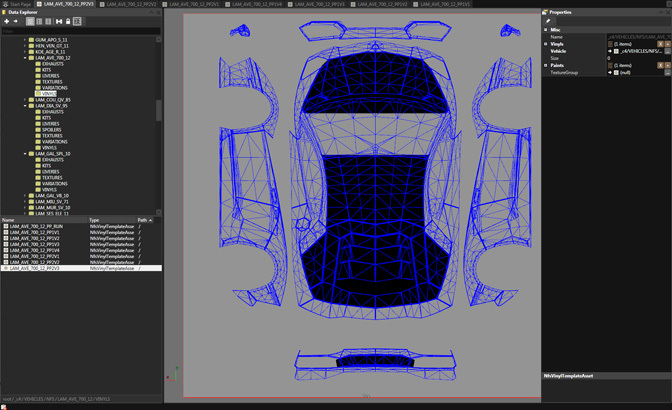
AB: Once the car and its kits are in-game, artist Mike Hayes and myself work on fleshing out variants of each 'preset'. We add licensed wheels, select paints for the body and rims, and sometimes add aftermarket hoods and spoilers.
While we work on these, other members of the team do a final polish pass. This is to check that there are no bugs and all materials are correct: paints, license plates, ride height, damage, LODs and so on. One of our artists, Alex Tse also creates detailed documents which are then sent to the car manufacturers for final approval. Some of these documents can extend to 20 pages per car.
Some of the customised cars will have graphics, so these vinyls are created and mapped individually to each variant. These can be a simple two tone as above or a full livery.
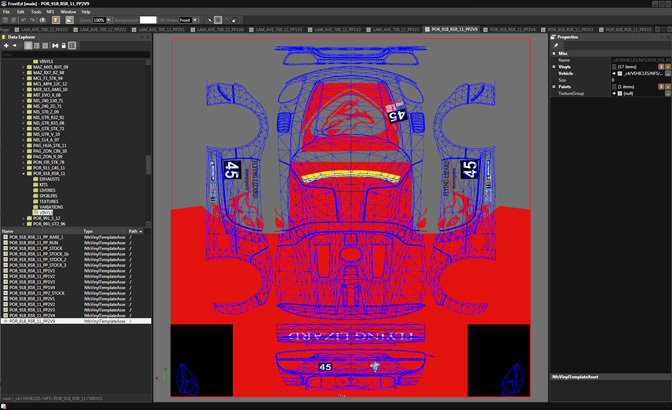
AB: While most of the supercars have a more subtle look, there are exceptions such as this special one-off Flying Lizard Porsche 918 RSR RaceLab!
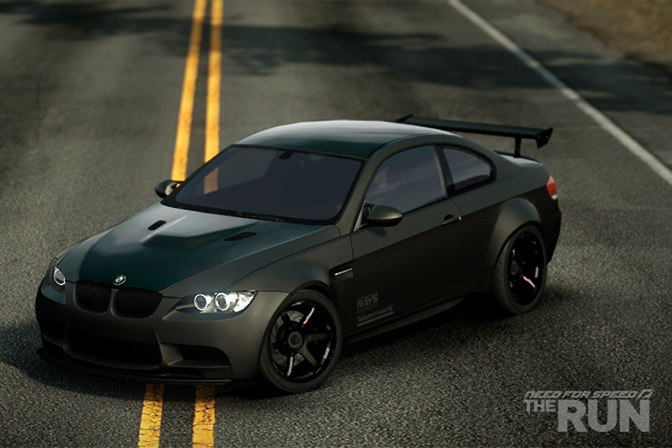
AB: We can also mix different paint finishes. For example this BMW M3 is satin with gloss carbon accents.
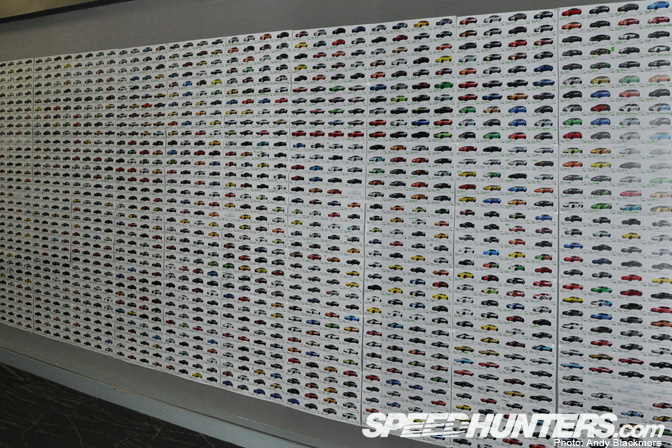
AB: There are literally thousands of car variations that end up being created. Here you can see just some of the variations on our wall.
Of course, there are some secrets to our trade that I can't reveal, but I hope you enjoyed this insight into what the daily jobs in the car team are like.
- Andy Blackmore and Carl Jarrett