

We all know that rules and regulations are a fundamental part of motorsport. Whether in place to simply define the competition or level the playing field, rules play a pivotal role in all motorsports and Formula D is no exception. Competitive drifting is still in its infancy and with each passing year it grows by leaps and bounds. The governing body of Formula D is constantly trying to come up with ways to make the competition fairer and less subjective.
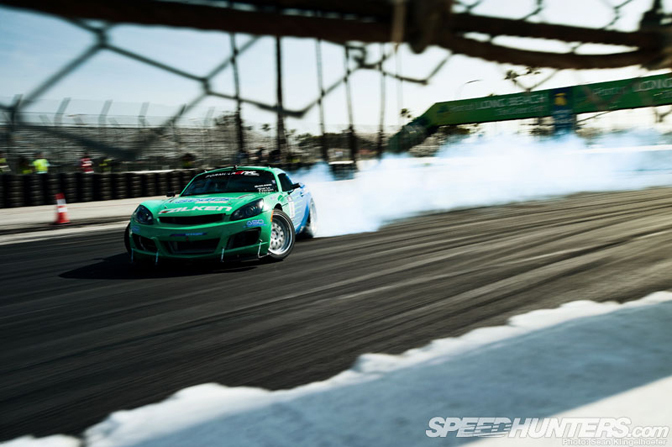
The one rule that most fans seem to be aware of, yet don’t completely understand, is the much discussed “tire rule.” But what exactly is “the tire rule” and how does it effect the competition? Well before we dive into the specifics, let’s first take a look at the round black things on all the cars – the tires. Tires are one part of a car that I presume most of you have some experience with, even if it was only changing a spare.

Whether the ones on your car are of the stretched variety or made of R-Compound sticky stuff, you’ve probably realized that the tire sizing has three basic identifiers – section width, aspect ratio and wheel diameter. The only bit of information that “the tire rule” is concerned with is the first number, the section width. This number i.e. 245, is the width of the tire in millimeters. Since these numbers do fluctuate slightly from manufacturer to manufacturer and model to model, the Formula D techs physically measure the width on each car at every event.
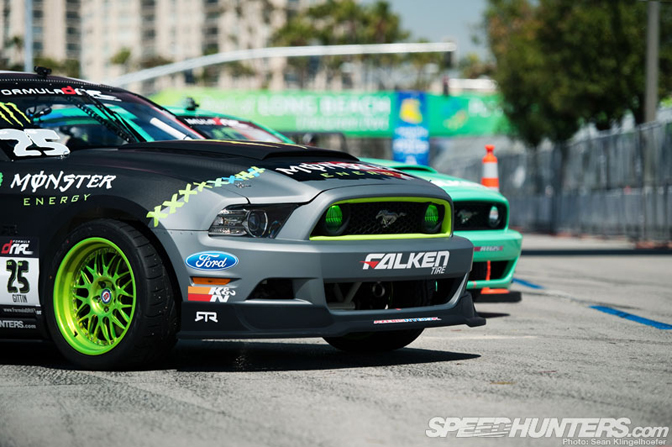
A larger contact patch is good, since as it grows so does the available static grip, and grip is almost everything in motorsport. The more grip you have the harder you can accelerate, the faster you can corner and the deeper you can brake – all of which are good things. Of course there are other factors that affect overall grip, but for now we’ll ignore them since “the tire rule” is only concerned with section width. Now that we’ve got the basics covered, we can look into the rules.
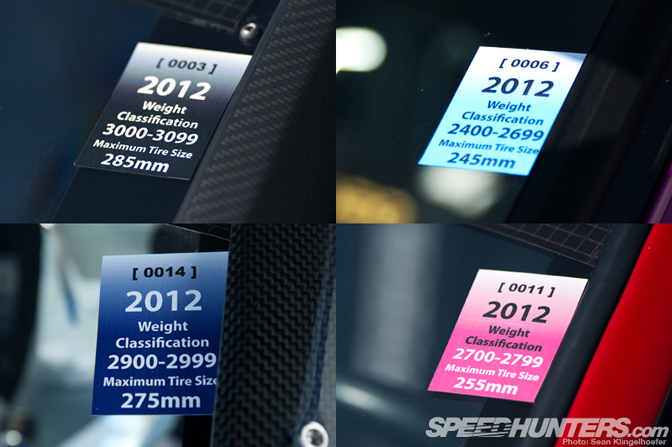
For starters the rule book is only geared towards the size of the rear tires, as these are largely responsible for the performance of a drift car. The cars are weighed in competition trim with the driver in the car and then placed into classes. Once the car has been classified a sticker is placed on the windshield indicating its group.
The classes are as follows:
2100-2399lbs up to 235mm
2400-2699lbs up to 245mm
2700-2799lbs up to 255mm
2800-2899lbs up to 265mm
2900-2999lbs up to 275mm
3000-3099lbs up to 285mm
3100-3199lbs up to 295mm
3200-3299lbs up to 305mm
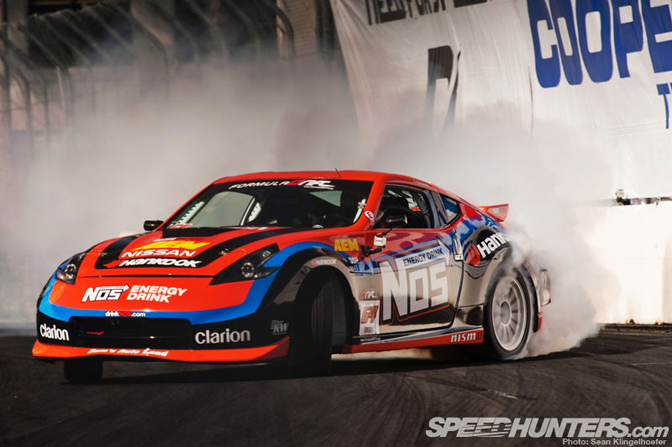
With many regulations in motorsport, the tire rule aims to bring down cost and level the playing field and in this case the contact patch is adjusted in proportion to weight and the teams have options when building a car. This allows heavier muscle cars to compete with lighter JDM chassis without spending buckets of cash lightening the body. Each end of the spectrum has different pros and cons. Some builders will choose a lighter car that won’t have great straight-line speed but will be very toss-able in the corners, whereas a heavier car will be able to pack on the ponies but suffer a little in the twisty bits – everything is a trade off.
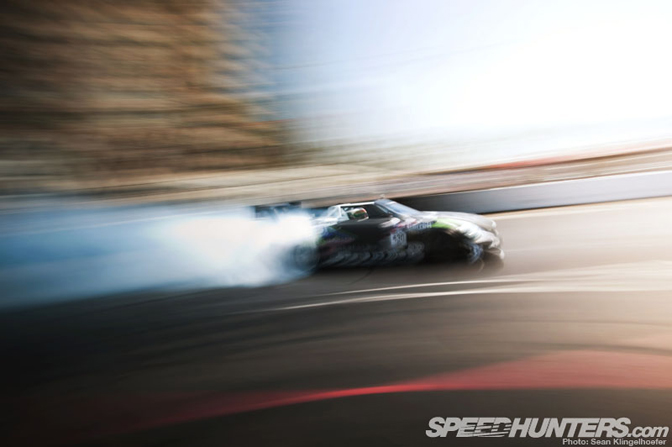
While some may be content at the extreme ends of the spectrums, others will sit closer to the middle. This is the exact setup that the boys at Bridges Racing have decided to run on FD rookie Daigo Saito’s much talked about SC430. After watching the car at Long Beach the setup appears to be solid but not quite as precise as the front-runners. The massive power on board was easily capable of smoking the 275mm Achilles.
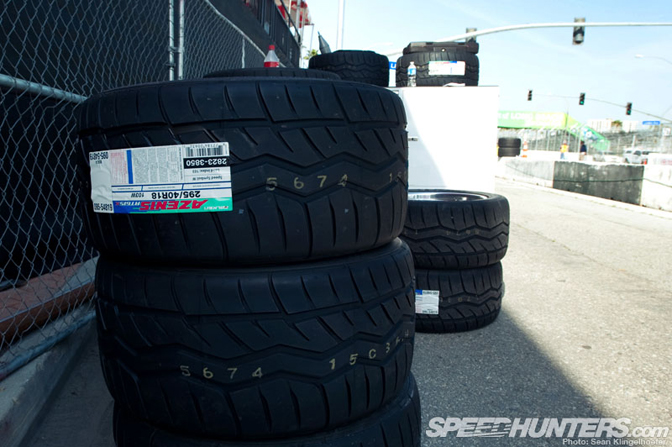
The range of brands and compounds found on the cars throughout the FD paddock makes it a bit difficult to make any concise statements on car setups, particularly after only one event. However it is interesting to take a look at the top two steps of the podium at Long Beach as both drivers were on the same tire but were using two very different tire setups – Dai Yoshihara on 255s with his S13 and Justin Pawlak on 285s with his Mustang. After reviewing their tandem battle a half-dozen times here, I have drawn the following conclusions.

The first thing you’ll notice about Dai’s car is how smoothly it transitions into a drift under its own inertia, it’s almost as if the car wants to drift all on its own. Watching Dai initiate for the first corner looks effortless and it’s obvious the car relies more on suspension setup than brute power to sustain a drift.
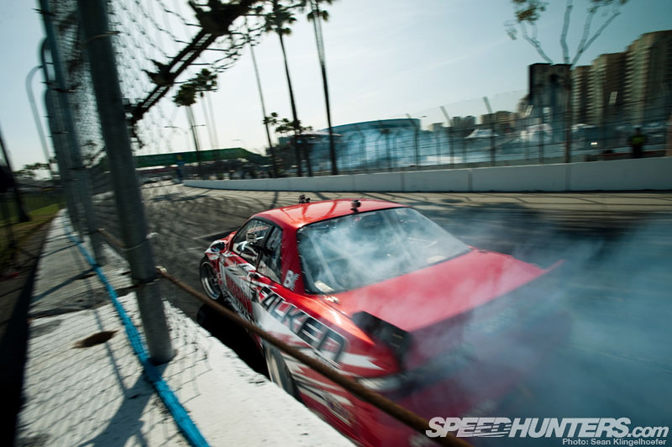
Although arguably a more elegant style, Dai’s angle is noticeably shallower in a few areas of the track in order to maintain big speed, particularly coming out of the final hairpin.

In comparison JTP’s ‘stang is a little more obvious when its weight is thrown about and seems to be a little tougher to initiate off-power. This shortcoming is easily overlooked when the throttle is pinned, it seems to snap into a drift more abruptly and relies heavily on Ford power to keep it going.
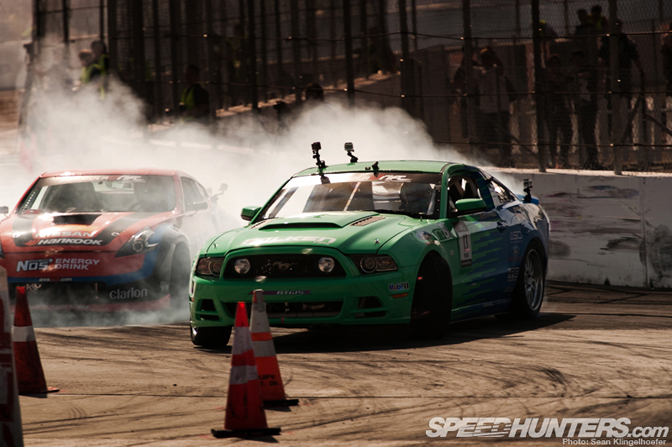
This setup had a decided advantage at Long Beach at the long sweeping section of turn two and the surface change at the hairpin. Some purists could argue, as Rod has mentioned in the past, that Justin’s car spends most of its time power sliding rather than drifting – but that’s a debate for another day.
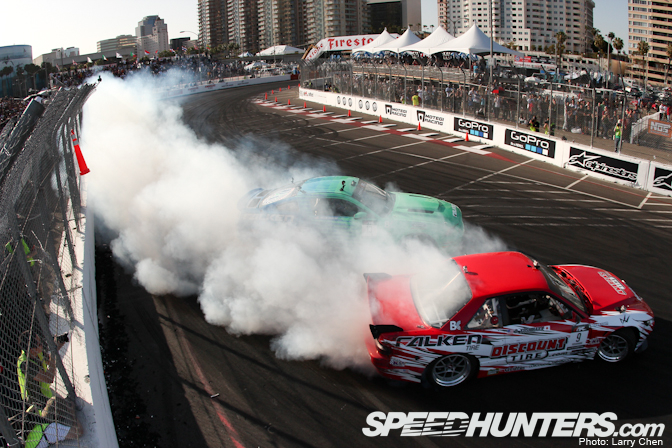
Although there are some key variances to both cars they are decidedly more similar than they are different and my observations are really nit-picks. If you remove subjectivity from the debate the numerical data becomes quite interesting – although he qualified slightly higher than Dai, likely due to slightly more angle mentioned above, JTP’s average speed was 53.9mph to Yoshihara’s 55.6mph. Time will only tell which setup is better as the season progresses, but if nothing else it’s more food for thought while cheering on your favorite drivers. I’d love to hear what you guys think.
Until next time…
More from Formula D Long Beach on Speedhunters
More posts by Sean Klingelhoefer on Speedhunters
-Sean