
Toyota were always destined to return to the sportscar scene, and Le Mans in particular. Since 1990 they’ve had two serious cracks at the great race, most recently back in 1998 and ’99 with the beautiful TS020 GT-One, but both efforts have just fallen short of their goal. The Toyota Team Europe rally team were enlisted to develop the GT-One from their base in Cologne, Germany, and they moved on from the Le Mans sportscar to head up Toyota’s assault on F1: a phenomenally costly and ultimately unsuccessful programme.
The positive was that the closure of that project left a lot of clever people and a fabulously advanced facility looking for Toyota to give them something to do. Le Mans was definitely seen as unfinished business (especially in the context of rival Japanese firms returning to the race in force, such as Nissan), and Toyota’s sights became firmly fixed on La Sarthe once new LMP1 rules had been announced that put hybrid powertrains on the agenda.

Work begun in private both at the European base and back in Japan, with Toyota’s motorsport division in Higashifuji woking on the engine. With the motor mounted in the gearbox casing, the TS030’s KERS unit uses super-capacitors to store and discharge the energy – this technology allows a much faster charge and discharge cycle – and supplies the extra power generated directly to the rear wheels.
Despite having already developed and supplied a 3.4-litre V8 to the Rebellion LMP1 team, Toyota instead constructed a brand new engine for their own project: again a naturally aspirated 3.4-litre V8. 2012 was to be a learning year, so time wasn’t originally a pressing concern…
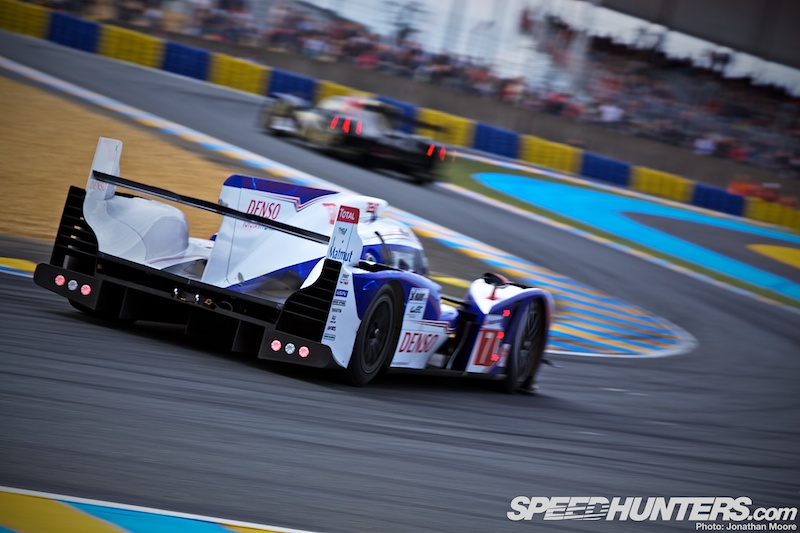
Without warning, their hand was forced by the withdrawal of the factory Peugeot squad at the beginning of the year: without Toyota they’d be no World Endurance Championship. Toyota engaged an experienced race team, Oreca, to run the track-side programme, short-cutting their lack of race-craft and experience of the contemporary sportscar scene. Testing early in the season was positive but marred with an accident that destroyed their only chassis of the time.

The two-car team of TS030 Hybrid’s would thus make its racing debut at the Le Mans 24 Hours after being forced to miss their planned initial start at the previous round of the FIA World Endurance Championship at Spa in Belgium. Even a team like Audi have experienced trouble coming into Le Mans with a new car and no race prep, so the challenge looked vertical for Toyota.
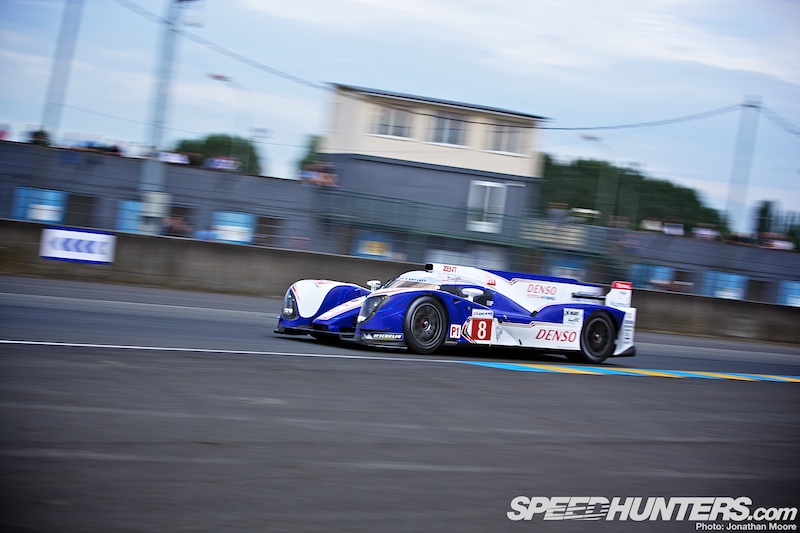
However, lap-times on the pre-race Test Day showed that the Toyotas were right up with the Audi R18s, and they carried that form into practice and qualifying, getting right in amongst the Audis and qualifying in third and fifth positions. From the rolling start at 3pm on Saturday the Toyotas stuck with the leading Audis, even taking the lead in the fifth hour with an overtake of the #1 Audi – much to the cheers of the fans.
Disaster then struck just after 8pm, on the 82nd lap: the #8 car of Davidson/Buemi/Sarrazin collided with a GTE-class Ferrari at Mulsanne corner, with both cars ending up buried in the barriers and out of the race. Davidson was later diagnosed with two broken vertebrae, and a possible three-month recovery period.
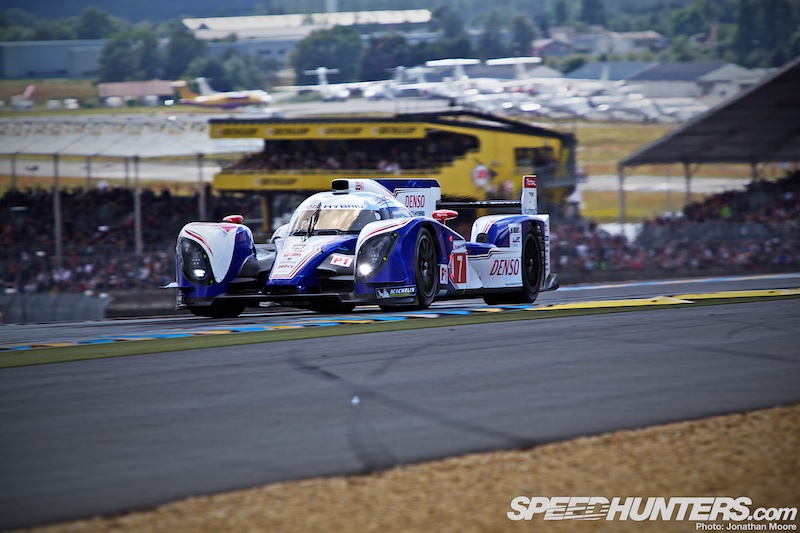
The #7 of Lapierre/Nakajima/Wurz looked like keeping the Audis honest – until the restart after the long safety car period required to fix the barriers from #8’s crash… Around 9.15pm Nakajima went for a gap inside Nissan’s Deltawing that simply wasn’t there, punting the Deltawing out and severely damaging the right-rear of the TS030. After initial repairs the car returned to the track, but it was soon back in again and up on its jacks for further repairs. For the next couple of hours #7 was in and out of the pits for more work before the garage door came down for good and the car was officially retired at 1:42am, to the disappointment of the team, the fans – and even Audi, who welcomed the fight.
It was the end of the prologue to Toyota’s return to sportscars: we’ll see them out for further rounds of the WEC ahead of a full-strength return to Le Mans next year. They might now not be able to claim the first victory for a hybrid-powered LMP car, but there’s still the prize of an overall win at Le Mans to chase – and possible opposition from Nissan, Honda and even Mazda to take on. Honour is at stake. Now it gets serious.
Jonathan Moore
Speedhunters at the 2012 Le Mans 24 Hours

Photo by Jonathan Moore

Photo by Jonathan Moore

Photo by Jonathan Moore

Photo by Jonathan Moore

Photo by Jonathan Moore

Photo by Jonathan Moore