Big power and equally big aero are the two main attributes that any serious time attack car will require these days. If you want to go fast you need the power and if you have the power you need to be able to unleash it efficiently, so you can pack on the speed and hold as much of it through corners. Seeing the progression of the sport in the last few year has really been interesting, witnessing those lap times come down, being amazed at the seemingly impossible things that have been achieved, not to mention always wondering how it could all be improved upon. Now this all well and good but as a mere mortal with a limited budget and a little car project of my own happening on the side, most of these cars are just way too advanced.

That’s why it’s always been the more down to earth builds that have attracted me the most, ever since I started covering the Japanese tuning scene, and I think the car I have for you today is a perfect example of this. Plus, the fact that it’s an NSX makes it all the more special – still one of the most sought-after sports cars to come out of Japan and one that will forever have a special place in everyone’s hearts. This is one of Kakimoto Racing’s latest projects, a car we have seen slowly progress since spotting it for the first time a couple of years back at the Nagoya Exciting Car Showdown. Unfortunately, being based in Osaka, in the Kansai region of Japan, has meant that the Kakimoto crew never really takes the car up north and enters it in time attack events that we know and love, like the Super Battle and Battle Evome. So despite never having seen it in action, this is one car that has always interested me.

The way every single aspect of the car has been upgraded without meddling with the initial balance the NSX boasted when coming out of the Honda factory all those years ago, is to me something that really needs to be commended. Had they wanted to create a record breaker, they would have stripped it down, binned the engine and replaced it with something hugely powerful, mating it to a CFD-developed aero package, a motorsports derived driveline and wowed people in the process. But they didn’t, they kept it real for lack of a better word, in the process creating something just as equally awesome. Some of you are probably well aware that Kakimoto is one of the oldest exhaust manufacturers in Japan, but you probably didn’t know that they also built some wild high-speed and drag cars back in the day to develop their own engine products and miscellaneous upgrades. Exhausts is what they’re all about today, either off-the-shelf units or full custom builds which they can knock up in a couple of days for anyone that wants something special. But I’ll touch more on that in the shop tour I have coming this month, because it’s the NSX I want to concentrate on here, starting first with the body.

What makes this project all the more down to earth is that they never wanted to market any of their parts with it; that’s why the custom body that they created isn’t for sale – the panels were just one-offs for this car. I’m talking about things like the widened fenders, there to help them run the widest possible front and rear tracks.

Then there’s the carbon fiber front diffuser with an extended lip, held in place with a series of adjusters. This joins a pretty wild canard set-up, boxed at each side to help push the NSX’s front end down onto the tarmac and get it to bite down through even the more challenging turns.

The RAYS Volk Racing CE28N and Kumho semi-slick wheel/tire combo provide the boost in grip, 245/35 on the 8.5″ wide eighteens at the front and 285/35 on 18×10.5 rears. Kakimoto adjustable dampers with 8.9kg/mm springs are used at the front, along with one-off adjustable A-arms that, much like everything else, were built in-house. But that’s just scratching the surface. You see, the NSX, during its initial development, had a bit of a crash which damaged the front end pretty badly. Rather than attempting to fix the aluminum chassis, Kakimoto decided to take advantage of it all and literally chopped off the front end of the car.

They fabricated a tubular frame instead, which allowed them to devise custom suspension pick-up points to get a more track-oriented geometry. Due to the fact that steel and aluminium can’t be welded together, the whole front end was bolted, bonded and riveted to the NSX’s lightweight chassis, something you can see very well by taking a look underneath the vented hood. That’s also where the ARC custom radiator sits, along with a small electric extractor fan.

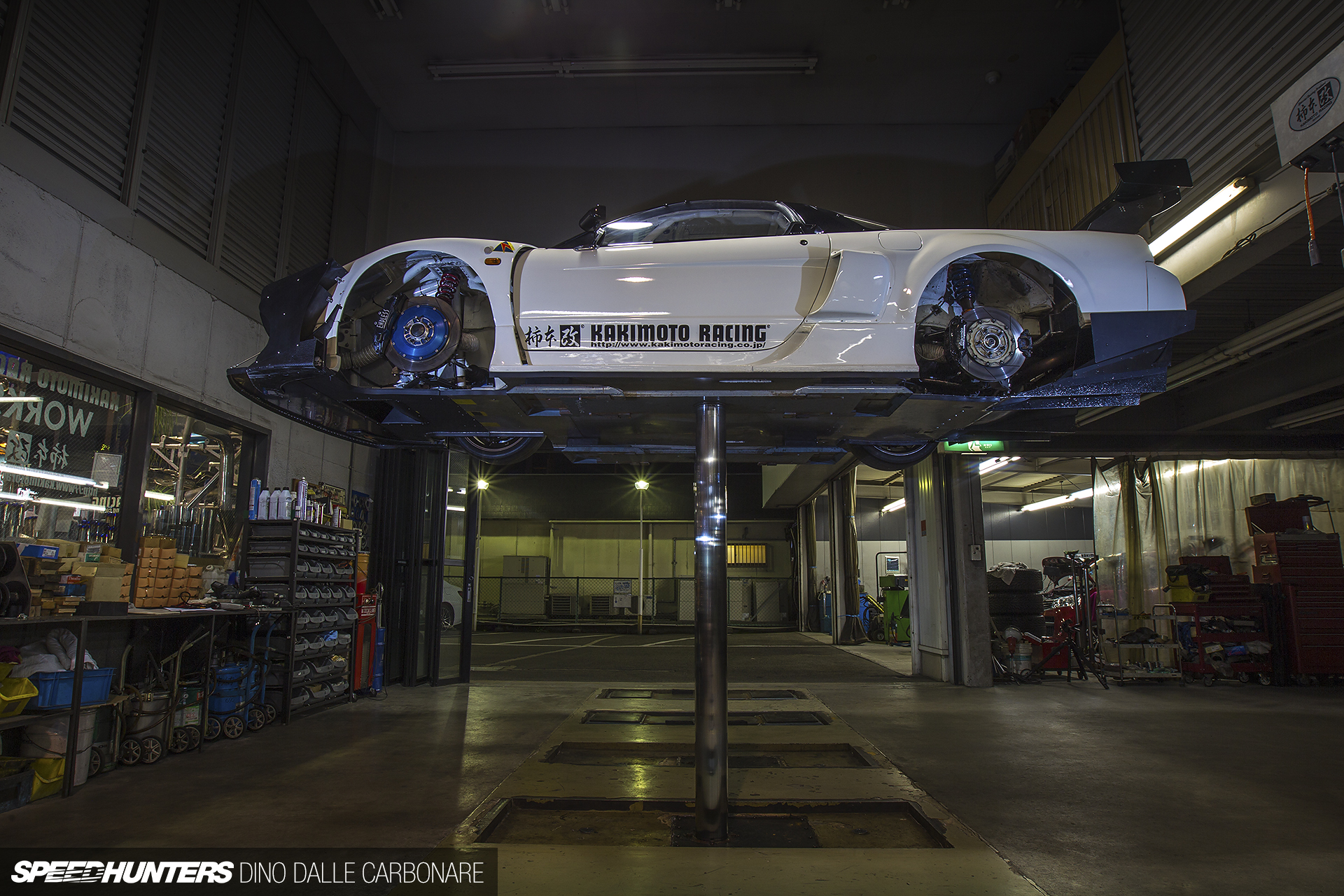
You can really appreciate the work from underneath the car: the custom sway bars, the rose-jointed links, the baffling and get a glimpse of how the front diffuser connects onto the rest of the underfloor. The stock NSX brakes were obviously not going to cut it, so Endless six-pots take care of shedding speed off quickly and effectively. Brake ducting makes sure these are also cooled well, so the middle pedal is always ready for action, no matter how many laps the car has been out on.

The blistered rear fenders give a very purposeful, almost GT-racer stance to the car, while the twin side air intakes have very important jobs to do, and that is feed air into the engine bay and keep the rear four-pot Brembo brake set-up within operating temperature. With decent levels of front downforce being generated at speed, coming up with a balanced set-up for the rear end was also high on the to-do list.

While the high-set rear GT-wing was there from day one, the rear diffuser and side canards came to be in a series of evolutionary steps, much like the extractors which have the delicate job of channeling out air from under the car and releasing it without causing any unwanted vortices. The four openings on the rear bumper add to this by further cutting down on drag. With the mid-engine layout and the high downforce generated, it was necessary to run very hard 23.2kg/mm springs on the rear Kakimoto dampers to take all that weight.

With the car lifted up in the air inside the Kakimoto garage, you can really see all the work that has been done to crate a functional underfloor set-up. It might not be as advanced as some other time attack cars out there, but it does its job very well.
Making aluminum stiffer
Swinging the paper-light driver’s side door open, it instantly becomes evident that making the car as stiff as possible was very much a goal of this project.

Much like the custom front end, the custom fabricated roll cage is riveted and bonded onto the chassis, with countless additional stiffening pipes further boosting its effect. It might have added some weight to the car, but the gains in rigidity more than make up for it.

From the Recaro SP-G bucket seat, the driver has nicely laid out Defi instrumentation to play with, with the big easy-to-read tachometer taking center stage.

Custom wiring the Motec M48 ECU into place was a monumental job, but one that introduced countless benefits when it came to extracting the best out of the engine. But more on that on the next chapter…

While the no-nonsense approach has made the cockpit all about functionality, the layout definitely has a coherence to it: the well-picked auxiliary instrumentation, the simple switch panel and the way exposed stripped areas are covered in a suede-like fabric to clean things up. It all makes for the sort of interior we’re not used to seeing on JDM cars, which for the most part tend to overlook the interior.

The Neko Corporation LCD640 may be an older unit, but it still does the job very nicely, displaying a variety of parameters from the ECU’s inputs and outputs. It’s main function in the NSX however is to display the air/fuel mixture.

The car’s switchgear has been grouped where the A/C and audio controls used to once be, along with an Auto Meter fuel gauge and the cut-off switch for the electrics. You can also see the Tilton brake balance adjuster, useful for fine-tuning the car’s braking set-up depending on grip conditions and of course track layout.
Electrifying response
Lifting the lightweight lexan engine cover reveals the heart of the NSX. You won’t find any turbochargers or superchargers here, as force induction was just not a route that Kakimoto intended to take. The idea was to further improve the engine and create an optimal balance between power, torque and response and to get going, the C30A was plucked out of the engine bay and taken apart. The aluminum block was bored and honed so it could accommodate the slightly larger 92mm forged pistons, which would give a slight capacity increase to 3,110 cc. These are then connected up to the stock titanium conrods and crank, and balanced to very high tolerances to guarantee vibration free rotation all the way up to the 9,000 rpm redline. The intake and exhaust ports on the two heads were treated to a little polishing to smooth and increase flow, while intake valves and head gaskets from the later generation C32B engine were swapped over. Custom milled cams followed, sporting carefully profiled lobes for both the normal timing as well as the VTEC side, specially devised to take consideration of every upgrade carried out to the engine. Wanting to maximize the V6’s true potential, the stock single throttle set-up was just not going to cut it. ‘Electrifying response’ was a key goal so Kakimoto devised their own mechanical six-throttle set-up, each of the six cylinders breathing through individual 48mm tracts and short velocity stacks.

Mid-engine set-ups have an inherent problem of high engine bay temperatures with very little air to cool things down, so it’s not surprising that Kakimoto created a carbon airbox to keep the six velocity stacks shielded from under-hood temperatures.

The sealed box is fed air through the passenger side rear intake and at speed can actually generate positive pressure, giving a little sort of ram-air effect.

With any high-strung naturally aspirated motor, the fine balance between intake and exhaust is key at getting the most out of a particular set-up. How may times have you heard stories of people bolting on big bore exhausts to their NA car and losing both power and torque? Being one of the most respected custom exhaust makers in Japan, this was not going to be a problem for Kakimoto, who devised a set of intricate headers which dump gasses into a center-exit single pipe topped with a pair of titanium-coated tips. This creates the exact backpressure the engine needs to maximize its power and torque outputs which top out at 345hp at 6,900rpm and 362.8Nm respectively.
If you’re wondering what that sort of engine set-up sounds like, it’s a good thing French Magazine Autoworks caught the car out testing in mid-2012. As you can see, they were still working on the aero package back then but that sound – wow!

The driveline followed, and along with the Exedy twin plate clutch a NA2 six-speed transmission was fitted. This sends drive via a shorter final drive to the ATS two-way LSD, a set-up that further boosts the engine’s explosive nature. To guarantee reliability and longevity, Kakimoto even devised their own transmission cooler made up of a small baffled radiator, mounted inside the trunk area and fed by the two NACA ducts on the lid.

Additional stiffening of the chassis was also carried out in the engine bay and rear portion of the car, and like up front, bonding and riveting was required to merge the steel pipes to the aluminum frame.

This NSX is very much a work in progress, a way for Kakimoto to have some fun on the side while getting their name out there. It’s something they have always done in their close to forty year history and something they will continue to do in the future. After all, as they say, ‘Racing improves the brand!‘
Dino Dalle Carbonare
Instagram: speedhunters_dino
dino@speedhunters.com
Kakimoto NSX
Numbers
345hp @ 6,900rpm, 362.8Nm (267.6 lb/ft) @ 5,900rpm
Engine
ø92 mm forged pistons, stock titanium connecting rods, balanced stock crankshaft, upgraded oil pump, custom profiled intake and exhaust camshafts (IN: P233º 9.3 mm lift, Hi295º 12.5 mm lift, S238º 9.7 mm lift – EX: P238º 8.4 mm lift, Hi 288º 12 mm lift, S243º 8.7 mm lift), strengthened valve springs, C32B intake valves, C32B head gasket, Kakimoto custom exhaust manifolds, Kakimoto custom exhaust system, ø48 mm six-throttle conversion, custom velocity stacks, carbon fiber airbox with titanium intake pipe, 370 cc/min injectors, Nismo high pressure fuel regulator, BNR34 in-tank fuel pump, custom collector tank, NGK #8 racing plugs, ARC racing radiator, Setrab oil cooler, Motec M84 ECU
Driveline
NA2 six-speed transmission, Exedy twin plate metal clutch, lightened flywheel, 4.643 final, ATS 2-way meal LSD, Kakimoto custom-made transmission oil cooler with custom baffling and intakes
Suspension/Brakes
Kakimoto custom front tubular subframe/chassis, custom front suspension pick-up points, Kakimoto original adjustable suspension, Eibach 8.9kg/mm front springs, 23.2kg/mm rear springs, Kakimoto custom adjustable suspension arms all round, Endless six-pot front calipers, Endless front ø370 mm two-piece rotors, Brembo F360 four-pot rear calipers, Brembo ø340 mm rotors, Brembo single pot e-brake caliper, AP Racing master cylinder, Tilton brake balance adjuster
Wheels/Tires
Rays Engineering Volk Racing CE28N 18×8.5 +30 (front), 18×10.5 +18 (rear), Kumho 245/35R18 (front), 285/30R18 (rear)
Exterior
Kakimoto front lip spoiler/diffuser, Kakimoto front canards, Front wide body aero, Kakimoto rear bumper, rear trunk NACA ducts, carbon GT-Wing, Speed Glass lightweight front windscreen, Rasty lexan rear hatch glass, lexan glass all round, custom flat underfloor
Interior
Custom welded and riveted roll cage, Recaro SP-G bucket seat, Simpsons racing harness, Momo racing steering wheel, custom dash with Defi gauges (tachometers, water temp, oil temp, oil pressure), Defi Advance ZD multi display meter, custom center console, custom carbon switch panel, Neko Corporation LCD600 digital display, ATL Fuel gauge
Time Attack feature cars on Speedhunters
Time Attack event coverage on Speedhunters