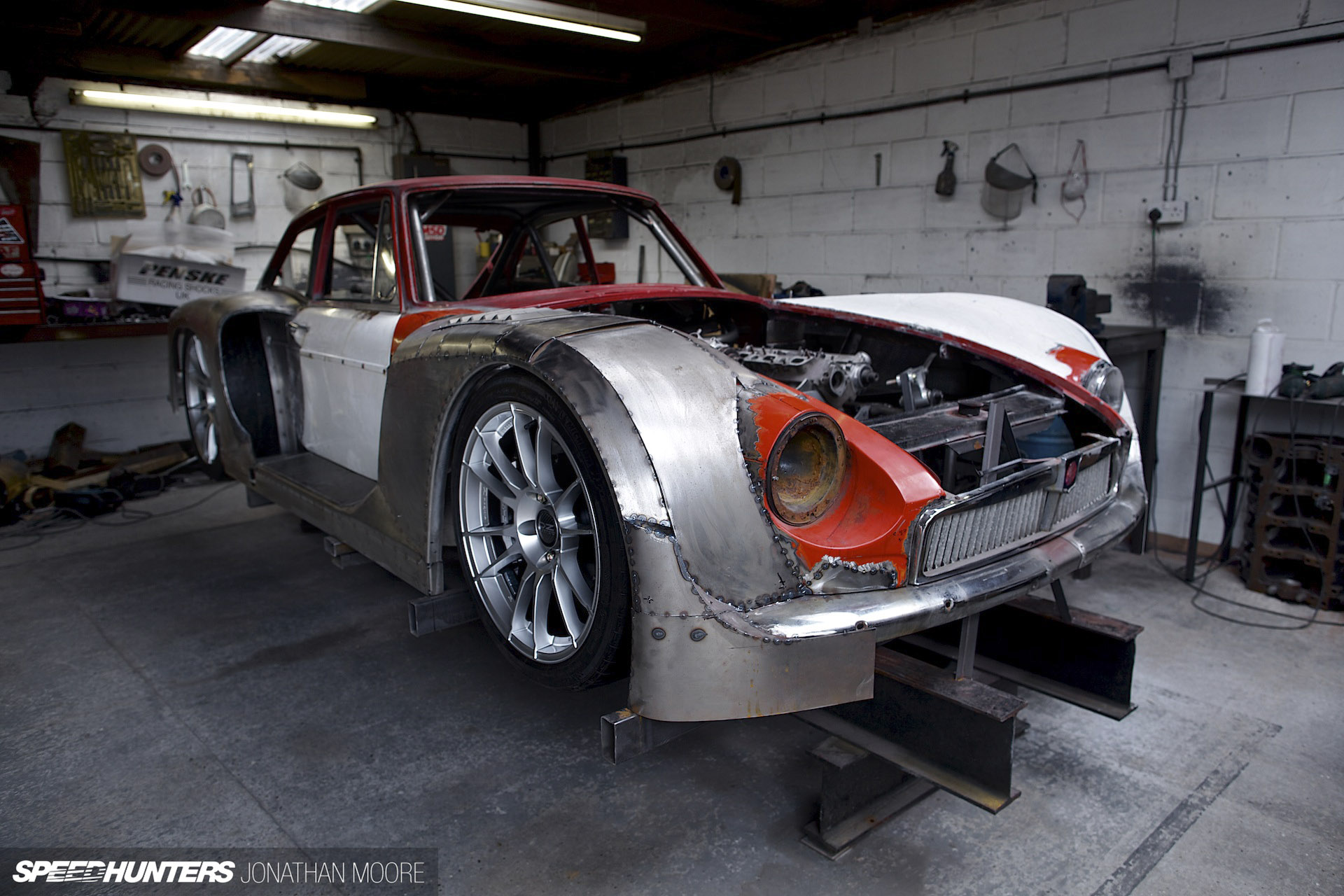
I kept asking car owner Jason Shalders and his build partner Chris Isaacs the same question – just to be sure I’d heard properly: you’ve got a classic 1966 MGB GT you’re building to FIA GT3 specification? And you’re aiming for the Nürburgring street-legal car lap record? And sorry to have to ask again, but this car will also be street legal?
Copious cups of coffee did not help keep my brain thinking straight and able to digest these three seemingly disparate goals. This is going to be one very special – and very, very fast – MG.

This is a build that is definitely led by passion. Its origins came from a simple love of a particular car, and then amped up by the sort of ideas that normally would only come from a very heavy night on the sauce. Yet Jason somehow persuades you that it’s been a perfectly natural evolution of the project that anyone might have come up with. Looking at the MG, sitting purposefully on its jig and already alluding to the sleek racer into which its gradually mutating, they’re well down the path. To either madness or a lap record – or both – only time will tell. Who cares about whether it’s sensible or not.

Taking just the starting point and one of the goals – a 50-year-old British coupé against the Nürburgring lap record – you’d think that’s aiming pretty high. But at the end of a chat with Jason and Chris, it all seems perfectly logical. And even achievable.

It all started with an engine – a Rover engine. Before people start dismissing that, remember that this is from a period where Rover still had credibility (I’d argue they did even into the ’80s with the SD1). Jason’s engine of choice was the four-litre aluminium V8, derived from the Buick 215, where his experience stretches back several decades. Back in the ’90s, Jason had been building cars for friends and customers and decided he needed a rolling test bed to help with engine development. An initial foray into putting a V8 into an MG was hampered by budget, and eventually he sold the car – though the concept remained firmly lodged in his mind.

Fast forward 10 years and the V8 project resurfaced with a vengeance. Jason had always wanted to meld Lotus cylinder heads with the Rover V8, and now circumstances allowed him to actively pursue that idea – with close compatriot Craig Ratcliffe on hand to encourage his return to his original plan. Jason bought a block and heads and started working on how he could bring these two contrasting items together.

The concept was hardly sensible from the amount of effort that would be required, but it ticked the boxes for both authenticity and power. The Lotus heads are renowned for their performance and strength; the Rover engine equally renowned for its power but poor air flow. Colin Chapman, the innovative design engineer, inventor and founder of Lotus, who always pushed the envelope, would be proud.

The aim is a high-revving, four-valve-per-cylinder, quad-cam V8, strong enough to take a pair of Owen Developments GT3582 HTA turbos further down the line and 650hp per side. Fitting the two major parts together would be a challenge. The bolt patterns were completely different, the cams in different places, they had different firing orders… the list goes on. Basically only the bore spacing was vaguely similar. Rising to the challenge, Jason just got on with chopping and welding, and got the two elements to work together. Whilst doing so, he also designed custom rods, pistons and a crank, created a billet dry sump system, with plans for pneumonic valves to go into the heads and has bespoke cams being made by Newman.

Don’t you just love this kind of pushing-the-limits project? Why make life easy when you can make life interesting. With his crazy engine plan in place, the next question was obvious. What was he going to put it in? The memory of his old MG resurfaced. How about reigniting that plan, and then some? How about making it tube-frame? Low-slung. GT racer-style? Thoughts multiplied, a dream became a concrete plan.

Enter Chris Isaacs Race Cars. With Jason engrossed in the engine side, Chris was the perfect partner to work on developing the chassis and creating the car to contain Jason’s Franken-engine. The Rov-tus V8. Or should that be Lot-ver? Chris is an expert builder who’s specialised in quarter mile machines. His drag cars have won numerous national championships, but it was a more recent project that caught Jason’s attention: a frankly insane Morris Minor circuit racer aimed at the Special Saloons championship in the UK. A featherweight Morris with 430hp from a Chevy small block.

With Chris enlisted, design work started in earnest around September 2012. The first step was to nail down as much detail as possible. The V8 and handling its potentially enormous output was the starting point, the MGB it was to fit into the second criterion to work from. Those massive Oz wheels were quickly added to the mix, and these three things helped move them towards deciding on the optimum wheelbase, ride height, chassis layout and mechanicals.

Before any metal was touched, Chris and Jason worked from photos and sketches, batting ideas back and forward. More than just an aesthetic element, this was about deciding a fundamental approach for the car. From the inspiration images Jason was flagging up, it was clear that a GT-style car was his goal – and GT3 seemed the ideal template. This might have started as a pure street car, but things were escalating – rapidly.
Everything Gets Bigger, Fast
Although the GT3 technical regulations would be great reference, particularly in regard to safety, there was also an aesthetic consideration. The best GTs are always the epitome of combining the essence of a base car with over-the-top aero and aggressive appearance. The current Z4 GT was a particular favourite for Jason. So, the MG’s design rapidly got wider and lower, whilst always retaining that classic MG look. No easy task, but one that Chris and his team (Jedd Guy and Anthony Parker) approached with relish.

An early profile sketch makes it pretty obvious why Jason fell for this look. It must have been a similar thing with a project like the LaSupra, where the heart rate increases as the car gets lower and wider.

With the goals for the car getting ever more ambitious, the tube-frame became intrinsic rather than aspirational to provide the rigidity and performance. The fixed points of the design took shape, with the addition of the cockpit layout and other important bits of packaging those points in space dictated the layout of the chassis. Then the conversations started about what kind of potential lap time it would be able do. From the off, this wouldn’t be a racer per se, Jason not wanting to risk the car in the cut and thrust of national racing, but instead aimed at Time Attack-style events.

Chris was using Lydden Hill as a baseline for decision making on suspension and aero, a circuit he knew like the back of his hand and one with a simple layout to work from. But Jason mentioned a larger target to aim for. One in Germany. That starts with Green and ends in Hell. The torque-heavy engine seemed ideal for punching out of the ’Ring’s corners, and the MG’s GT3 concept ripe for the task. Chris’s reply, rather than being dismissive was quite the reverse. Okay, so, what could be possible? A mid seven-minute lap? Maybe faster. Then that’s getting towards record territory. Okay, let’s aim to go for the road-legal lap record. Simple.

I think there might be something seriously weird with the air in Essex.
But before physical construction could start they needed a donor car. They wanted an early MGB, because of that other aim of keeping the car street legal. Even as I type that, looking at the pictures I again have that bit of doubt creep in that I heard that right… Anyway, as luck would have it a perfect car popped up on a popular online auction site. £300 later, and a rough shell was sitting in Chris’s workshop. Everything that could be unbolted had been, but that was fine: the shell was the important bit, and the roof and surrounds were all in sufficiently good enough condition.

Even better, a slot opened up in Chris’s schedule in spring of ’13 and the chopping could start. The first thing to do was to get the chassis onto a jig, position the wheels and set the ride height; then the MG’s arches could be chopped out. The poor MGB must have looked almost comedic, sitting down low, dwarfed by the enormous wheels. Everything would be pushed out – the wheelbase would be five inches longer, the wings four inches longer and raised up to accommodate the wheels and suspension, the track increased by six inches.

Half the donor MG disappeared in the first two days. Chris started work on the frame, which would be constructed from 4130 chromoly. The main six-point cage has been built to full MSA racing standard, 1-3/4×095 tubing, with slightly thinner material used for the subframes to make it as light as possible. Triangulation and bracing have made this one stiff construction, despite only weighing around 70kg, but then Chris’s stock in trade is that most fearsome of environments, drag racing.

The suspension was planned out using various CAD programmes based on the desired wishbone and crank geometry, with the aim of keeping the roll centres as stable as possible. Originally Chris looked at a cantilever set-up before decided to go inboard, using Penske shocks and custom-made arms and uprights. They’ll incorporate a slight rising rate matched front to rear for maximum stability.

All that hard work at the design phase pays back during the build – working out the rough packaging should mean avoiding difficult compromises further down the line. The last thing Chris wanted was to be in the position where something like the errant location of a tube prevented the ideal placing of a component, so there’s been a methodical approach taken at every step.

On my visit about four months into the build process, the chassis had been fully laid down and the bodywork was beginning to take shape, giving a real idea of how awesome this MG is going to look. What is great is how much of the classic MG shape is evident: the roofline, tailgate and doors – but most importantly the nose.

I think it’s just perfect: a blend of classic shaping with modern, over-the-top GT style. The best thing? The aim is to retain chrome detailing where possible, such as on the grill. The original chrome trim lines will be followed as well, even if they end up being painted on in the final instance. A new valance would be following on once the MG’s radiator is supplied from Pro Alloy; ITG were also creating a bespoke air intake system. The project has been generating a lot of positive support from suppliers, which is hardly surprising.
Hammer The Metal, Forge The Shape
The car is going to be tightly packaged, meaning the elements of the car are all inter-related. Starting on the bodywork might seem premature, but having the shape defined would allow further internal component positions to be nailed down – everything evolving at the same speed.

Chris’s biggest concern at the time was the positioning of the water-powered charge coolers (two for the V8, a single unit for the smaller engine). Its fitment in front of the rear wheels would be impacted by bodywork, which would also then need to be balanced against the gearbox and diff radiators, fuel and oil tanks, and so on. A veritable jigsaw puzzle of elements.

All the bodywork will eventually be formed in carbon, but I just love this raw sheet metal look, especially with the highlight of the red donor car such a contrast against it.

This is the more creative part of the build, compared to the raw engineering expertise required underneath, and you can see that Chris and the team are passionate about the result. It’s going to be one good looking car for sure.

Each panel will be removable to make working on the car as easy as possible, especially valuable at a track like the Nürburgring where every second lost on track will count. Fibreglass panels will likely be formed from the sculpted metal patterns initially, and then moulds made for the final items.

The shapes and intakes aren’t just pretty: they’re functional as well. Aero will be critical on the MG, and all their know-how has been brought to bear, as well as that of external consultants – including Simon McBeath, a well-known aero consultant and regular contributor to Racecar Engineering.

There’s no attempt to reinvent the wheel, aerodynamically speaking – accepted principals are being applied in their most sensible ways to ensure the MG is as efficient as possible from the off. Air flow, from both the ducting away hot air and channeling in cold points of view, has been throughly examined by Chris to provide the optimum results.

The rear wing is based on GT3-spec, a huge carbon unit made by DJ Engineering; they’re hill-climb specialists and also supply components to many big race teams. The end plates are temporary and once the wing is mounted a final decision will be taken on the optimum size to keep air flowing to the wing’s underside in the most efficient way.

A big rear diffuser will rise up at the rear, linked by ancillary side outputs and fed by a venturi in the flat floor.

The right side of the car was well on the way to being finalised when I saw the car; the next step would be working on things like the exhaust manifolds, and then packaging the steering column, pedals, driver controls and so on.

The seat positions have already been fixed: so how about a driver? The plan is for sportscar racer Oli Webb to drive the car once its ready for its ultimate test. He’s also a test driver for BAC, and a regular at the Nürburgring.

With Jason working on the actual block back at his base, the engine in the MGB was just a dummy unit. This meant that Chris could plan out the precise placement and where all its ancillaries would fit – whilst of course trying to fit in all the stuff like suspension and the steering rack.

Chris likes to use solid motor mounts, so the engine can be used as a stressed member, and he’s left the majority of the plate intact as work progresses. It’ll be trimmed down once work is nearing completion, but having that big slab available gives the option to mount parts to it during the build, rather than starting with a cut-down part and giving yourself less options down the line. One big option – just to make things even more confusing, Jason is also working on a four-cylinder, single-turbo motor as well. This will be a Lotus engine, aiming at producing around 600hp, and another development testbed that will allow them to market parts in the future.

Taking up a considerable area in the cockpit space is the sequential Elite Racing Transmissions gearbox. This is the seven-speed that’s matched to the V8; there are also mounting points for a six-speed to go with the four-cylinder motor.

Sitting in perfect isolation – for the time-being at least – is this beautiful billet aluminium diff housing. It’s a beefy unit to handle the projected power of the engine up front, using 8.8-inch Ford internals to send drive via custom 31-spline stub axles bolted to Porsche CV joints. Like the engine up front, it’s also mounted to a solid plate and a stressed part of the chassis.

The suspension layout was locked off early in the build, to give an accurate view of the ride during the bodywork phase.

The rear, longitudinal set-up was waiting for the installation of the shocks – which coincidentally arrived whilst I was at the workshop – and are of pushrod bellcrank design with adjustable anti-squat.

The MG sits on 19×11-inch and 19×12-inch OZ Racing Ultraleggeras: it’s pretty obvious why Jason chose these right at the start… Hiding behind them, the brake are huge HiSpec units: 400mm vented disks with eight-piston callipers at the front and 360mm disks with four-piston callipers at the back.

Achieving the magical three Rs – racing, road and records – is no easy task. It’s not a short process, and it’s definitely not cheap. The £300 for the shell is a distant memory, but seeing that MG sitting on the jig must be enough to remove any doubts Jason has. The plan is for the car itself to be pretty much complete by early 2015, bodywork finished and painted, wiring in and ready to roll for Jason to finish the engine work. I can’t wait to see the next phase of this car.

I know I’d rather cheer on a bunch of guys putting together an awesome build to chase the Nürburgring lap record from a modest garage in Essex – instead of a multi-million pound marketing operation where lap times are often insinuated rather than released. My dream racecar grid is getting bigger. KRB’s Audi and Lotus Esprit. The Lancia LaSupra, Mini Quattro and V12 Cobra. The Forge Golf. The Lotus canyon racer and the Nissan 300ZX fighter plane. And now the MGB GT3.

Stay tuned for the next stage of this build as it edges towards completion. We’ll be catching up with the next major step change towards the end of the year, but in the meantime you can keep an eye on progress here.
Jonathan Moore
Instagram: speedhunters_jonathan
jonathan@speedhunters.com