
Since it’s not every day that Nissan allows you into their DNA Garage, I really wanted to share as much as I could with you. Which is why I decided to split it all up between two posts; the first one dealing only with production cars and the unusual, and this one, which contains the really cool stuff: Nissan’s racecars!

Can you say dream garage? I mean, seriously – just look at this damn place! After shooting in here for about an hour I came to the conclusion that if I wanted to capture everything properly, and feature my favourite cars – of which there would be many – I’d need to bring a tent and supplies and probably live in here for a good two months.

If you thought the road car collection was insane, then the Datsun, Nissan and Nismo racecars that form part of the DNA Garage collection will blow your mind.

Let’s kick things off here: the number 27 R90CK from 1990, and one of the most powerful cars in the museum. This was built in collaboration with Lola to compete in the JSPC and WSPC championships, and it packs a mighty twin turbo 3.5L V8 developing 800hp and 784Nm in a chassis that weighs just 900kg. Can you imagine what it would take to drive this thing at full pace for an extended length of time?

As soon as you walk in through the DNA Garage’s red door, the first cars you notice are these Super Silhouette racers from the ’80s. We have seen the Skyline many times at the Nismo Festival, so it was the other cars around it that I wanted to take a closer look at.

The March, for example, is one that I’ve always liked. This was an unusual base for such a visually-striking conversion, but it worked and did pretty well in its class back in the day. Nismo actually built it for Masahiko Kondo – a famous Japanese singer and racer that now heads up the Kondo Racing team in Super GT.

I’ve chatted to Yanagida-san of Central 20 a few times in the past about his days racing this crazy Bluebird. Depending on the perspective, you often can’t see how exaggerated its fender flares and splitters are.
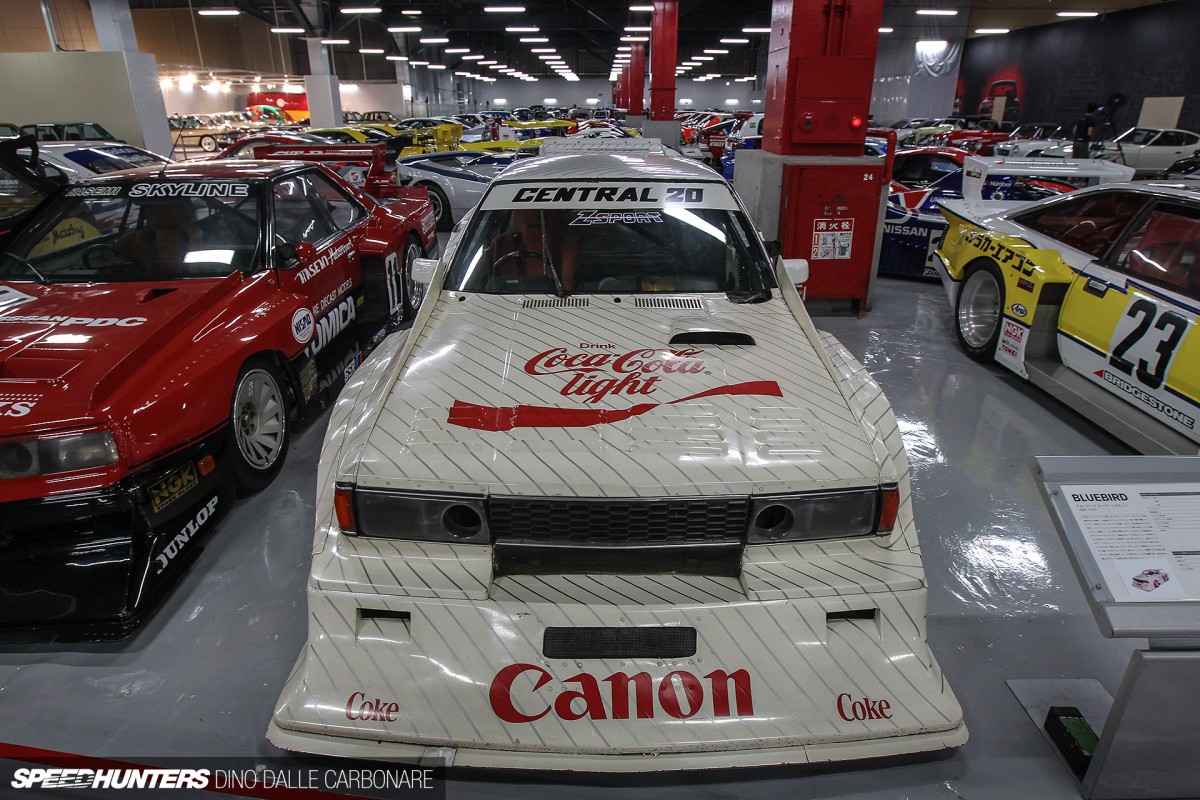
See what I mean? This thing was serious! The Central 20 machine was a very successful racer in the Super Silhouette series, winning the 1980 and 1982 championships and coming pretty close to grabbing a third title in 1983 too.

However, the slickest of them all was the KS110 Silvia driven by Hoshino-san of Impul. This car was powered by the same 570hp LZ20B engine that was used in Hasemi’s DR30 Skyline and Yanagida’s KY910 Bluebird. Of course, the car rides on a set of Hoshino Racing rims – a staggered fitment with plenty of width and a ton of negative offset to fill out those massive wheel wells.
Stepping Back In History
Right behind the Silvia is a racecar from the previous decade – albeit one that never actually got the chance to run. The R383 was the final machine in a string of GP cars that had begun in the mid ’60s with the R380, and with a wild 6.0L V12 engine developing 700hp, it was designed and built to dominate. But when the 1970 Japan Grand Prix was cancelled that opportunity sadly never came.

Before it, was the R382. The is a very important car in Japanese racing because it proved Nissan’s capability of building a competitive racecar. Powered by a 600hp version of the same V12 fitted to the R383, Kurosawa Motoharu (Gan-san from Best Motoring videos as many of you may know him) took the car to a win at the 1969 Japan GP with a second R382 grabbing second place.

In doing so it beat Porsche and the successful Toyota 7, making it an instant legend. A quick look at the rear end gives you an idea of the potent hardware it was packing under its sleek body.

Before the R382 came this – the R381, which was nicknamed the ‘Monster Bird’ due to the fact that the massive rear wing was split and moved independently depending on the direction the car was turning. Because Nissan put this car together in a hurry, they never had time to finish their own engine – instead calling on Dean Moon of Mooneyes fame for one of his special built Chevy V8s.

It’s impressive to see how Nissan quickly became competitive in international racing and the various series it ended up competing in over the years. This is one of two R391s that were entered in the 1999 Le Mans 24 Hour. Unfortunately neither finished, which signalled an end to Nissan’s involvement in the famous race for many years.

Nissan’s Le Mans project had really got serious in 1997 when they first developed the R390 GT1. The car finished 5th in class and 12th overall, which sent Nissan back to the drawing board. They came up with the R391 for the following year, entering a total of four cars – all of which finished in the top 10.

We may have seen it in the previous post, but I just had to include another image of the R390 GT1 road car. What a thing of beauty!

Nissan had always campaigned GT-Rs in Group A, which then became the JGTC and now is known as the Super GT, but for a few years – while Mizuno-san and his team were making sure the R35 generation of the GT-R would be a true performer – the Z filled the gap. It was very successfully too, bringing in countless wins for the various teams that ran it.

Not too far away from the Super GT Zs I found another special GT-R. We saw the one-and-only homologation special in the previous post, so here’s the Le Mans racecar it paved the way for.

Of course, it’s the R33 GT-R LM – sporting what is now an iconic colour scheme. In 1995 the car used a slightly modified N1 version of the RB26, but it developed only 400hp would you believe. In building this machine, Nismo ditched the AWD system to shed weight, and the car finished 5th in class and 10th outright.

In 1996 Nissan returned with this car, now packing a stroked 2.8L version of the RB26 developing ‘over’ 600hp. But it still wasn’t enough to be truly competitive, and the car finished 10th in class and 15th position overall. After this Nismo really got really serious with its Le Mans program!

For how cool all the wild race machines we have seen so far are, it will always be the Group A BNR32 Skyline GT-Rs that truly do it for me. This is where the GT-R really shone. Aesthetically, it was barely different from its road going counterpart, but it came onto the scene and annihilated the competition for three years straight.

Even the JGTC years were great for the GT-R. The the R33 and R34 that followed stuck with the RB-engine and Nismo worked hard to make the most of it. They developed a dry sump version, and despite the GT500 regulations which capped output to 500hp, managed to turn it into an absolute torque monster, which allowed the cars to lead for years to come.
The Dirt Machines
Come on, you didn’t think I would have forgotten about all those cool rally cars that Nissan has campaigned over the years, do you?

I love it when rally cars are restored mechanically, but the battle scars earned in competition are left intact. This RVS12 Silvia – which still looks like it did when it finished the 1988 Safari Rally in 2nd place – is a perfect example.

This 240RS, however, looks like it just came out of the race workshop!

Here’s another restored great from Nissan’s rally past. This PA10 Violet took out the 1982 Safari Rally, and in doing so notched up the fourth consecutive win for Nissan/Datsun at the gruelling East African event.

This is all from a time before Mitsubishi, Lancia, Audi and Subaru ruled the rally special stages.

How about this for a considered restoration! The Datsun 240Z on the right is yet another Safari Rally winning car, back from when Lofty Drews and Shekhar Mehta stood on the top step of the podium in 1973.

Here’s another race car from Nissan’s arsenal that never really managed to show its true potential. Built to compete in the World Sportscar Championship, this 1992 Group C NP35 was only raced once before the series was cancelled. It was the year that turbochargers were banned, so engine-wise it employed a VRT35 3.5L V12 good for 630hp.

Out of all of Nissan’s greats, there is never much mention of the Cherry. Racing alongside the Sunny, the KPE10 Cherry Coupe X-1 was a great way for younger drivers to get a start in motorsports. What made the Cherry different was that it was front-wheel drive, and therefore quite forgiving.

And here’s the KPB110 Sunny.

I’ve been lucky enough to hear this 200hp version of the LZ14 from the Sunny at full chat around Fuji Speedway, and it sounded like no other ’70s four cylinder I’ve ever heard. Especially as it approached its 9,400rpm redline!

The R31 may never have reached the success its successor did in racing, but it sure was an important piece of Nissan’s history. At the hands of Nissan Motorsports Europe, it did pretty well in the continent.

And it was still in Europe – more specifically the UK – that this Primera left its mark. This 1999 BTCC car won 13 out of the 26 races it started, and stole the manufacturer, driver, team and privateer categories in that particular year.

I’ll finish up with an image of probably the most visibly striking and recognisable racing Skyline GT-R of all time: the 1999 Penzoil Nismo R34. Straight out of the box, Érik Comas won the JGTC driver’s championship two years in a row, and again – like many other racing GT-Rs before it – the car became an instant legend.
A big thanks to Nissan for allowing us access into this remarkable place! The question is, when can I go back? And more importantly – next time can I bring a tent?
Dino Dalle Carbonare
Instagram: speedhunters_dino
dino@speedhunters.com
Nissan’s Secret Stash: The Production Cars Of DNA Garage
Nissan Heritage Collection website