
Let’s for a moment rewind the clock back to the Paris Auto Show two years ago, when one car seemed to steal the show thanks especially to its wild looks and execution: the Sbarro Eight.

I eventually saw this car in person a year later at the Essen Motor Show where it was on display in the hall of concept cars, and couldn’t help but wonder what kind of loony minds came up with a creation like this. It was an odd concoction – a modern take on the hot rod concept, powered by a Maserati V8 of all things.

A bit of internet research on the people behind the car led me to automotive design school L’école ESPERA Sbarro in the industrial town of Montbéliard, France, and arrangements were made for a visit.

When that day arrived, I was greeted at the front gates by one of the teachers from the school, Anthony, who immediately ushered me to small hall in which some very strange and wondrous four-wheeled creations were jam packed.

ESPERA Sbarro School of Automotive Design was created by the renowned Swiss designer Franco Sbarro over two decades ago. Its aim is to foster creative ideas in the field of auto design, in an age of overly-regulated and sterilized car designs.

Students come here from all over the world, and over the the period of 10 months are taught all the basic aspects of automotive technology and design, culminating in the creation of one-off automotive design studies.

The team at the school gets to know the students for a couple of months before the studies kick off in September. For the first eight weeks or so they study the basics of car building, such as modelling, welding, mechanical engineering and other technical aspects.

During this time the students and the teachers come to terms with what kind of project the students want to undertake, based on their background and interests. Once a base design concept is sketched, the students begin work on their project in January, with the deadline set for the Geneva Auto Show in March.

This is an incredibly short amount of time to get a car designed from scratch, let alone by a group of young students who are at it for the first time in their lives.
Hands On
ESPERA Sbarro adopts a literal hands-on practical approach to designing cars. According to Anthony, students here do not use computer-aided designing at all.

To hone their skills in crafting shapes out of nothing, one of the first exercises the students are tasked with is to carve an Alfa Romeo 8C scale model out of a solid block of foam.

The teachers provide a little bit of help and occasional advice, but for the most part the students are on their own. Each student has to prepare a model and the final results are evaluated.

What makes this all the more interesting is that they have to do it using minimal tools and only reference photographs as a guide. This way they get a real feel for the shapes and learn how to bring curves and lines in their head onto material.

During the first couple of months metal fabrication is also in the curriculum, and all of the work on the project cars is primarily undertaken by the students.

The practical approach also extends to the technical side of things. Here the students practice swapping an engine in and out.

Most of the projects that are undertaken at ESPERA Sbarro involve a full transplant of an existing powerplant – in this particular case the supercharged engine and running gear from a Jaguar XJR6.

All over the place there are projects in their fetal stage just waiting to become something truly special. Since the students collectively come up with the idea for the projects themselves, they tell me that it’s almost like their baby that gestates over the study period.

The base for all these projects is a welded custom tube frame chassis.

The shells are almost entirely made of fibreglass, which the students prepare themselves in-house.

There’s a moulding cabin where the students prepare the moulds for the scale models of their initial designs.

Walking around the halls of the design school, I saw many strange shapes wrapped and tucked aside in a corner, some familiar, some alien.

I see a little bit of Pagani Huayra in here, do you?

A vision of a hot crossover hatchback perhaps, complete with generously flared arches.

Or how about a little bit of Alfa Romeo GTV here?
Fruits Of Toil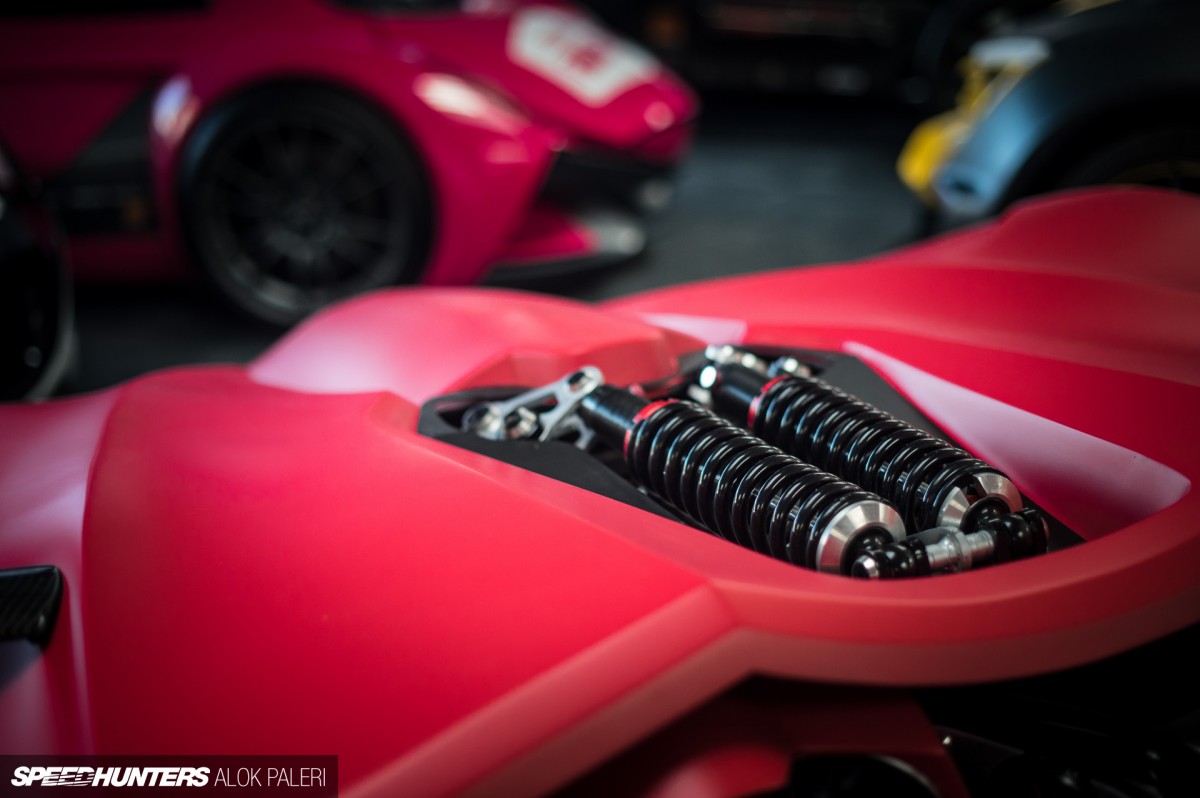
The result of all these unconventional methods of education – as developed by Franco Sbarro himself – are some of the most insane and creative builds I’ve ever seen. This is one area of car design when the expression ‘WTF’ seems positively appropriate.

This, for instance, is one of their latest creations, dubbed the Sbarro Grand Prix. It pays homage to F1 cars of yesteryear and is powered by a fire-breathing BMW V12. It’s hard to believe that it was built in the space of just 10 weeks!

At the other end, you have this very pink and alien-looking electric car called the Intencity.

It features a canopy where the full top part of the car lifts up to reveal in-line seating – just like a fighter jet.

If those tires look a bit odd to you, you’d be right – there’s motorcycle-spec rubber wrapped around the OZ Racing wheels. Think about the contact patch for a second, and the lack of rolling resistance as a result of it!

This one, dubbed the Sbarro Evoluzione, is a design study in what might happen if a Lamborghini slept with a Ducati superbike. I’m sure you’re wondering where the Ducati part went, but just wait till you see the rear end of it…

Yep, it’s just that insane! This car features a superbike-like exposed frame and inboard suspension.

Imagine a group of 25 students coming up with something like this in just 13 weeks!

In keeping up with the jet-fighter theme, inside and out the whole car is full of jagged edges that look like their main purpose is to scramble radar signals.

And the party piece? It’s a three-seater like a McLaren F1!

Then you have this, the Sbarro Sparta. This is one of the very few cars at ESPERA Sbarro that has a license plate on it – and for good reason too.

It has to do with that sticker right there. Each year the students set themselves a target location to present the car. Usually it’s the Geneva or Paris Auto Show, but in this case the Sparta was built to race in this year’s Rallye Monte Carlo in the new alternative propulsion category.

Pulling out all the stops, they managed to enter the race, but unfortunately had to retire the car part way through due to technical complications. One of the main difficulties with the Sparta was that it was a lot more complex than most of the creations by the students.

The rear wheels are powered by a mid-mounted Peugeot 1.6-liter four-pot, while two electric motors assist the front and rear wheels to output a total of 407whp.

In a time when we are flooded with regurgitated takes on auto design, it is so incredibly refreshing to see that there are still people who stick with the analog way of doing things.

Sure, it’s a lot easier to do a CAD mockup of a body and then produce the panels accordingly, but in the process it loses a certain amount of character.

When Anthony (right) received me at the gates when I arrived, he initially hesitated to step in my car because his clothes were too dirty. But sometimes dirty is the way to go. Lab coats seldom foster a soul, you know.

It is exactly this kind of thing that gives each of the Sbarro cars a soul. Each individual part has been affectionately caressed by whoever was in charge of it. When I was told that the cars are like children for the students, it’s easy to see where the feeling comes from.

It’s little things like these that make a car a lot more than the sheer sum of its parts, before it has even turned a wheel.

So here’s to dirty fingernails.

And here’s to the future creators.
Alok Paleri
Instagram: rennworksmedia
alok@speedhunters.com
ESPERA Sbarro Official Site
The Creators Theme on Speedhunters


