
War is a strange human invention. It often slices such a strong dividing line in the timeline, that more often than not the time predating the war is so much different than that following it.

Its consequences effectively force a hard reset that spans nearly all realms of life, including car culture.

Cars from the pre-war days were different. They were built in an era when the automotive state of mind didn’t resemble much of what we have in place now, not to mention the technology available at the time.

These were the glory days of the designers and coach builders – true artists of their time. As we all know, timeless shapes of the bygone past will remain there, their current reincarnation prevented by the modern regulations on health and safety.

There is no denying that there are still people around today bursting with imagination and ambition to design something truly special; cars that are free of real-world strings. When I visited Montbéliard ESPERA Sbarro a few weeks ago, I got to meet some of these individuals.

And this is what they – a group of just 27 students – created. It’s called the Sbarro Grand Prix, and it pays homage to the Formula One cars of the yesteryear while featuring design cues that make it look like it just popped out of a wormhole from the future.

The Grand Prix is essentially a full tube-frame chassis that has been wrapped with fibreglass and carbon fibre body panels. It was created solely as a design study, providing no thought to the modern rules and regulations that govern automotive design.

These days the beauty in F1 comes from engineering and mathematics, but the inspiration for the Grand Prix comes from a time when cars were without wings, a time when design was art and a time when bodies were formed from beaten and hand-rolled sheets of metal. This car isn’t based on one particular pre-war F1 car, but the entire Grand Prix of the period.

One of the first things I noticed about the Grand Prix is just how low it sits. Considering the size of the wheels, the suspension arms are ridiculously low down.
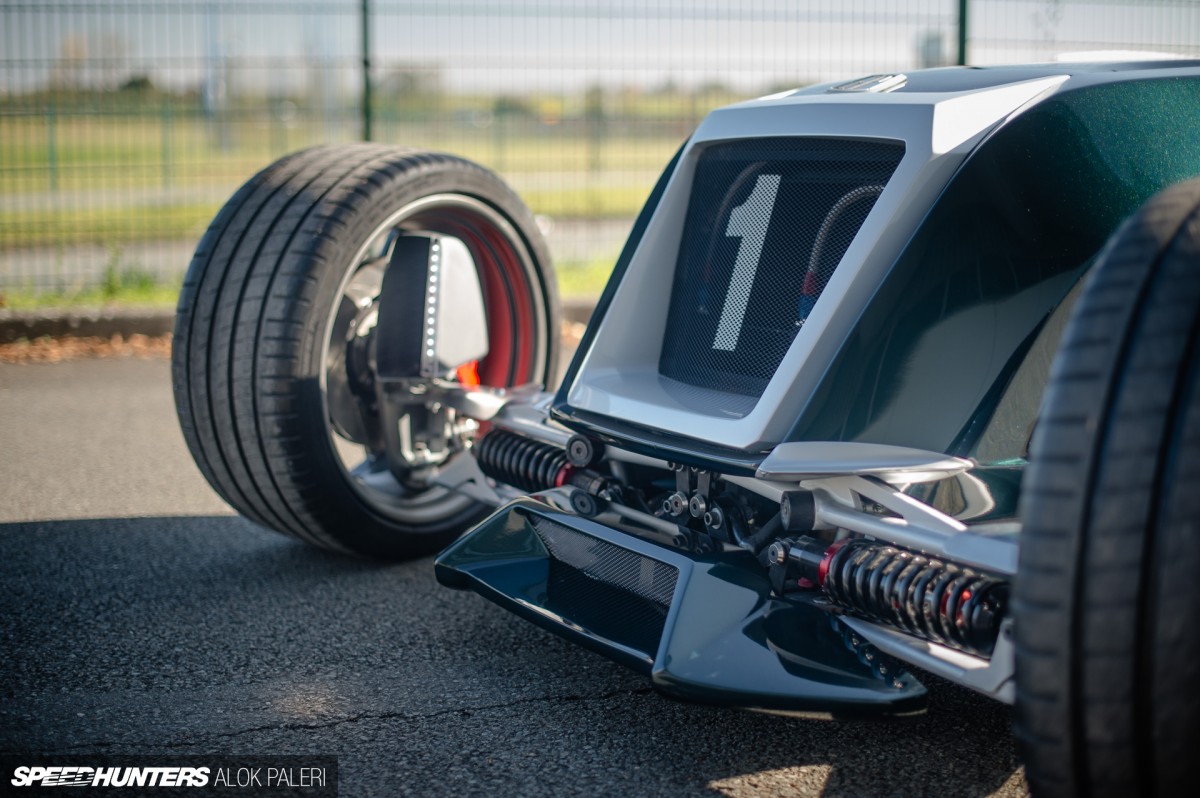
It’s partly down to the suspension witchcraft by the students at ESPERA Sbarro. One of the teachers at Sbarro, Anthony, who was at hand to give me a demo with the car, told me that there were just a couple of centimeters of freedom of movement for the suspension in any direction.

I don’t know if it’s just me, but from this angle it looks like the wheel cannot possibly be joined to that axle.

The Grand Prix is fitted with 20-inch Vossen CV7 wheels in matte graphite at all four corners. They don’t look that massive because of the sheer proportions of the car.

Wrapping the wheels are sticky Michelins that measure 295/30R20 at the front and a crazy 305/35R20 at the rear.

Fibreglass panels channel air towards the brakes on each of the front wheels. Each of these panels are also laden with powerful LEDs that act as the headlamps.

The Grand Prix was created in collaboration with the telecommunications provider Orange France, so aptly there are two iPads on the dashboard. One provides navigation services and the other is used for in-car entertainment.

Students were more or less allowed to let their imaginations run free. These tiny wing mirrors are closer in size to those found on a modern F1 car than to any road car.

The front of the car is covered in a light mesh providing an inlet for air to be sucked into the engine.
Firepower
The entire front of the car is one massive cowl which needs unscrewing to gain access to the engine. There are are two nostrils atop the engine which give a sneaky glimpse of the beating heart beneath.

That’s a massive BMW M70B50 5.0-litre V12, pulled from between the front struts of an E32 750i, putting out 300 horsepower. The engine is so big, it seems like the rest of the Grand Prix was attached to it as an afterthought.

The engine fills nearly the entire front half of the car under the endless bonnet. Despite the heavy V12 lump, the Grand Prix weighs in at 1,050kg wet.

The exhausts exit right by the side of the engine via a custom system that brandishes a vintage Grand Prix insignia. The proximity to the driver cabin combined with how rich the engine was running when I had my chance behind the wheel, meant that I spent most that time crying my eyes out from the fumes.

The driver’s seating position is pretty much directly on the rear axle in the open cockpit, with a tiny and extremely raked windscreen up front. A thin taillight stretches vertically along the rear extremities of the creation, much like the racecars that inspired it.

The Grand Prix has an automatic 4-speed gearbox, with a milled shifter with carbon fibre accents.

The gas tank sits right behind the driver’s compartment. One thing I noticed after spending a day with the car, is that it loves gasoline, and most of the fuel put in here is dumped back out though the exhaust.
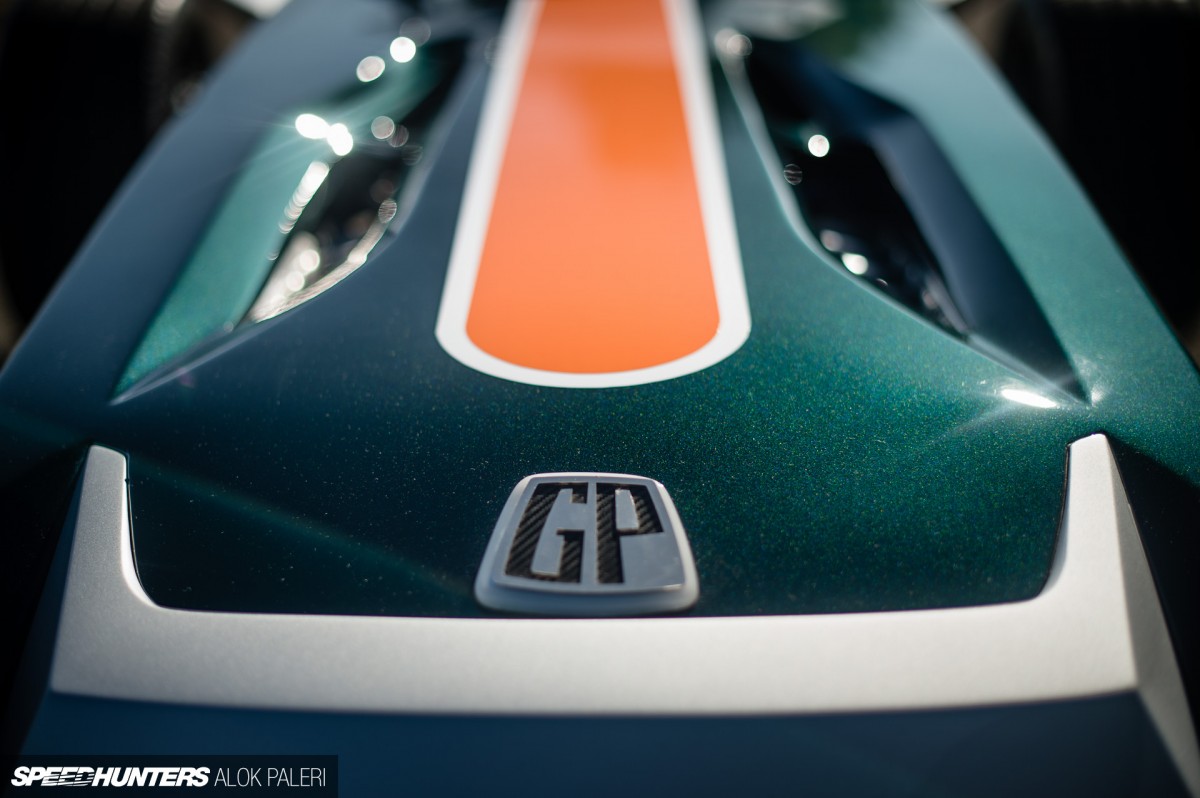
The cues don’t just end with the structure – the paintjob is an obvious nod to Lotus racecars of the ’60s.

Instead of opting for an off-the-shelf bucket seat, the students at Sbarro designed a custom leather padded seat that’s mounted right onto the body of the car.

The starter switch is a milled aluminum wheel installed on the centre console alongside the necessary fuses and power switches for the engine. Paying homage to the old racecars, the Grand Prix is a single seater, with the prop-shaft running from the engine to the rear axle through a tunnel between the legs of the driver.

When I first saw images of the Grand Prix prior to my visit to Montbeéliard ESPERA Sbarro, I was very critical about the thoroughness of the execution that was happening at the school.

Once I visited the school though, it flipped my opinion on its head.

We live in an age where we are spoiled by cars that are mass-produced by machines with perfect shut lines and impeccably fault-free parts.

But judging a design study alongside any production car for build quality is like comparing low-rent fast food to a home cooked meal.

It still amazes me that a fully functioning V12 car that looks as stunning as this was built in just 45 days. And not by industry professionals, but by students who are still learning their craft of auto design.

Sure, the build is a bit wonky and some of the welds are not up to the standards to what we are used to seeing in mass-produced cars, but downplaying the value of the Grand Prix would be missing the point altogether.

It is not a car built to clock perfect lap times or pull consistent slides corner after corner. In reality, it’s the embodiment of the vision of a handful of students who at one point believed that they could learn to create a car from scratch in just 10 months.
It is, quite literally, a fruit of pure design.
Alok Paleri
Instagram: rennworksmedia
alok@speedhunters.com