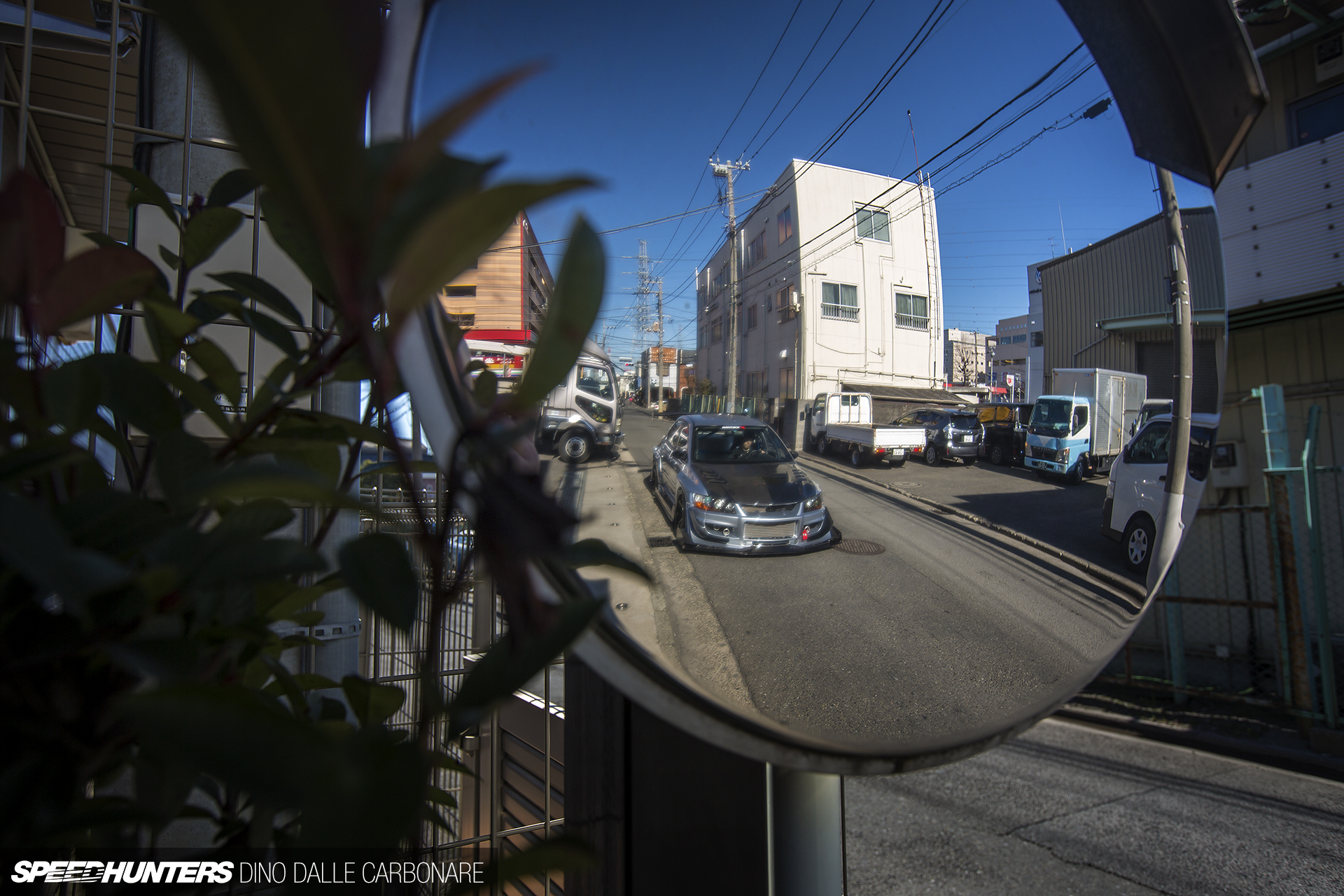
Do you think the guys at Garage G Force, or any other specialist Lancer Evolution tuner in the world for that matter, are going to give a damn that Mitsubishi has dropped the Evo from its line up? I’ll take a wild guess and say that they don’t, after all, the majority of the high-power builds that they create are still based around the older 4G63-powered cars. Machines like this Evo IX, that G Force’s Tazawa-san has built to participate in the various time attack events that are run throughout the year at Tsukuba Circuit and Fuji Speedway.
Mitsubishi may no longer care about giving faithful followers of the Lancer Evo anything more to play with, so it’s up to tuning shops like G Force to do the rest.

By this I mean keep things relevant, and continue to develop parts and setups that allow these older cars to still rival modern day supercars. Time attack is always the best place to showcase this sort of research and development, and it’s precisely what this Evo IX is all about.

We first saw the car last month at Tsukuba during the Rev Speed Super Battle event. I did a little Spotlight on it then, but there’s a lot more to tell.

This Lancer is a true hunter of speed. Every modification that has been made to it is centered around extracting as much performance as possible. It hasn’t been built to go head-to-head with the wilder cars in the Open class though, think of it as more of an old school approach to JDM time attacking.

So while it might not have a purposely-designed aero package like you’ll find on Under Suzuki’s S15 or the Revolution FD3S, it does have some additions that help shave precious tenths off its lap times through the trickier corners. After the chassis prep was completed – which included a back-to-bare-metal strip down and the fitting of a 15-point Cusco rollcage – the exterior was upgraded with the complete Varis wide body kit.

The guys at Varis then created a secondary set of aero parts made out of carbon fiber and designed to boost downforce. The front end features an extended diffuser section, while vertical vanes added to the side underskirts help create a smoother passage of air along the profile of the car. Vortex generators then finish things up at the rear corners; the low pressure created in these areas helping extract air flowing beneath the car.

A conservatively sized Voltex GT wing and a finned rear diffuser complete the package. Given the massive amount of mechanical grip that a car like this naturally generates there wasn’t a great need to overdo things on the aero side. In fact, unless you actually R&D aero parts through CFD or in an actual wind tunnel, most ‘let’s see if they work’ bits and pieces will probably just create drag. Hence my comment before about this being an old school sort of JDM time attack car. I like it because of this, as it doesn’t try to be something that it isn’t.

With the angular widened fenders the Evo looks the part. After a few years of people going a little OTT on the whole aero thing, it’s also strangely refreshing.

Tazawa-san has outfitted the Evo with a set of Öhlins DFV adjustable dampers that have been custom valved to his own specifications. Also in the mix are Hyperco springs which run some pretty high spring rates to take full advantage of the aforementioned grip.

That is partly due to the widening of the fenders, which are able to accommodate 18×11-inch RAYS Volk Racing TE37SLs fitted with 295/30R18 Advan A050 semi slicks. Yep, this Evo runs a wheel and tyre package that’s these days referred to as the ‘new GT-R size’.

The increase in front and rear track and tyre width meant that G Force could run a huge set of brakes, and they took full advantage of that fact by specifying an Endless monoblock setup.

That means big 6-pot calipers at the front with slightly more compact 4-pot units at the rear, all biting hard on 2-piece E-grooved rotors.

I’m sure you’ll agree that it all seems pretty legit so far, but as Tazawa-san explained to me, it gets even more interesting once you look at the work that’s taken place beneath the lightweight Varis vented bonnet…
A Torque Monster
The orange-capped MIVEC 4G63 is the core attribute of this particular build, and this hard-tuned package is one that Tazawa-san will offer to his most demanding customers in the future. Like all of the G Force motors that have come before it, track testing is a big part of the development process.

Underneath those candy orange covers lies a hand-assembled bottom end fitted into a honed and bored block. For this particular setup G Force have gone with a Tomei 2.3L stroker kit, which comes complete with a billet counterbalanced steel crankshaft and H-section connecting rods.

These in turn are mated to a set of Tomei forged pistons, and all combined create a seriously strong base for the rest of the upgrades. The engine is fed 2.2-bar (32psi) of boost, so making sure that intake and exhaust flow was maximised was high on the priority list. That was taken care of by a heavy dose of head porting and polishing followed by a pair of Tomei 270-degree cams.

And that brings us to whole point of this engine and car: the turbo kit. G Force has always like to experiment in this department, but for this build settled on a BorgWarner EFR 8374. In performance circles, EFR series turbos are what everyone has been talking about for the last couple of years, and Tazawa-san’s interest was piqued by the impressive response that their Gamma-Ti turbine wheels allow.

The turbo is mounted low on a Full Race stainless steel exhaust manifold and is controlled by a TiAL external wastegate. With the supporting fuel system, which is comprised of a pair of RH9 fuel pumps and a set of 1000cc/min injectors, this engine is able to deliver 665PS at 6,712rpm – a lot for a 2.3L engine, but not that much in the realm of the Lancer Evo. But power isn’t what G Force was shooting for, rather torque and response which always takes precedence in time attack.

Exhaust gasses are channeled to the rear of the car by a custom-made G Force titanium exhaust system, but it’s the sum of all parts that really impresses. Thanks partly to the MIVEC system, this motor is able to generate 78.2kg/m of torque at 4,751rpm. That’s 565lb/ft available right smack-bang in the middle of the rev range, and what makes this one of the most drivable time attack setups G Force have ever created. If you need proof, on its very first outing at Tsukuba Nob Taniguchi managed to wring a 55-second lap out of it…
The 4G63 Is Here To Stay
And so, this car suddenly makes even more sense – a true ‘Evolution’. JDM-built 4G63s won’t be the same once people realise what these BorgWarner EFR turbos are capable of delivering.

Open up the lightweight carbon fiber doors, which are also fitted with a glossy carbon inner skin, and the functional cabin is exposed.

Everything in here is very much centered around the driver; Nob always being the #1 choice for Tazawa-san.

The Cusco 15-point bolt-in rollcage is something that potential customers building their own fun time attack Evo can relate to. Not everyone has the budget for a top-spec custom fabricated cage, and this is why we see many shops in Japan taking the bolt-in route.

Keeping an eye on engine vitals is a must, and while back in the day JDM car interiors were more akin to jet fighter cockpits with countless gauges scattered all around the dash and pillars, there are far more cleaner options these days.

For a track-dedicated car a Racepak LCD dash display makes total sense as it allows quick and easy access to all the sensors you care to plug into it. It keeps the driver’s eyes in one place too, so it’s much safer as well.

Aside from the HKS A/F Knock Amp and the new-gen HKS EVC boost controller there are a couple of other cool additions. First up it’s the GPS-based lap timer, which was still proudly displaying the 55-second lap that Nob recorded in December at the Super Battle. There’s also a Do-Luck Digital-G sensor mounted on the transmission tunnel, which allows the Evo’s AYC system to react far quicker, and also be controllable so that Nob can fine-tune the behaviour of the car through the turns.

Nob is also able to tweak the fuel mixture via the dial on the shifter assembly – something that comes in handy during the humid Japanese summers. On the subject of shifters, there was no way that the stock driveline was going to be able to handle the amount of torque that the engine now develops at low RPM, so it’s been upgraded too. The Holinger 6-speed sequential not only takes all the twisting force in its stride, but also allows for instantaneous gear shifts.

It may not be the fastest Evo to have ever lapped Tsukuba, but this car stands for a whole lot more. I have no doubt that we will see Nob shave a few more tenths off its 55″52 best too.

If you compare the images from this feature with the ones that I posted in the initial Spotlight, you will notice that there have already been a few changes made to the engine bay and interior. This is very much a work in process, and in that respect there’s definitely more to come.

Garage G Force were also out at the HKS Premium Day at Fuji the other week, where Nob managed to wrestle a 1’42″154 out of the Evo IX for third fastest in the AWD class.
So yeah, Mitsubishi, we couldn’t care less if you’ve decided to abandon loyal followers and enthusiasts by discontinuing the Lancer Evolution. We’re good. We’ve got plenty left to play with and Evo guys will be entertained for many years to come!
Dino Dalle Carbonare
Instagram: speedhunters_dino
dino@speedhunters.com
Garage G Force Mitsubishi Lancer Evo IX
Numbers
Max Power: 665PS @ 6,712rpm, Max Torque: 78.2 kgm @ 4,751rpm
Engine
Tomei 2.3L stroker kit (2,323 cc), Tomei billet counterbalanced crankshaft, Tomei H-section connecting rods, Tomei forged pistons, Tomei Pro Cams 270-degree in/ex, ported & polished cylinder head, Full Race stainless steel exhaust manifold, BorgWarner EFR8374 turbocharger, TiAL external wastegate, G Force downpipes & titanium exhaust, G Force induction pipe, HKS Power Flow filter, G Force custom air box, HKS R-Type intercooler, HKS SSQV blow-off valve, 2x RH9 255L/h fuel pumps, ARC radiator, HKS oil cooler, HKS F-CON V Pro engine management system
Driveline
Holinger sequential transmission, Exedy Carbon-R twin-plate clutch, Cusco RS 1-way front & rear LSDs, Do-Luck Torque Manager Digital G-Sensor
Suspension & Brakes
Öhlins DFV G Force version adjustable dampers, Hyper springs 16.1kg/mm (front), 14.3kg/mm (rear), Marchè adjustable suspension arms, Cusco front & rear power braces, Endless 6-pot monoblock front calipers, Endless 4-pot monoblock rear calipers, Endless front & rear 2-piece slotted rotors, Endless CCR-G brake pads, Endless brake lines
Wheels & Tyres
RAYS Volk Racing TE37SL 18×11-inch +17 front & rear, Yokohama Advan A050 295/30R18 front & rear
Exterior
Full Varis widebody aero kit, Voltex carbon rear wing,
Interior
Cusco 15-point bolt-in roll cage, Recaro bucket seat, Takata harnesses, Racepak IQ3 digital display, HKS AFK meter, HKS EVC boost controller, Defi Control Unit II, Mixture controller
Garage G Force
Other Garage G Force related stories on Speedhunters