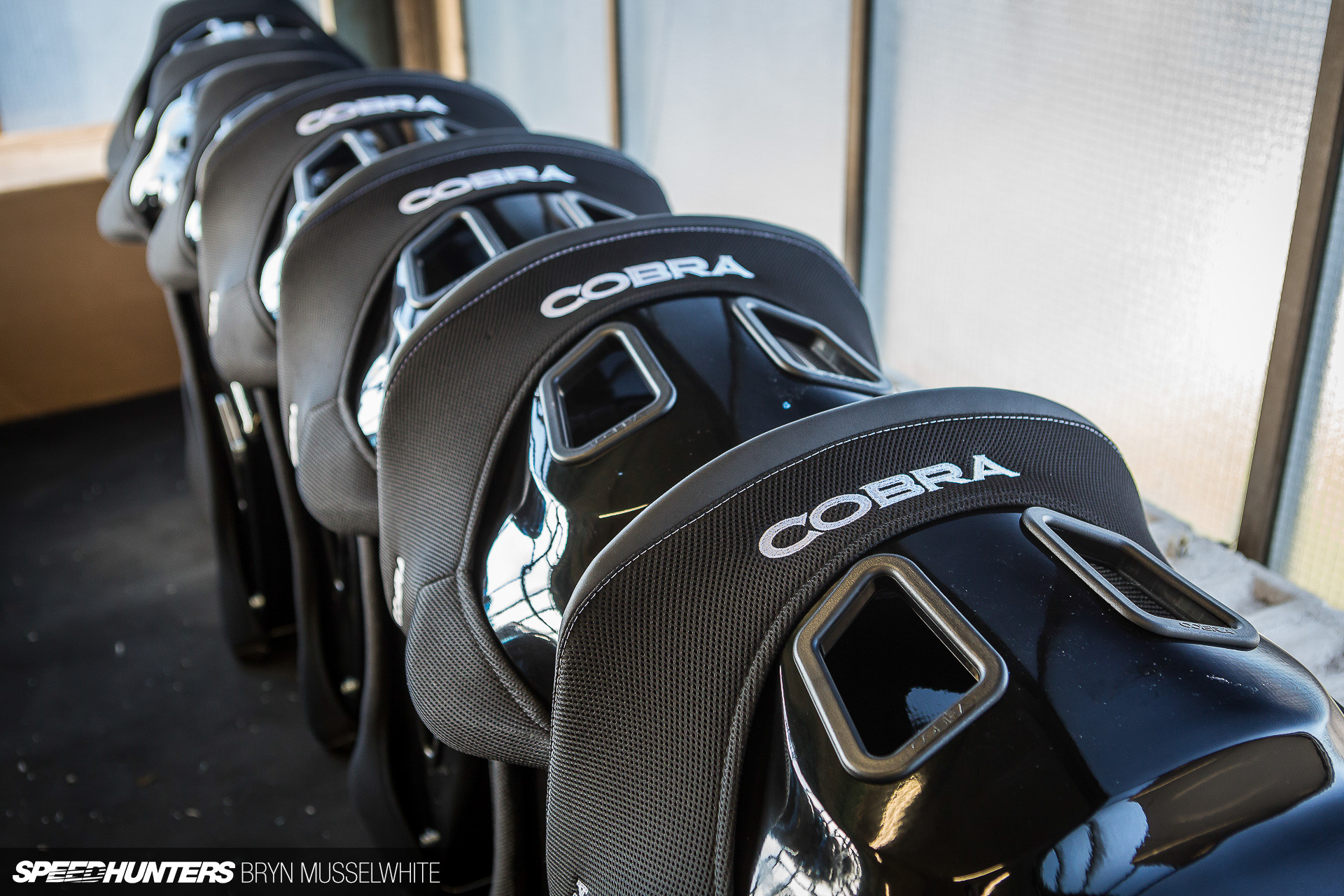
I feel like I’ve just been fitted for a suit, a really sharp, three-piece, single-breasted piece. The kind of suit you’d take a second look at yourself in a window just because you look so good wearing it. But I haven’t been – not quite anyway. I’m sat opposite Mark Dunsford from Cobra seats, and from the other side of his desk he’s just completely nailed my measurements from neck to inside leg. All this from the guy whose dad made the seats for the Millenium Falcon in the original Star Wars trilogy. My inner geek is just freaking out right now…

And it should be, Cobra have been around since the mid-’70s and roughly 20,000 car seats of all shapes and sizes leave the factory every year. Cobra made the seat in our Scion Tuner Challenge winning FR-S and shipped a matching passenger number out when Jay Leno wanted a drive. Keith had to sit somewhere after all!

I’m as guilty as the next person who’s bought a pair of seats based on the way they look and maybe ‘fit’. I didn’t fully understand what I was literally getting in to. But it boils down to three main reasons why you replace the existing seats in your car: safety, comfort/fit and then the weight advantage.

Mark knows better than most how important a seat is. “There’s one fundamental thing that comes from motorsport that we learned years ago, in that for you to pilot a car to your fullest potential you need to know what it’s doing, and 90 per cent of what it tells you comes through the seat,” he says. “Your feet are moving around and dancing on pedals, so the only feel you’ll get will be through the modulation of the brakes and clutch. The only muscle input on your steering wheel should be to turn it – there should never be any used to hold yourself in the driving position.” Now admit it, we’ve all held onto the steering wheel at one time or another.

It sounds pretty obvious when you hear it, but how many of us even know what a good fit is? And how do you achieve it? Now think about it – given the dizzying amounts of different suspension systems and settings you can have, how can a seat just be a seat, right?

Of course I’m playing devil’s advocate here, and it’s this apparent lack of knowledge that Mark has come to handle rather well since he started with the family business 25 years ago. His expertise has been built on bed rock of craftsmanship passed down from his grandfather, who was a master trimmer with AC Cars. Yes, the same ones that made the Cobra with Carroll Shelby. Those skills are still used today in the factory.

Back then the world was a different place, but Mark’s mother who worked alongside his father had already learned the importance of tailoring a seat to suit a body type or market place. In the mid-’80s, she’d got on a plane to Japan and headed to Autobacs for a meeting about supplying the Japanese market. Mark remembers from the early trips out there that the Japanese body type has a longer torso, shorter legs and is generally slimmer than the western body. That lesson has taught the team to look at every application in a personal way.

Just as you don’t walk in to a shop and see ‘one size fits all’, why do we think it is for a seat? It goes far beyond ‘wide’ or ‘narrow’ versions even. Safety, material choices, customisation and a whole load of other stuff is at play here.
But How Do I Know?
So let’s get down to the nitty-gritty – how do you buy the right seat? That secondhand bucket seat might be a good price, or a brand you’ve never heard of but kind of looks like one you have, but we all know it’s not the way to go. Not for a second are we saying that Cobra are the only people to buy from, but consider this – a lot of the established names are now marketing companies who use their brand name on products made elsewhere and as Mark says, “We make our seats here and it’s pretty much all we do. We don’t dilute the brand and we do it all here in the UK. Which means I can keep an eye on everything.”

So as long as you know exactly where your seat is coming from and you trust that source, you’re off to a good start. Then I guess it comes down to whether the people making it know what they’re doing, and more importantly how you can be sure of that. We can’t all go for a factory tour every time we want to buy something!

That’s where internationally recognised testing comes into play. “In the FIA test we complete there is a 20G deceleration with a sustained pulse of 20 milliseconds, which it has to pass,” says Mark. “That’s enough to kill you, so basically you’ll expire before the seat does.” That test came about in 1999, and if you’re in any doubt as to its validity check out this video…
That was Rob Collard in the BTCC last year having the biggest off they’ve seen in 20 years. Like most of the grid, Rob was strapped in to a Cobra product so Mark got the phone call to have the seat checked out as there was a tight turnaround before the next round. “I asked them if there were any issues when removing it from the car and they said one rear side mount bolt didn’t undo with the correct torque setting,” says Mark. “We stripped it down, steamed all the covers off and went all over it with ultrasound, then wound the bolts back in with way more torque than usual and everything was fine. I thought ‘there’s nothing wrong with this seat’, and that was massively satisfying. Although we didn’t get to sell them a replacement of course!”

So any seat that has been through a stringent test procedure is one you can start to trust. Mark adds that for him it’s personal, “It starts with me and I can sleep at night. We have racing drivers using our hardware all over the world, I have two seats going for testing tomorrow, it’s going to cost £4,500 to test them and I’m not going to get anything out of it other than ‘good they’re still doing what they should’. Every year I have to do production conformity tests, these are for my insurers, my customers, and official bodies like the FIA.”

The expense of that testing is going to put a lot of people off in the first instance, so it’s buyer beware if your new seat doesn’t have it. And yes, we hope you never need it to perform in such extreme conditions, but if the frame did snap at the crucial moment or break, chances are you’re going to be dead or in a pretty bad way. It’s a wake up call when you think of it like that. Walking around the fully equipped machine shop downstairs in the factory really brings it home how important quality control is.

It’s this that prompts me to ask my next question: is the expense involved why there’s not more people making seats? Mark replies, “I think it’s because it’s hard – it really is difficult. When you look at what goes into the seat, we’ve got over 300 different suppliers that bring in all the components, plus the stuff we make in-house. Couple that with the experience needed, CAD work and the safety standards you have to meet, then you also have to make something that’s comfortable, looks good and is personalised. It also has to be still relatively affordable!”
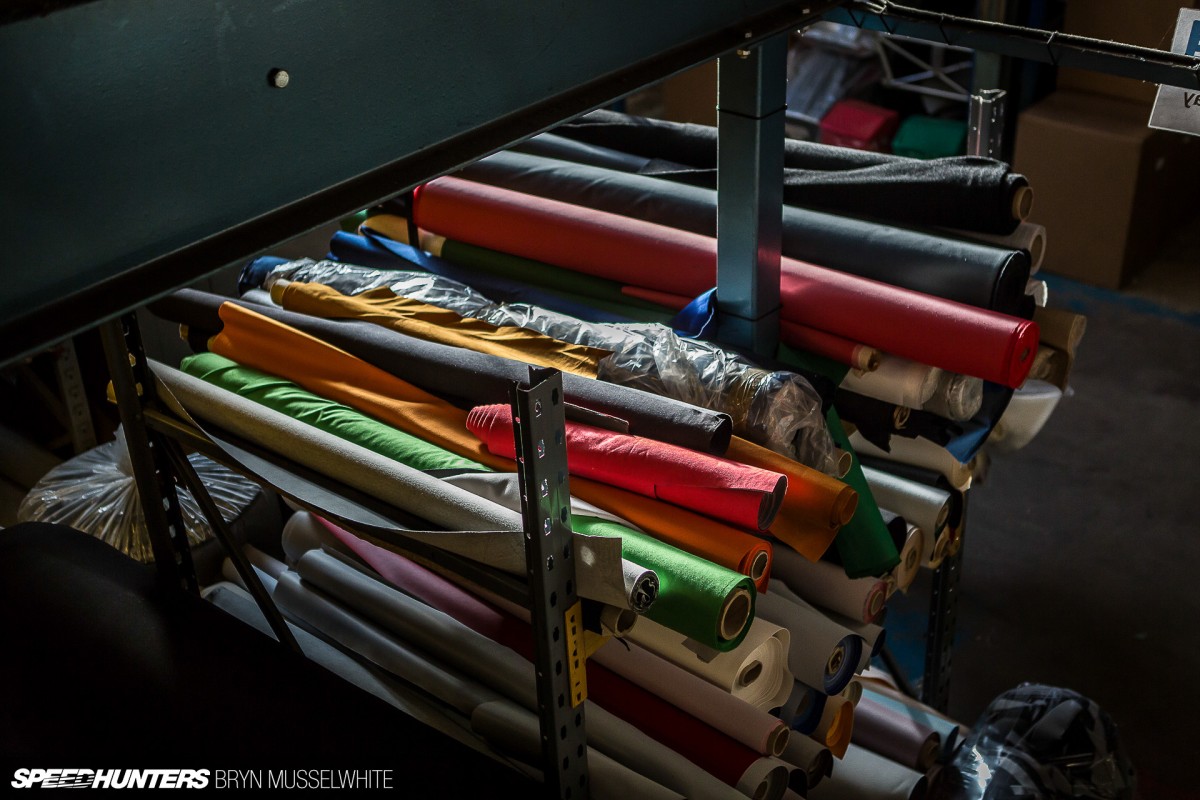
I guess my innocence was bliss as I think about the no-name carbon buckets I have in the Strip Club Volvo! Enough about the safety though, what really blew me away is the whole range of clever materials which go in the seats after the initial frame has been made. If you’ve ever felt hot or sticky in a bucket seat, then read on because here comes some science!
Good Enough For NASA…
This is Outlast – a temperature-regulating textile. It’s a micro-capsule system and as you sit down they draw the heat away from your body. The molecule goes from being hard to liquid form, then it imparts it back to you when you’re cold. It smooths the corridor of your body heating and cooling, and it’s technology that’s often used in race seats. Developed by NASA and used by people like the Israeli bomb disposal squad in their fatigues, as I hold onto it with my warm hand, it starts to feel cool in seconds.

Live somewhere cold? Well, then you’ll need a heater element. Just visible here, Cobra can combine this with Outlast and any other fabric you mind can think of. This is a seat out of Jay MacTolridge’s Golf, back in to be retrimmed ready for a road trip to Wörthersee. You may recognise the seats further back as being the ones from our old feature…
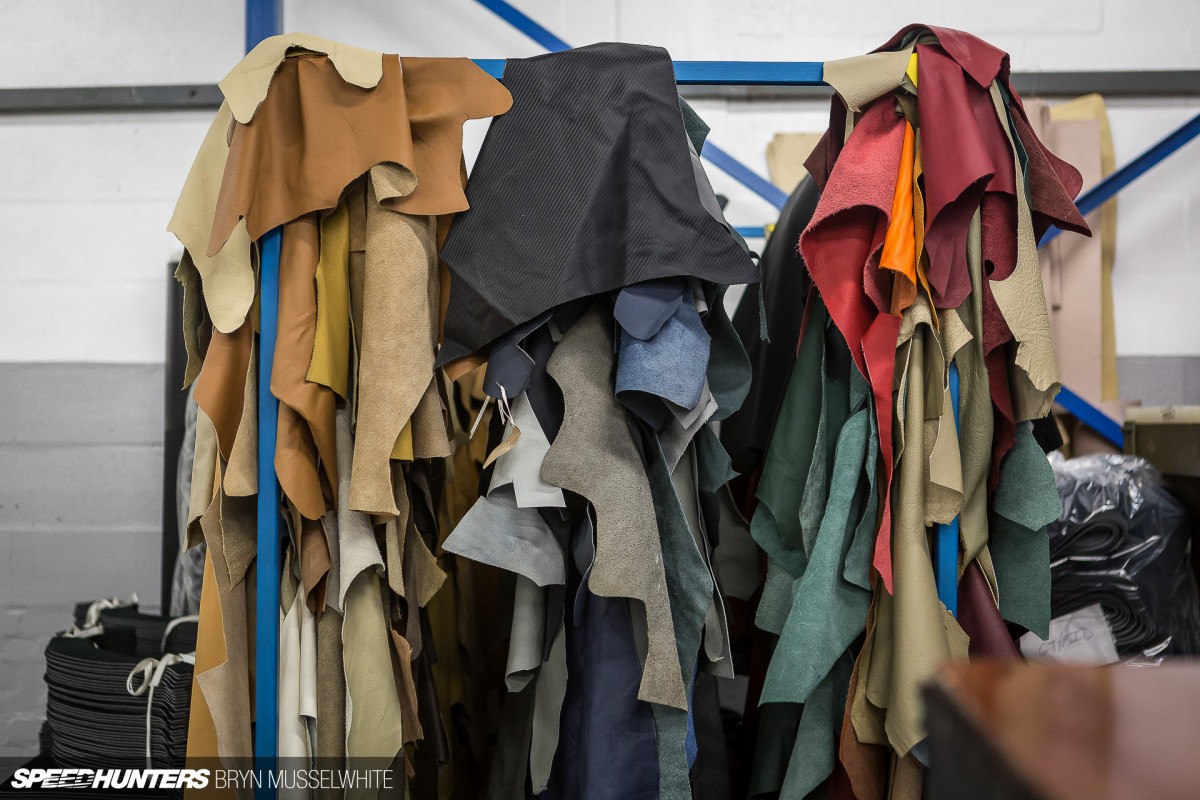
Suddenly having a leather seat in a car doesn’t present so much of a problem when it’s cold or hot, which has always put me off in the past. These hides are from Bridge of Weir Leather in Scotland, which I randomly toured in 2012. It’s one of the most technologically advanced facilities of its type in the world, and they supply leather to Aston Martin, Jaguar, Land Rover and Volvo amongst others. So the quality is the best you can get.

And that’s the other key thing for me here – the interior of anything quality made in the last decade or so is actually really good. So, with manufacturers having upped their game, why upgrade? Just look at how popular the ‘OE’ movement is with seats from an R8 finding their way into a Golf or similar. If you’re buying from the aftermarket then, the product has to be as good, if not better. The Gerber cutting machines Cobra use are the same you’ll find in a top-end manufacturer’s trim shop.

The same goes for the sewing machines, which is where Cobra have created another genre. After all, who wants a seat that looks like everybody else’s? I’ve seen loads of examples of the different logos and stitching the guys have done over the years and with in-car cameras these days, it’s things like this which prove invaluable to race teams all over the world.

These are some of the panels laid out ready to be sewn together for another BTCC team, and here you can also see the difference in materials and textures able to be mixed and matched.

I’m not a massive football (or yes, soccer if you’re in the States) fan, but I know Paddy is. If you ever watch a match on TV, most of the premier league teams have Cobra seats in their dug-outs for the players and all those other people who I don’t really know what they do.

On top of all this there’s the Pro-Fit system that Cobra offer. Going back to the start of our conversation, Mark looked at me and said, “You could go in a standard seat, with a medium back rest and low seat base. Your shoulders will then be in the right place for a correct harness fitment, where they don’t touch the seat. I use a rule of thumb that if I can get anymore than a magazine down between my hips and the seat, then it’s too loose for me. The fit is fundamental to the success of the seat – there should be no undue pressure on any part of your body that comes in to contact with the seat. It should be a constant, even pressure. We have different density and height cushions to achieve this.”

Now I’ve banged-on for longer than I was going to, but that’s just because my eyes have been opened and there’s loads more I could have written. But you can’t dispute what Mark says about being connected to the car through the seat, so I get that. The fit has to be paramount. Safety? Well, we’ve all done stupid stuff, but the older I get the more I have to lose, so yes, I admit it is important to me and it should be to you too. That’s just about learning from other people’s mistakes. Saving weight? I’m up for a bit of that too, because less mass means more speed.

So is the seat the most important part of your car? Well, it’s the one you have the most connection with, it feeds what the rest of the components are doing through to you, so maybe it is. I’ll say this – I think it’s a lot more important now than I did when I first walked through Cobra’s front door!
Bryn Musselwhite
bryn@speedhunters.com
Instagram: Speedhunterbryn
More Shop Tour stories on Speedhunters
Cutting Room Floor


