Numbers. We use them so often when talking about cars. Power numbers. Engine sizes. Torque delivery. Model variants. Raw digits that directly describe capacities, possibilities and performance. But here’s a more abstract set of figures, for me a kind of automotive Fibonacci sequence, that provided a collective definition of the spirit of racing across the decades.
A car is just a collection of metal and material unless it has a story. The intricacy of a build, the effort put in or the heritage of the model involved all weave a narrative, and people provide the creative force. But location provides another level of context. That could be both the birthplace of a car, the workshops and factories around the world, or iconic pieces of road or race track. After all, without somewhere to drive, a car isn’t much use.

So here I want to talk about a single day filled with the ghosts of epic battles, furious slip streaming and the most famous of racing drivers. But this is about location and atmosphere: gaining an understanding of what drivers had to face, not the cars they used.

So those headline numbers? Four Grand Prix tracks in the environs of Barcelona, Spain. One day to visit them. 93 years of competition history. 17km of racing circuit. 20km of walking. 27,288 steps.

The result of this formula is a blast of images and sounds, both real and imagined, from the past and present. It’s the summation of how one area has become a focus of worship for the world’s speed merchants.
There’s a reason why we used to prefix our track visits with Temple Of Speed.

I warn you now, there are only two racing cars featured in this post, and one of them isn’t even real.
Here it is now.

I’d had the idea for a couple of years, following my first trip to the sun-bleached Barcelona circuit for the Spirit Of Montjuic Festival back in 2013. Spain has always been steeped in motor racing history since the beginning of road racing over a century ago, with international drivers drawn to its warm climes and long balmy days.

Modern Spain is littered with racing circuits, mostly a legacy of the testing arms race at the dawn of the new century when Formula 1 teams were presented with a plethora of freshly-built Grade 1 circuits vying for their business. But how many cities in the world can claim to have not one but four historic Grand Prix tracks within a 10km radius of their boundaries? That’s the unique situation with Barcelona. A beautiful city in its own right, made even more of a Mecca when you throw in all this racing heritage.

My plan was to walk each of the four circuits to get a proper insight into their individual challenges. The precipitous Sitges-Terramar oval from 1922; the lesser known blasts of the Pedralbes street circuit from the 1950s; Montjuïc Park’s brutal mountain course made infamous in the 1970s; and then finally the link to today and the Circuit De Catalunya that still holds the Spain’s Formula 1 Grand Prix. Armed with print-outs and map apps, nevertheless I expected to take the odd wrong turn…

My first stop would be the Sitges-Terramar oval. My previous visit back in 2013 was truly whistle-stop, part of a road rally where I was riding shotgun in a Corvette Stingray. That time I’d literally only had time to run round a couple of parts of the track and push through the brambles before jumping back in the ’Vette for the cross-country journey back to the Circuit De Catalunya. This time, I arrived under my own steam and was able to go full Kurtz on my own around the track.

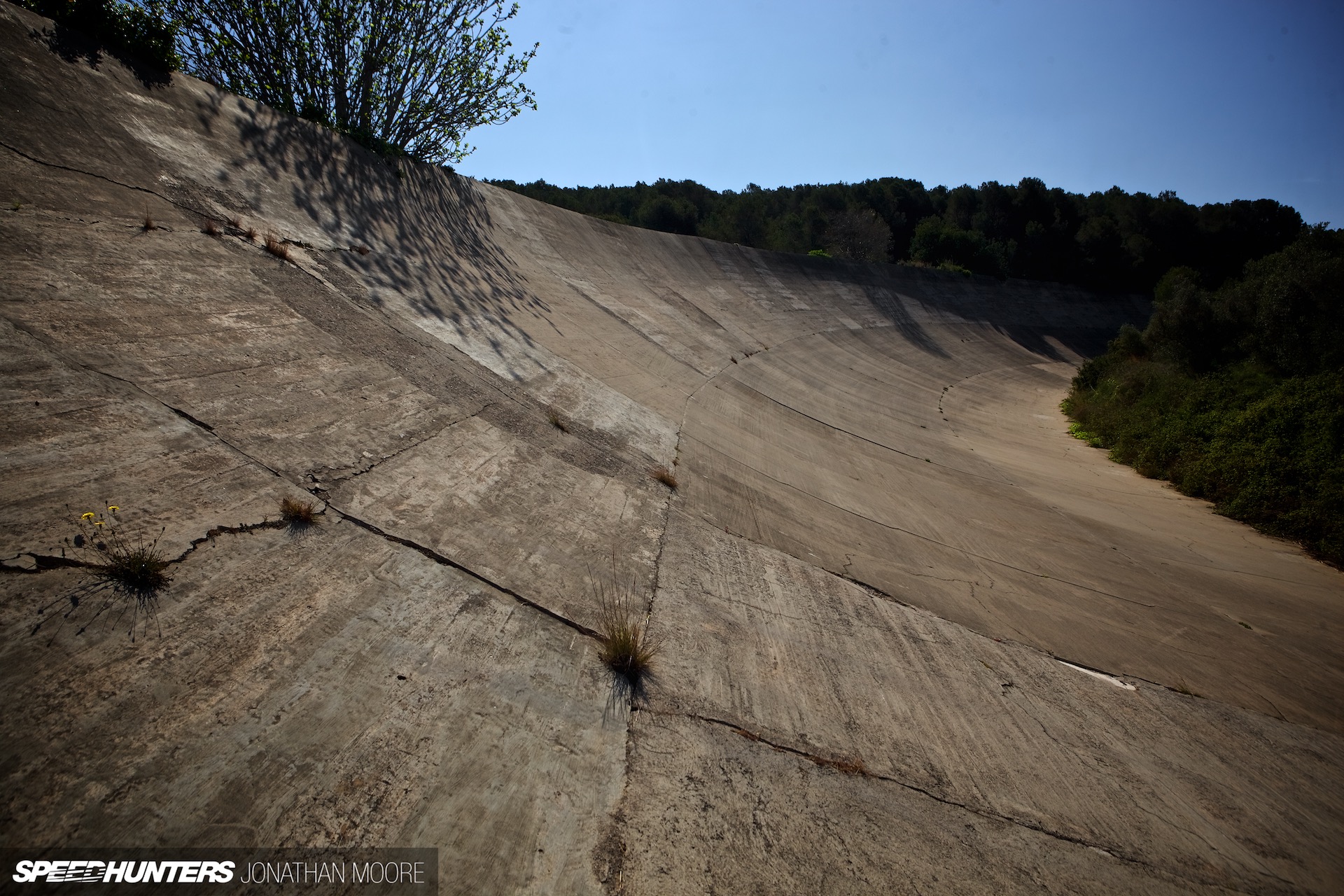
It’s a truly overwhelming place to see. Complete in relative terms, the track is frankly insane. It doesn’t make any sense to have such vertiginous banking, given the kinds of cars that were in play back in the early ’20s. It may not have the sheer scale and sprawl of Brooklands, which at 2.75 miles round could fit two Sitges within its perimeter, but it’s just as impressive almost because you can see the entire track snaking its way round – and through – the countryside.

It’s concrete versus nature, with concrete coming out on top.

The main tribune building has been used as a barn for many years by the local farmer – most of the interior of the kidney-shaped oval is planted with crops and small holdings. Although openings have been plastered over and corrugated iron placed over the top, the grandeur of massive concrete structure is still immediately apparent.

Effectively the practical necessities of converting the tribune’s use have acted to protect the building. Rather than being exposed and eroded by the sun and blowing sand, the tiered seating atop the tribune lies dormant but intact.

Inside, the skeletal frame of access stairs and supporting columns. The use of raw, formed concrete means that in the 1920s it must have been like a spaceship had landed in the middle of this otherwise quiet, dusty and agricultural landscape.

The track was completely still, the only sound the loud chirruping of insects. It would be impossible to not close your eyes and let your imagination run wild: you’d have to lack a soul. I wasn’t about to fight it, and that would be the theme for the day. Hear a crackly PA over the sound of the harshly revving engines, smell the wild fuel mixtures being burned and see drivers sliding their impossibly fragile cars away from the apron and towards the vertical wall of the first turn ahead.

The track might have been doomed financially from the start, a vanity project of the most positive kind if like me you live for this kind of thing, but the faded glory and ambition of the place defies anything nature can throw at it. It’s all about that startling positivity and excess of the wealthy 1920s set, doing anything and everything to put the horrors of the First World War behind them.

The impressive block-fronted manor house that overlooks the track features a family crest; surely the winners of races held here must have ascended those steps to receive their wreaths and trophies.

Arriving early as the sun began to gather its strength, I had the track almost to myself – just the odd visitor and a lone cyclist whistling by at one stage as I strolled along. What a proto-velodrome to have on your doorstep.

That first turn though. You almost can’t face it straight on, like some kind of monster of legend. It’s just too imposing, too overwhelming as an example of man’s willingness to take things to the extreme.

Walking along the edge, you notice the post-holes where the inconsequential barriers would have been installed. I’m not sure which thought would be worse: firing off the edge or making a mistake in the middle of the gaping banking and tumbling down to the apex. Drivers in period complained that the transition from flat to banked was too extreme – and that’s something coming from a generation who barely knew fear.

As the huge opening banked turn tightens, disappearing into the rising ground and surrounding trees, it’s impossible to maintain a high line and you quickly ebb down to the lowest point. Attempts to climb its face past the halfway point are futile; you’d need ropes and climbing gear, it’s just that steep.

Look down and you see the reality of the crumbling concrete that defines the surface – what from a distance seems a smooth parabola gives way to a cracked and broken moonscape. Still drivable, sure, but more appropriate for a rally car than fast road.

That said, the original construction was incredibly high quality. How else could it have survived over 90 years in these harsh conditions. It actually doesn’t feel like that much work would be needed to bring it up to a level where it could be in more frequent use, if perhaps not utilised for actual racing – and the current owner and his team do have exactly that in mind for the future. The idea of a historic festival at Sitges-Terramar would surely be enormously popular, should it come to fruition.

My leisurely walk round the two-kilometre track eventually brought me back round to the tribunes, the heat building as the clouds gathered. The orchards planted in front of the tribunes gave some respite, and also the chance for a final respectful glance at this sleeping concrete giant that’s draped over the countryside.

As I struggled to pull myself away from Sitges, the first visitors for the day were being greeted – the oval is often used as a destination for organised road rallies. Although I’d enjoyed having the track to myself, the noise of cars and the shouts of people seemed welcome. This oval needs to live again.
Mountain Monster
Sat-nav set, I began the short drive towards the city and Montjuïc Park, the steep rise of the harbour-side hill clearly visible in the distance compared to the otherwise gentle gradients of Barcelona. If Sitges-Terramar is a neatly preserved time capsule, then I knew the next two would need far more effort put in to find any more than the street outline of their previous explosive lives.

The track around Montjuïc is one of those epic street circuits that you maybe dream of around your own home town but never think could actually happen. In parts obscenely quick, with snap crests guaranteeing cars would get airborne and neck-breakingly long arcs of flat-out corners, there’s then a sinuous lower section which is classic street track: tight, twisty, hairpin after hairpin as the circuit cascades downhill to its lowest point.

The heyday of the track was at the debut of the 1970s, although the layout was used as early as 1932. Four F1 races were held there, twice won by Jackie Stewart (’69, ’71) and once each by Emmerson Fittipaldi (’73) and Jochen Mass (’75). This was the era of flat-pack, wedge-shaped missiles, wide and low with huge outsize rear tyres that looked like they’d been taken from dumper trucks. High air-boxes. Stone age aero. Huge power. No grip. The perfect formula. Back in the Circuit De Catalunya paddock sat Jacky Ickx’s Lotus 72 that he man-handled to second place around the park in the ’75 race.

The start is right up by what is now the Olympic park. In fact, that site is part of the reason for Montjuïc’s downfall, as the complex sits on top of the old pit lane.

What was the long curving starting point for the track is now lined with parked cars, though you still get the idea of how wide the track was.

From launching off the line, the F1 cars would blast up and over the crest before plunging down to the tight first turn – invariably the scene of an early crash or two. This view is looking back to that crest, a classic camera shot of the time.

With traffic lights in place, the modern traffic flow round the old turn one is now a lot more sedate.

All of this part of the track is pretty clear and easy to follow. Video footage from races means it’s almost familiar, with the sprawl of the city clear to see in the background as I followed the track downhill. The pavements might now reduce the width of the track, but even so it was hardly wide in the first place – especially if you think you’d be tucked down in the cockpit and well below the level of the surrounding Armco barriers.

The twists past the colourful theatre building led to my first wrong turn, taking a right a block too early. Map double-checked and an about turn completed, the last little wiggles of the downhill stretch were navigated.

A hard left onto the main thoroughfare left you blinking in the sunlight as the road went from narrow back-street straight up to four-lane boulevard.

After what seems like the only flat bit around the 3.8km layout, past the stunning Palau Nacional, the drivers would be nailing it all the way back uphill, through the never-ending sweepers that led back to the start line.

The four F1 races have gone down in history, putting Montjuïc Park up there amongst the great tracks. An absolute rollercoaster, fast, dangerous – even walking it was a dizzying experience.

But then consider that the track was also used from 1965 to 1986 for 24-hour endurance motorbike races. If the single-seaters weren’t frightening enough, then the idea of two-wheeled round-the-clock racing here certainly is.

Although top-line F1 cars never raced there again, racing did continue right up to the building work for the ’92 Summer Olympics. More recently, marking a welcome change in attitudes towards racing, the local authorities marked the site with the plaque back in 2004, and in 2007 the park again echoed to the sound of DFVs to celebrate 75 years of the track. That included Fittipaldi lapping round in his winning Lotus 72, which will now go down as one of my most frustrating missed opportunities…
Ultimate Street Fighter
The afternoon was rapidly evaporating – as was the good weather – so the next circuit beckoned: Pedralbes. The biggest challenge just to find it, locked up in the myriad grid of streets in the north of the town just two miles from Montjuïc.

Like Montjuïc Park the 6.3km Pedralbes circuit was run on Barcelona’s public roads, but this was a completely different beast. For a start the circuit literally exists just as a memory – at least Montjuïc acknowledged its past, but like the fearsome Rouen-Les-Essarts circuit in France, Pedralbes has been effectively erased from the local consciousness, consumed by an expanding city.

Races were first run here in 1946, just as Europe was beginning its slow recovery from the Second World War. Pedralbes held the national Penya Rhin event four times, in ’46, ’48, ’50 and ’54, as well as Grand Prix proper in ’51 and ’54.
The track was run on roads in the rolling fields north of the city, which at the time were barely built-up. Contemporary videos show the startling difference: the main straight stretches off into the distance, rising slightly before the first turn. Impossibly long low-line tribunes lined the road, packed with spectators.

Where once post-war legends like Fangio, Ascari, Farina, Chiron and Trintignant blasted along the wide boulevard, there’s now just another nondescript city thoroughfare packed with traffic and buses and lined with offices. But you can still get an impression of how long and wide this section was, so unlike any kind of modern circuit.

The modern city bypass has hacked off the top end of the half-arrowhead layout. The location of the first turn is gone, lost under a confusion of flyovers, slip roads and underpasses; a public park is located in the crook of where that acute corner was. Where the track rose up, the excavated bypass drops down – you have to follow the exit road that leads into Pedralbes to get a sense of where the track ran.

Typical suburban streets and low-rise buildings now cover the area, where before hay bales defined track limits. Pedralbes was located on the rising ground that leads up to the hills that surround the city, which gave the track its two-tier style: the lower, ultra-quick boulevard blast and then the fast turns of the upper ground.

Of course, you can’t get away from Antoni Gaudí if you’re in Barcelona, and neither would you want to. Even though my mission was focussed on racing history, I couldn’t help but admire his architecture as I walked around.

Pedralbes was at the heart of some of his finest work, including the Güell Pavilions, Royal Palace and nearby Portal Miralles, all built at the turn of the 20th century. He predates the events held in the city, so his buildings are some of the few you know are contemporary with the races.

By now my feet were beginning to feel every metre. Even halfway round Pedralbes I’d toyed with the idea of cutting out the last section of track, under the excuse that a shortened triangle version was run for the first couple of years before the extension down Passeig de Manuel Girona. But I’m a completist. You can grow new feet, right?

The final right turn at the bottom of chute that is Calle de Numància used to open out onto the long straight, and videos show cars sliding through as they tried to maintain speed. Now, it’s just another urban intersection.

The finale awaited: the Circuit de Barcelona-Catalunya, just 15 minutes up the road. The 4.8km track was built in 1991 as the Olympic park subsumed Montjuïc Park, taking over almost directly from Montjuïc as the city’s primary track and immediately regaining the F1 race.

Classic touring cars were power sliding round as I pulled into the parking area; the Group C monsters would be the welcome closing act for my long day. Having now been to this track a couple of times I have both far more respect for it and also a better understanding of its flow.
Catalunya was also the stage for epic battles with the greats of the more recent era: Senna, Schumacher, Mansell and of course the current generation of F1.

You can see why it was such a popular testing venue, as the layout is far more exciting than you might have been led to believe. Except for that silly final chicane added at the end of the lap to appease F1… Seating for 140,000 means that crowds for smaller races are lost in the grandstands, but that just means it’s easier to choose your optimum spot.

Walking around this track brought things up to date: no need for exploration, no need for maps. Gates and fences hemmed you in, run-off and gravel traps between you and the cars. A different era represented. Not better or worse, just a natural progression. At least the Circuit De Catalunya has a lived-in feel, its paint slightly peeling and its surfaces covered with a thin veneer of sand and dust. It means this track doesn’t stand apart from the other three, unlike if it was more one of the modern high-tech-a-dromes that can rip the spirit out of racing.

So four Barcelona tracks visited, and with that a better understanding of just what each generation of driver has faced.

However, the elation of thinking I’d completed a full set was tempered during subsequent research. I’d missed not one but four earlier tracks – all using sinuous public roads such as they were in the Barcelona area – used for the Copa Catalunya, Armangué Trophy and Penya Rhin Grand Prix.
Four.
That’s without including the other local circuits still in use like Calafat in Tarragona, not far from Sitges.

However, as with most early circuits, those four varied from 15km to 30km in length, so, excuse me for saying that if I get back to Barcelona to tick them off, I’ll be doing it from behind the wheel of a car…
Jonathan Moore
Instagram: speedhunters_jonathan
jonathan@speedhunters.com