The popularity of historic Japanese cars, or kyusha, doesn’t seem to be slowing down here in Japan. At least that’s the impression I’ve been getting through the shows, events and meets that I visit.
Not only am I coming across more classics than ever, but it’s plainly obvious that owners are striving to come up with exciting new takes and ideas when it comes to restoring, modding and tuning their prized vintage machines.

Thinking outside the box has become synonymous with this scene, and when the owner of this Australian-market Datsun 240Z decided to do something rather unconventional, he brought Koseki-san from Scoot into the picture.

Getting reactions from fellow car enthusiasts has become quite a goal it seems, and it sort of makes sense. I mean, when you are talking about a 40-something-year-old car like the S30, you can safely say that every possible thing has been tried and experimented with.

Yes, swapped and tuned examples of old Zs are roaming the streets everywhere, but if you checked out my recent tour of Scoot’s workshop in Kanagawa, you’ll know why this Z might be a little more special than that 600hp V8-powered S30 your friend’s uncle built in his shed.

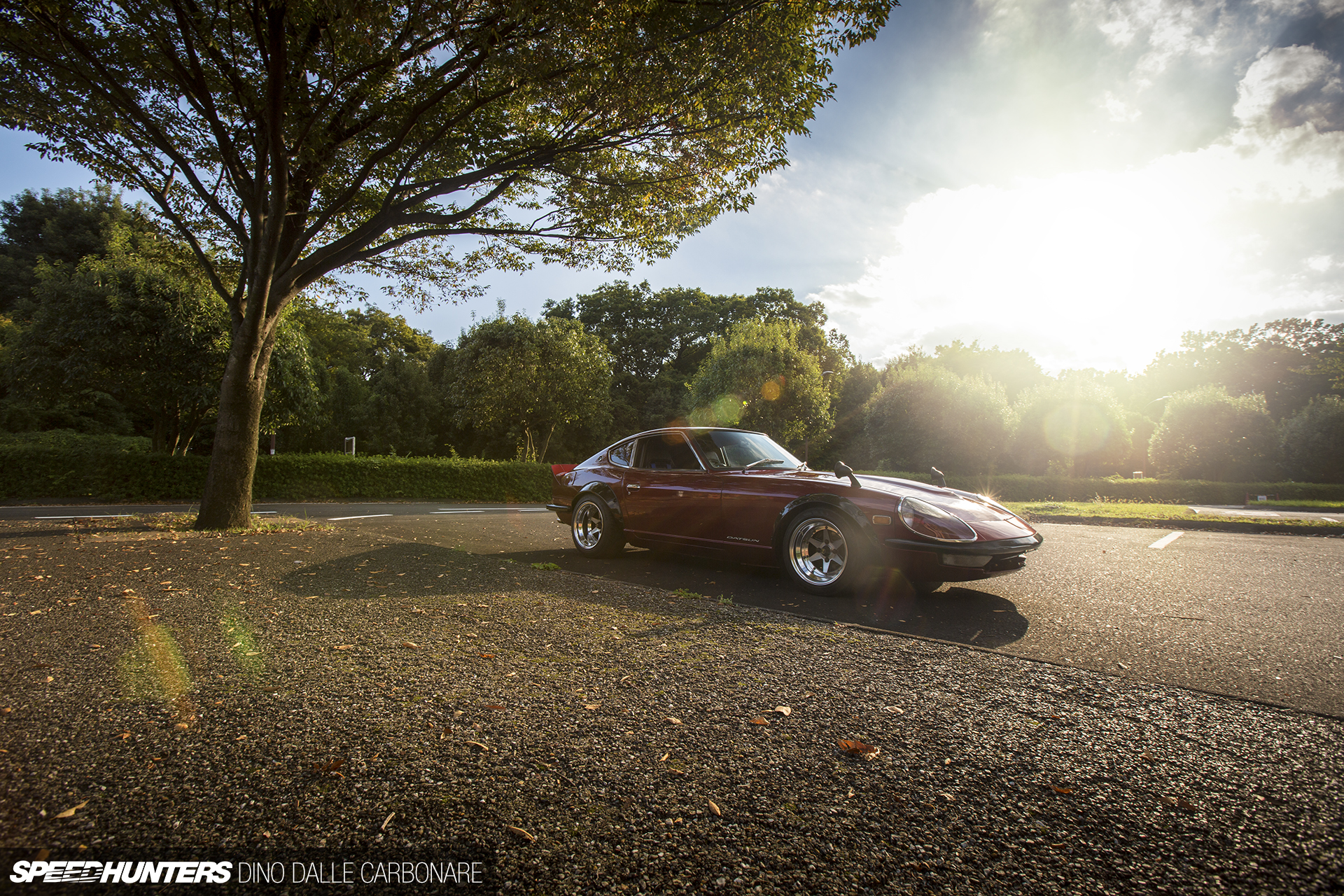
The fact that this car is an import makes it a superb base to create something a little unique with, and running the longer G-nose conversion gives it even more visual presence.

As I’ll touch on soon, the long nose actually created a few issues when it came to the engine swap, but there is certainly no arguing that in the looks department at least, it makes perfect sense.

The Datsun sports an authentic look with bolt-on over-fenders gently increasing the car’s proportions and adding aggression just where it’s needed.

The rear flares are a little bigger allowing for the SSR XR4 Longchamps to be fitted in a slightly wider size than the 15×7.5-inch fronts – 15×9-inch to be specific. Tyre-wise, you’ll find Yokohama Advan AD08s transmitting every steering input at the front end, while the rear makes do with a pair of older Advan Neova AD05s.

I’m a great fan of ducktail spoilers on cars like the Z – they add the right sort of finishing touch without ruining the vintage lines. Except this ducktail seems to be a bit taller than most I’ve seen.

And to emphasise the fact that this is not actually a Nissan Fairlady Z, but a rare, right-hand drive import, there’s a 240Z badge to set people straight.

A well cared for and sufficiently spiced-up exterior is always a nice thing to see on a S30, but if you came across this car at a big Japanese classic car event, it probably wouldn’t stand out that much.
A 240Z That Goes Brap Brap Brap
Even the quad tail pipes don’t really give too much away. It’s only when the engine is fired up and the Datsun is doing a fly-by that its hidden secret is revealed.

I’ve seen Mazda rotaries dropped into old Zs before, but never a 4-rotor. I’m not going to take the tabloid journalism route and declare this as the ‘first and only 4-rotor S30 in the world’ – maybe someone has done something similar, and great if they have. But what I can say is that this is definitely the only S30 running a custom Scoot 4-rotor motor in Japan.

And like Koseki’s own FD3S demo car, it runs the newer itineration of his engine based around four 13B housings and rotors.

The beauty of a setup like this is its size. Physically, it’s no longer than the Nissan L-series engines that we usually see in this chassis, but it’s slightly lighter and all the weight sits lower, which does all sorts of great things for the car’s center of gravity and weight distribution.

‘Custom’ is a good way to describe everything you see here, and most components are either hand-built by Koseki-san or adapted. Each of the housings sport peripheral ports, which is of course the ultimate way to make big power on a naturally aspirated Wankel engine. These ports are matched to milled and flanged sleeves onto which each of the four intake tracts bolt. They’re topped with individual mechanical throttle bodies fed by short velocity stacks, which as you can see are fitted with sponge filters to help cut down on unwanted debris being sucked in by the engine. Right below the intake ports are the exhaust ports, which channel away exhaust gasses through a one-off exhaust manifold that Koseki-san fabricated. Given the intake and exhaust ports are so close to one another, a heat shield has been added as well as some heat wrap to the exhaust side and heat-reflective material on the intake. As I mentioned before, the G-nose does cause some issues, and they’re all to do with the cooling. Even at speed, the massive core of the radiator just isn’t as efficient as it would be if it had more airflow passing through it, but the two electric extractor fans at least help in that regard.

Given its position at the front of the engine bay, the alternator suffers from the heat too. Koseki-san has fixed this with some large-diameter flexi-pipe.

With two spark plugs per rotor, there’s a lot of igniting that needs to be done, which is where the eight remotely-mounted coils come into play. The custom engine package is controlled by a Vi-PEC V88 ECU, which has no problem handling the ignition and fuelling maps for the 4-rotor. Koseki-san has certainly come a long way on the engine management side of things; I recall him using a pair of A’PEXi Power FCs on Scoot’s 12A-based 4-rotor prototype engine he built back in 2004. The result is 530PS in a car that probably tips the scales at around 950kg.

What’s the greatest thing about rotaries? The sound, of course! However, with what some may classify as a ‘normal’ exhaust setup running your usual silencer or two, you would never quieten the raw bark of an engine like this. That’s where Koseki-san had to really think outside the box as one of the main goals here was to end up with a totally useable, street-legal car.

In theory it was pretty simple – there was a need for multiple silencers and big ones at that. In practice, however, it was a bit of a headache. Finding the space to house these extra cans meant that the factory fuel tank had to be ditched all together. The spare tyre recess was cut out and sealed up with a flat sheet of steel, and above that there’s now an ATL 60L fuel cell. Where the stock tank once was is now home to the rear end of the exhaust system featuring three large mufflers. It’s a work of art and actually manages to muffle the noise rather well.

The exhaust is finished off with four oval pipes, which may make the car look like it’s running a V8 swap.
Hit play and hear it for yourself though! The engine isn’t fully mapped yet so it’s a bit rough and unresponsive when cold, and you may pick up some of that in the last portion of the video.

Hearing that unmistakable engine note certainly makes you look at this 240Z in a whole different light, doesn’t it?
The Finishing Touches
The Datsun sits on a set of height adjustable Star Road coil-overs. Yes, it could be lower but then the underside would be kissing the road way too often.

With a new-found 500hp per tonne on tap, the factory S30 brakes were in obvious need of a beef up, which is where R32 Skyline 4-pot calipers come into play. They’re good enough to keep you from sweating too much, and manage to fit inside the 15-inch SSRs. The rear drums have been left stock.

The familiar S30 cabin has been treated to a few select upgrades, starting with a carbon fiber cover for the dash, which adds a modern touch to the interior.

The Datsun Sports steering wheel is always a great classic addition.

Since the engine revs up and down faster than a V10 F1 motor without a flywheel, there was the need for an accurate tachometer – hence the Kameari upgrade. Koseki-san told me that the engine can safely rev to 10,000rpm, but the redline has been set at 8,000rpm (400rpm after peak power is achieved) for longevity’s sake. More modern instrumentation follows with the digital speedometer and some temperature gauges.

The leather seats are supportive and very comfortable, and for when the car is used in anger Willans harnesses are always at the ready.

The repositioning of the fuel tank means that the car has pretty much no trunk room, except for whatever space is left behind the seats.

I couldn’t stop looking at the car from the rear. It may look like many other S30s, but there are a few touches that hint towards the extent of its modifications. Those old AD05s at the back looked slightly past their use-by date and a tad on the narrow side to juggle 530PS and 50kg/m of torque, but it must be one hell of a drive!

Is re-powering such an iconic Datsun with a custom Mazda rotary a travesty? Of course it isn’t. This is the stuff dreams are made of – a crazy idea turned into reality.
We salute people like Koseki and the owner that commissioned this build; this is precisely what we like to see come out of Japan. More of this please!
Dino Dalle Carbonare
Instagram: speedhunters_dino
dino@speedhunters.com
Scoot 4-Rotor Datsun 240Z
Numbers
Max Power: 530PS @ 7,800rpm, Max Torque: 50kg/m @ 6,400rpm
Engine
Scoot custom Mazda 4-rotor engine, 13B rotors & housings, peripheral ported, Scoot apex seals, Scoot eccentric shaft, Scoot custom exhaust manifold, Scoot custom exhaust system with triple silencers and resonator pipe, Scoot quad intake pipes with mechanical throttles & velocity stacks, sponge filters, Scoot 4-rotor ignition, large-core radiator with Flex-a-Lite electric fans, ATL 60L race fuel cell, Vi-PEC V88 engine management system
Driveline
Mazda FD3S 5-speed gearbox, Exedy carbon twin-plate clutch, R200 rear end, Nismo LSD
Suspension/Brakes
Star Road height adjustable suspension kit, harder bushings, R32 Skyline front 4-pot calipers
Wheels/Tyres
SSR XR4 Longchamps 15×7.5-inch (front), 15×9-inch (rear), Advan Neova AD08 205/50R15 (front), Advan Neova AD05 225/50R15 (rear)
Exterior
G-nose conversion, front & rear fender flares, ducktail spoiler
Interior
Leather seats, carbon dash cover, Datsun Sports steering wheel, Kameari tachometer, Daytona digital speedometer, Auto Gauge water & oil temperature gauges, ATL fuel gauge, Cusco carbon/aluminium shift knob