
When you start making a car your own through various modifications, you generally focus on the physical side of things like wheels, suspension and seats, making decisions about all the stuff you can bolt on and in it. But when you look back a decade later, it’s a different story. Literally, because it’s the stories that stick in your head, and you can never predict them.
For me, this one started in a shed nearly 20 years ago.

But the story of this Land Rover isn’t mine; it’s shared between a group of us. And by ‘us’ I mean all car people, so you’re in this now too.

The shed I referred to was ruled by a friend called Steve Dyer, who wanted a hot rod. The trouble is in the UK, when you’ve not got a lot of money hot rods can be an expensive proposition.

But wade through some traditional historical guidelines, add an incredibly rare piece of metal, the desire to p*ss off some purists and a random route through nearly two decades of different owners (one of which was me), and you’ve got a story.

Yup, this a bit of a personal dream come true. It was always my intention to shoot the hot rod for Speedhunters, but when Larry was in London for some Speedhunting back in Spring 2015, I managed to introduce him to my friend Bruce Holder who owns the Land Rover now.

Then some Porsche nut called Magnus decided to have a meet at the Ace Cafe. Although it was meant to be a Porsche-only affair, Bruce took the rod along after Magnus had seen some pictures and figured it would be cool to mix things up. And here’s the result: one of my favourite photographers, taking pictures of one of my favourite things, and I get to write the story.
That’s a win-win-win in my book. Because as you’ll no doubt understand, projects like this don’t just get ‘built’. They evolve over time from a germ of an idea, so it would be a shame to just list off the tech spec and make some assumptions. Oh no, let’s get back to the logical start point and the reason ‘why’.
Home-built Hero
In the hot rod world, which I guess most people would see as being rebellious, there are some universal rules that kind of bind things together. One of which is the use of a pre-1949 body style to allow you the use of the label ‘hot rod’, and that’s generally accepted as something made no later than 1948. Now, I totally get that there is a massive debate over what a true hot rod is, so I’m not going to get in to that here.

But 1948 is conveniently the first year of Land Rover production. Which is what Steve, who I mentioned back at the start, was in to, and still is actually. He grew up on a farm in Somerset, in the south west of England, which means two surefire things: one of your 5-a-day as a teenager was cider, and you had a story about learning to drive with an old Land Rover in a field somewhere.

Reading car mags taught us all about how people around the world were doing things, but in our little corner of England early model Fords were scarce and expensive. So when Steve came across a genuine 1948 grille and other front end alloy parts, he figured that was enough to spark a build that he could call his own.

Remember this is before we all got lost on the internet; before ‘rat’ become a term, patina a label or Instagram gave us a constantly open window into other people’s lives. This build was born in a barn, with a bunch of mates and some basic tools. I wasn’t a regular visitor to the barn, maybe every other month or so, but I remember seeing a naked chassis laid out and ideas being thrown around.

The plan was to start with the chassis from a 1960 Rover 80, which has a lovely kick up at the back that lends itself to having an axle tucked up under it. Steve also had a bunch of them lying around. Plus, the engine that would have originally been in the 80 was derived from a Land Rover four-cylinder motor, being from the same family.

The 15-inch steels at the front are another clue that not all is normal underneath. People naturally assume that it’s a Series 1 which has been drastically lowered, but that’s not so. It was built like this. The Rover 80 chassis runs all the way forward, and as the front suspension was retained the standard disc brakes were used too. A no-brainer choice of underpinnings then.

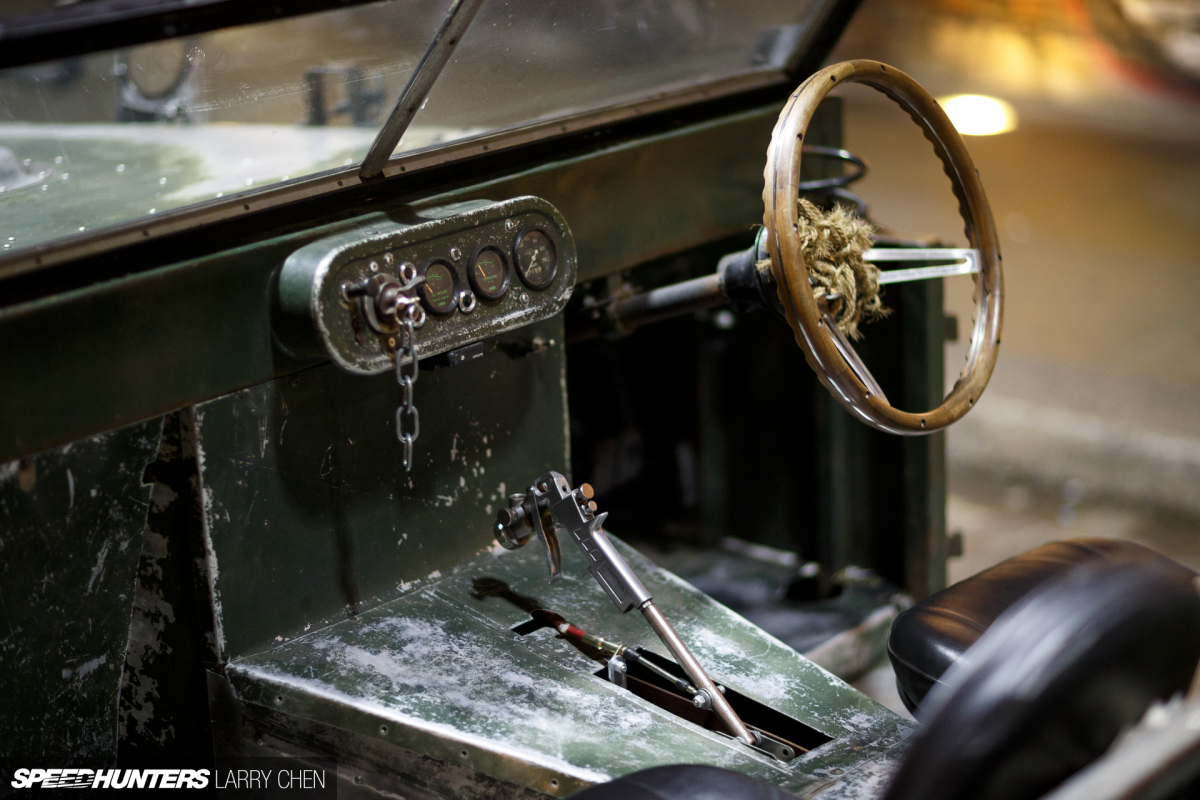
The bulkhead gives the game away really, as it’s way thicker than it would have been if standard. This means there’s room for the 3.9-litre Rover V8 in the front and things like your feet. The heavily raked screen has been cut down since Steve’s days, when another friend, Clive, bought it from him.
History In The Making
Steve had the ride height a couple of inches higher than this when he had it back in the early ’00’s, and I guess he sold it around 2003/4. That’s when Clive took some height out of the front springs. It does ground-out, and I once got stuck on a Belgian petrol station forecourt; but it’s actually not as bad as you’d initially think. As Bruce says, “Despite its appearance, the suspension has been tweaked to make it a much smoother ride than you’d ever believe. Yes, it does get caught out by the odd pothole, but overall the ride is far more forgiving than it has any right to be. And, no, it’s not on air.”
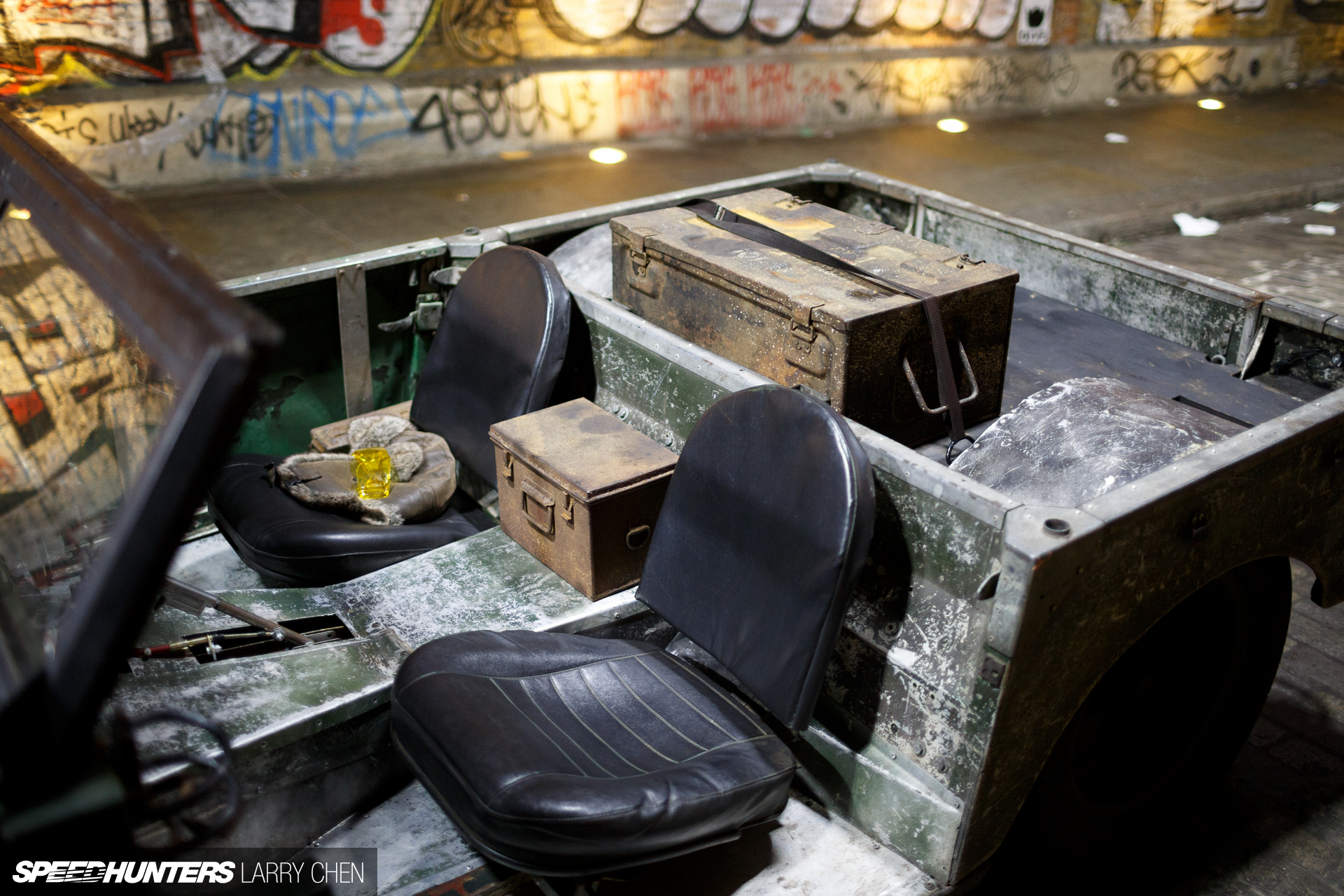
Bruce took over as custodian around the start of 2012, and since then he’s kept the spirit of the Land Rover very much alive whilst improving pretty much everything you can’t see.
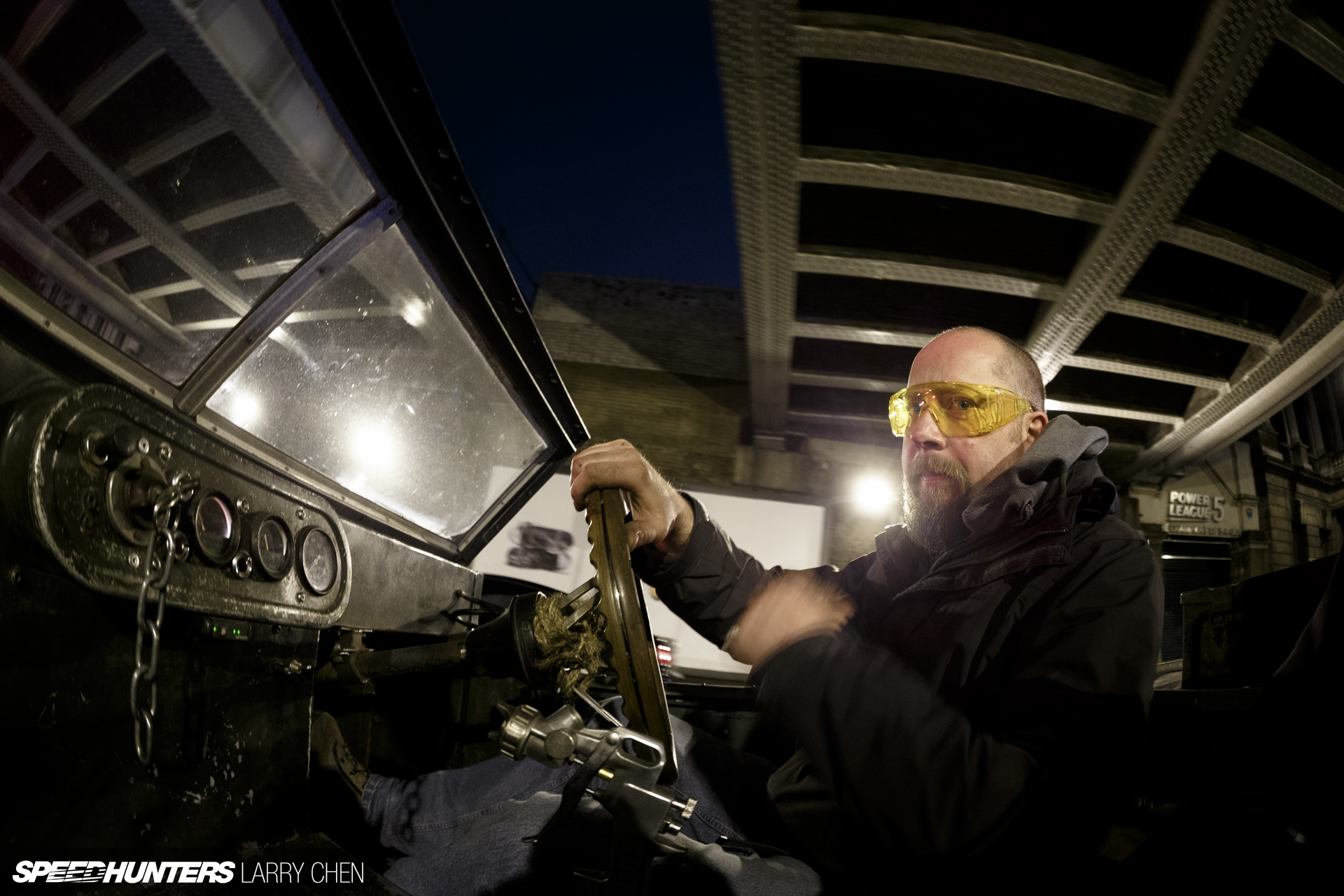
He’s like that, you see – he ‘gets’ it. He’d watched me have my fun with it, and it was on his radar well before that too. Because going back to the start of the story, the parts are interesting, but the stories they’ve generated could fill this website.

And that’s why I love this old thing. That spray gun shifter for the auto transmission is to poke fun at the people who ask about when it’s going to get painted. Bruce needed something to grab D with after upgrading the transmission and this seemed like a natural choice. Funnily enough, the spikey Moon shifter knob I had fitted is still sat next to my desk as I write this.

The body is distinctly Land Rover, the grille genuine 1948, with the wings, bonnet and front bumper being a mix of slightly later parts melded together.

The rear body tub is ’48 too, with the very distinctive early D-shaped rear light lenses on each side. That body work has seen more life than I ever will.

And that’s the thing here; without getting all emotional on you, this Land Rover transcends being a vehicle. It makes kids and grown adults point and smile. Everybody has a story about their favourite Land Rover, even though they never really understand what they’re looking at.

Whilst all the while it sits there being thoroughly bad ass, because you have to be committed to drive it. You have to want to do it. Bruce was 120 miles from home when these pictures were taken, having just popped out for the evening.

It commands your attention, but somehow makes you feel secure. Your exposure to the elements heightens the experience so much. There are no seat belts, no roof or door tops, and quite often that screen is folded forward and the full force of the wind is in your face.

The connection with your surroundings is sublime; it’s like a V8-powered roller skate. For two. Which means you get to share the experience.
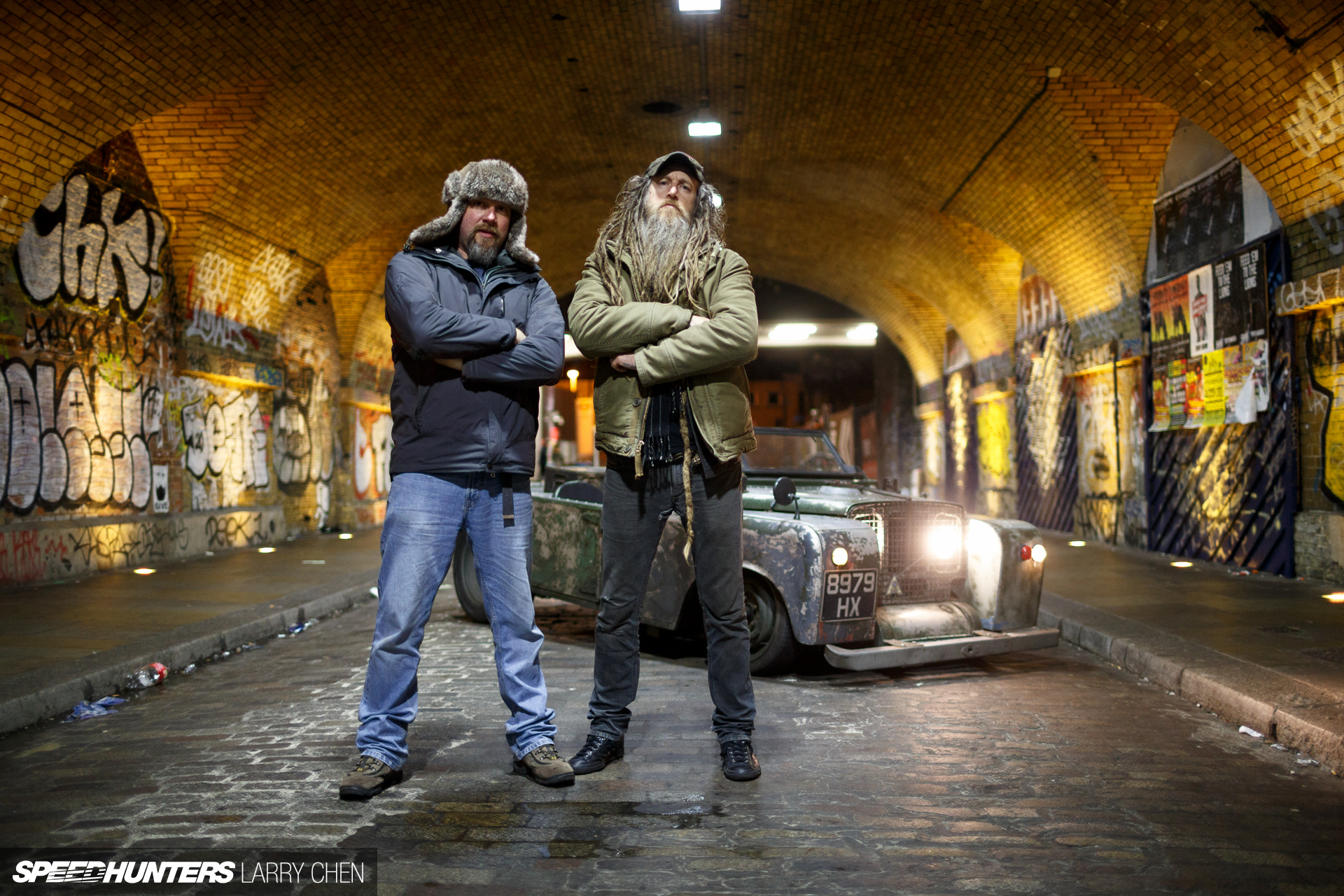
Everybody has an opinion when it comes to the Land Rover, but as Bruce sums it up, “I have no problem with people not liking it, even positively disliking it. Everyone is entitled to have their view on the car and I am not naive enough to think everyone will love it. I do, however, get really annoyed when people say it’s ‘ruined’, because that shows a complete lack of understanding of what the car really is, where it came from and what it would have been today if it hadn’t been saved. They seem to think a perfect, or even usable Series 1 was hacked up to make this car.”

But now you know it wasn’t; this was a pile of parts brought together to create so much more. One thing we all have in common is the way it begs us to drive it. “The thing I love most about it is using it,” says Bruce. “Just driving it, in any weather and at any time of the year, be it just to go to the post office or visit friends in London, or pick stuff up from the DIY store – normal everyday things. I get the most joy from being behind the wheel and using it as and when I feel like it. Not for any reason, just because I can.”

So there’s a quick glimpse into what happens sometimes when what you might set out to do becomes something so much greater than you first imagined. The soul of a project is often what defines it, and this one has a very unique soul of its own.

Which means nobody ever really owns it, they just hop on for a ride and see where it will end up. One day Bruce might want to sell it, or he might just carry on developing it. But in the meantime he’ll keep on investing in memories like the ones made on the evening when these pictures were taken. “Driving it in heavy rain, on the motorway, in the dark, in December, with the windscreen down – I imagine it’s what Han Solo feels like when jumping through hyperspace in the Millenium Falcon with all the windows removed,” he says.

There is no moral to this story, other than maybe next time you plan a project, forget the shopping list and invest in some quality time with your car. Get out there and enjoy it. Meet up with friends, drive fast and talk to strangers.

This mixed up, home-brewed hot rod taught me a lot about having fun, and for that I thank Steve Dyer, Clive who sold it to me after his time came to an end, and now Bruce for looking after it so well.
Long may you continue to rock on, old friend.
Bryn Musselwhite
bryn@speedhunters.com
Instagram : Twospeedbryn