
Every individual with a healthy obsession for automotive tinkerings has their unicorn. The rare, the expensive, the unattainable, or in some cases simply unusual enough to warrant being acquired as their ultimate garage filler.
It’s often that those with an affinity for a particular marque or even model have their hero car. If you’re a Skyline aficionado for example, you might pine for the ultimate evolution of the R34, Nismo’s barnstorming Z-tune creation. But at the other end of the scale, the British-Leyland weirdo might scour classifieds well into the night in search of an Austin Allegro estate that was only available in a particular shade of puke-yellow for three calendar weeks of 1977.

Let’s say you’re something of a Toyota loyalist. For the vast majority of your car-owning history your chosen method of four-wheeled fun has centered on the brand best associated with steadfast reliability, stratospheric sales figures and generally epitomising the motor industry of Japan. More accurately though, you’ve got a special affinity for Toyotas of the older persuasion.
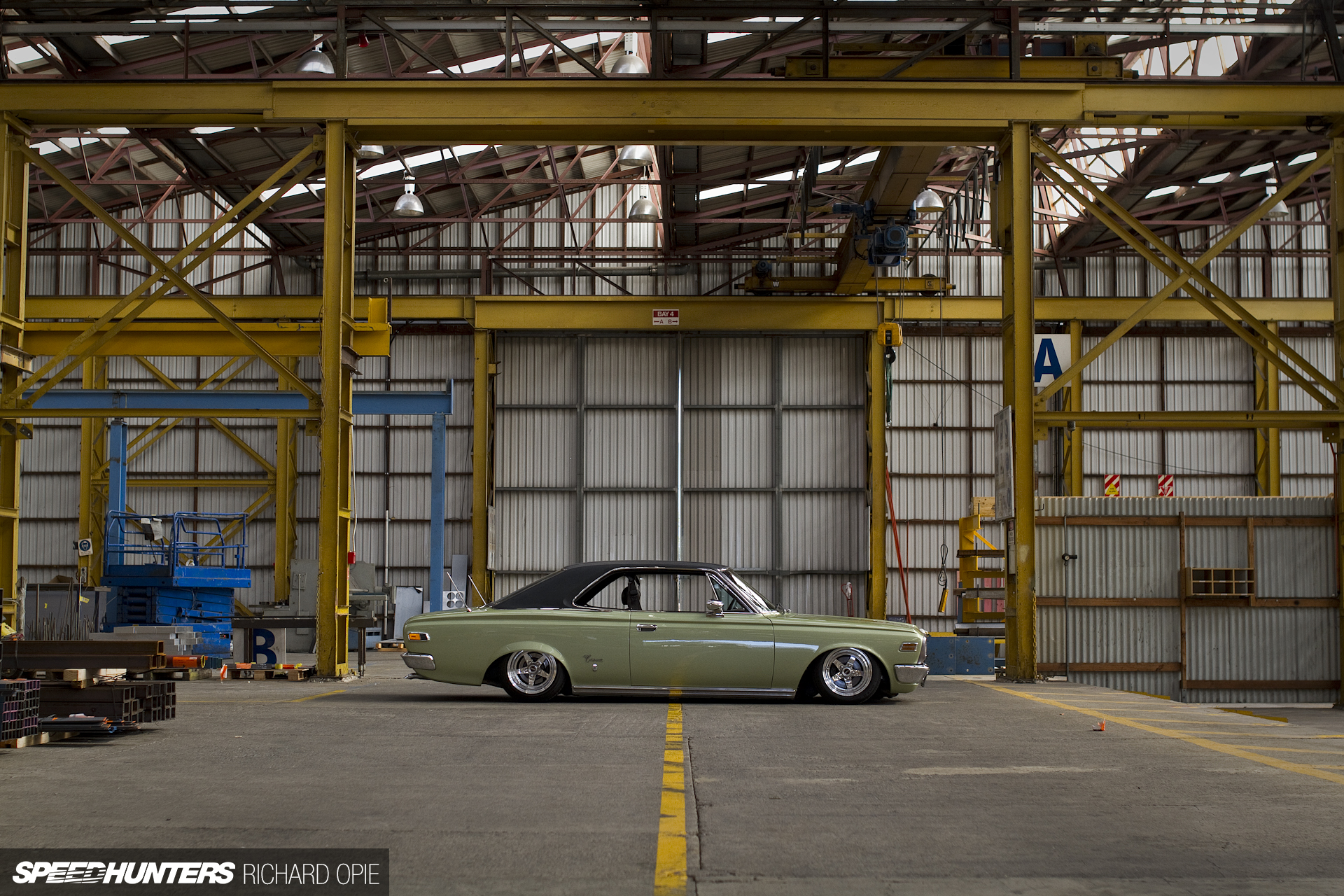
If while your eyelids were dipped, images of TE27 Corolla Levins, RA25 Celica GTs and even rock-crawling FJ40 Land Cruisers flicked past, you may well suffer the same affliction of David Arthur, who as well as being the fabrication guardian angel for my own Toyota project KP61, is also the owner and builder of this sublime MS51 Toyota Crown hardtop.
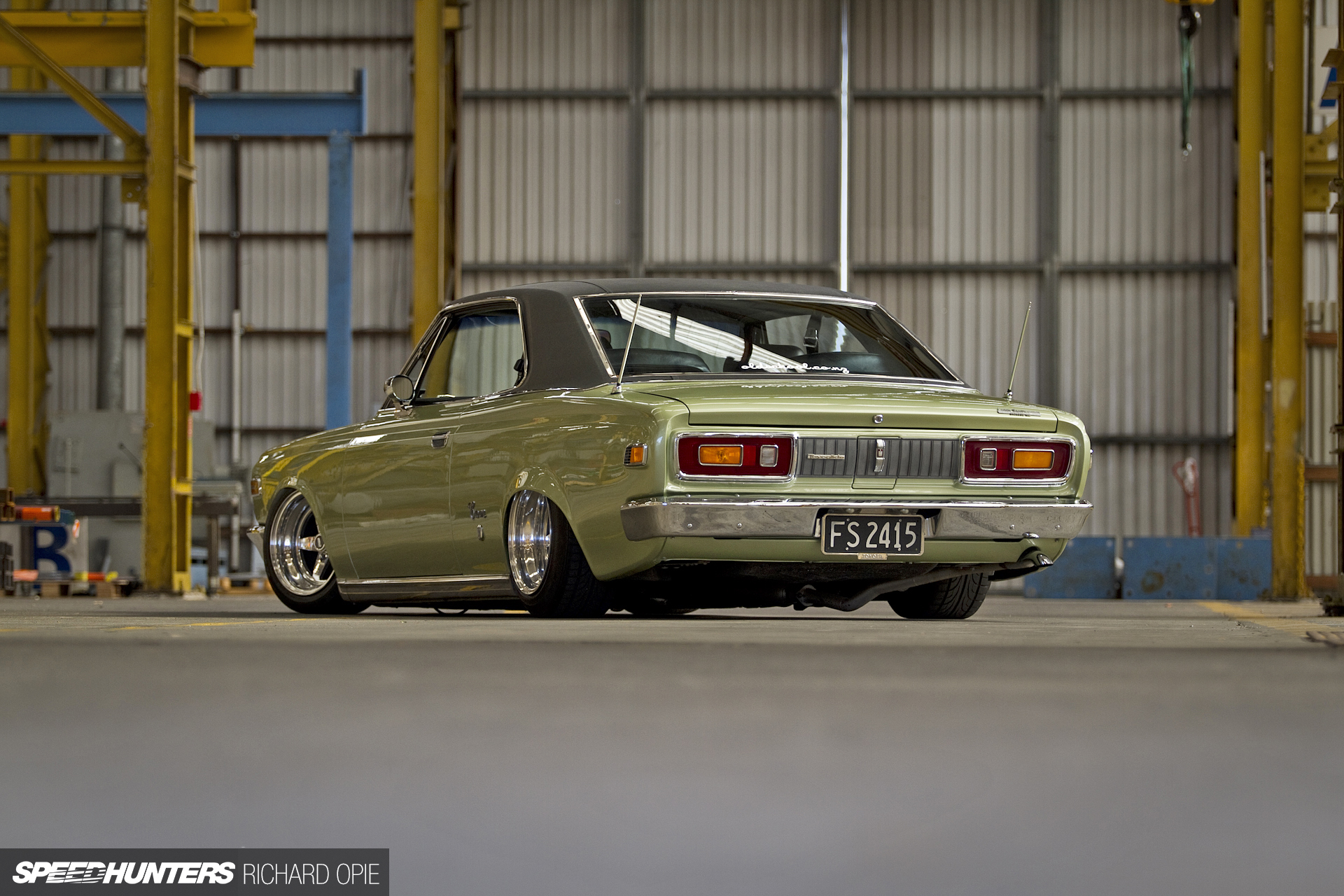
As something of a serial offender in mucking about with a variety of old Toyotas, this particular Crown – as you may have already guessed – is by no means David’s first rodeo. In fact, it represents the latest in a fairly rich lineage of well thought out and comprehensively modified Toyotas to emerge from David’s modest suburban garage. And while the Crown is the most recent, it’s also representative of something of a circle narrative.
You see, David’s Toyota journey began some decades ago now, in the days when getting the proper deals on a decent retro steed meant a 6:00am pilgrimage to the local dairy (or newsagent for those not lucky enough to live in New Zealand) for that week’s issue of the classified advertisement paper. The usual sequence would go something along the lines of – turn directly to the page concerning your favourite brand, run your finger down the columns until a suitable deal jumped out at you, then get on the phone (a landline, of course!) and wake up the hapless vendor with the insistence you were en route to view their surplus vehicle.

No longer had David hung up the handset, did his trip down the iron-oxide-ridden highways of early Toyota ownership commence in the form of a Crown – an MS65 sedan variant in this instance and perhaps something of a blueprint for the future. A plethora of the ‘big body’ Toyota saloons followed, including a solid half-dozen MS75 hardtop coupes – the catalyst for a genuine appreciation of the pillar-less style offered by the two-door Crowns.
Some years passed; the lawn was eventually cleared of derelict 60-series Crowns and the last of the MS75s was on-sold to a lucky new owner. Project priorities then stepped up a notch and were focused on a brace of 1970s Celicas (running a 1JZ-GTE and a 1UZ-FE respectively) until a slightly haggard, ‘barn find’ style 50-series Crown proved an attention grabber.
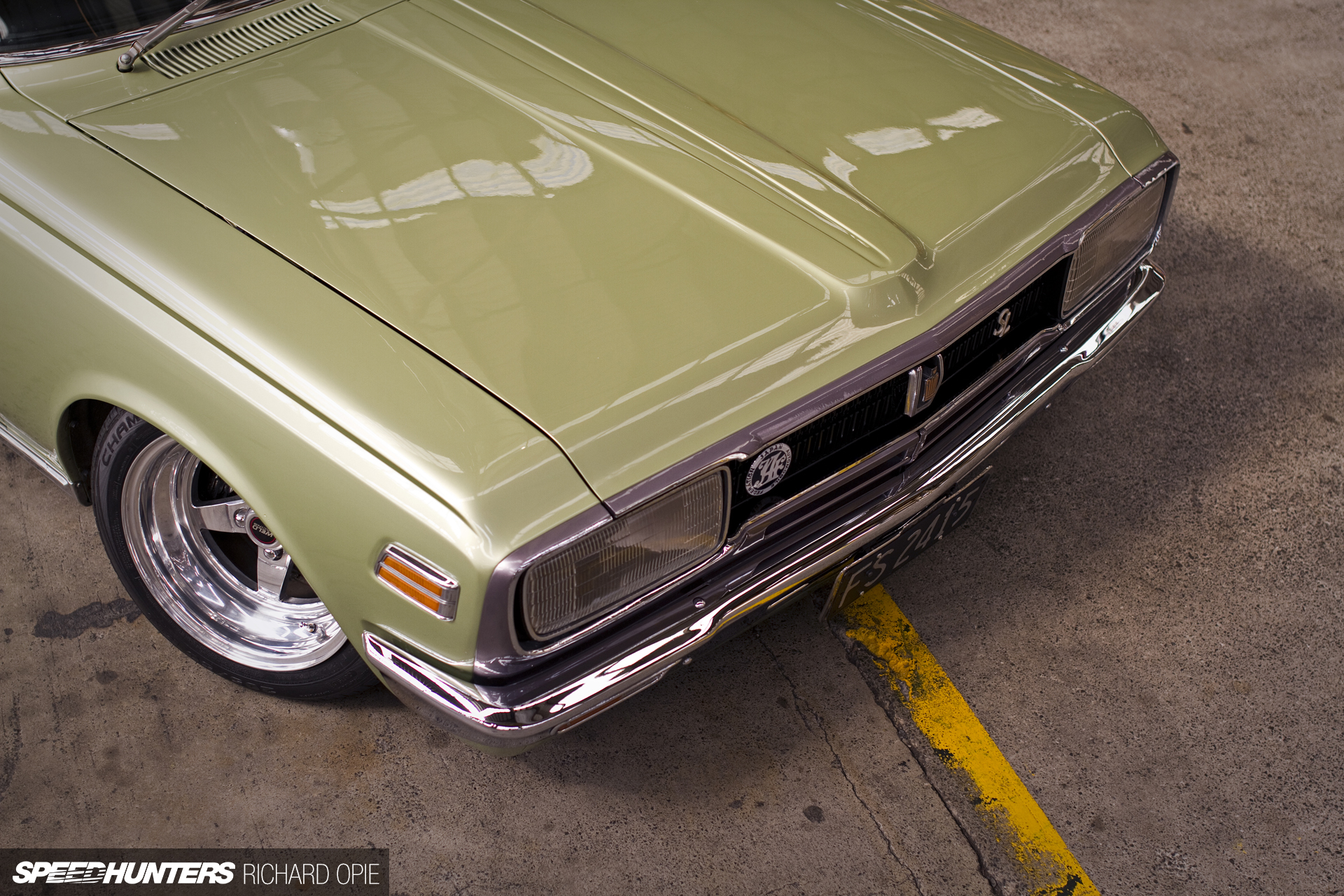
The Crown, a 1969 MS51 hardtop, was for sale and David “absolutely had to own it”. The unicorn had been uncovered. A deal was struck, the Crown was loaded onto a transporter and was soon wheeling its way the 1100 kilometres north from Christchurch to Auckland, arriving in relatively short order. Although outwardly resembling an untouched (albeit tired) example of the 1960s Toyota luxury coupe, the time-weary white paint of the hardtop encased some common – and typical – sins appropriated by many a New Zealand ‘handyman’ towards Japanese cars of the era.

The original 2M 2.4-litre straight-six engines have something of a dubious reputation for reliability, with a seemingly unquenchable thirst for headgaskets. At some stage, an industrious and resourceful home mechanic had seen fit to equip the Crown with a 265ci Chrysler six-cylinder and associated gearbox, including some transmission tunnel modification leaving much to be desired. Nonetheless, the rest of the Crown remained intact.
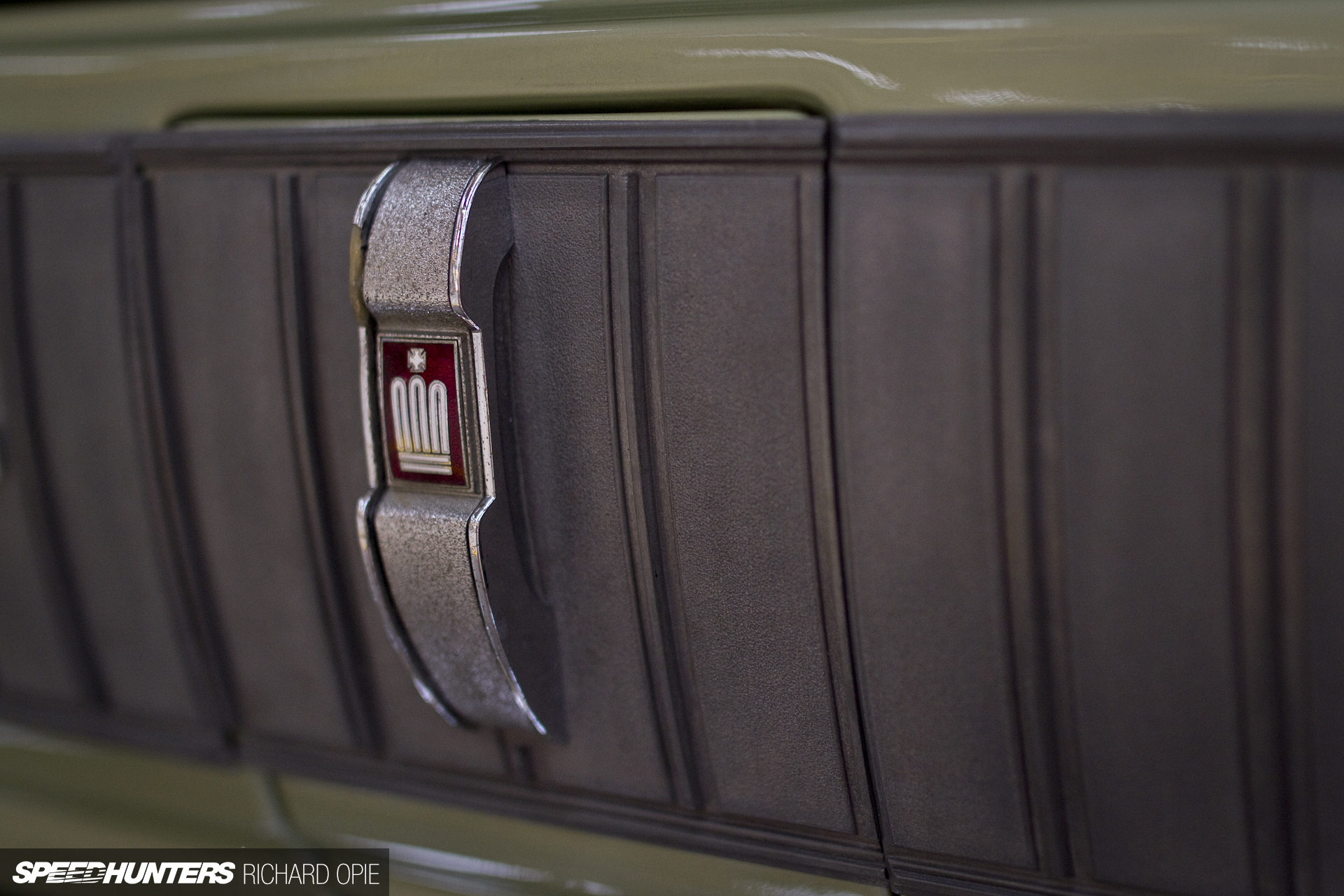
While a largely rust-free structure is a substantial drawcard to a would-be retro revivalist, an aspect that’s of possibly even more paramount importance (particularly on Japanese cars of the period that don’t have the traditional aftermarket support of their classic American or Continental counterparts) is the presence of all the little trim pieces, emblems and embossings that really characterise the styling, or more particularly the ‘over-styling’ techniques so commonly found on a 1960s through 1970s Japanese design.
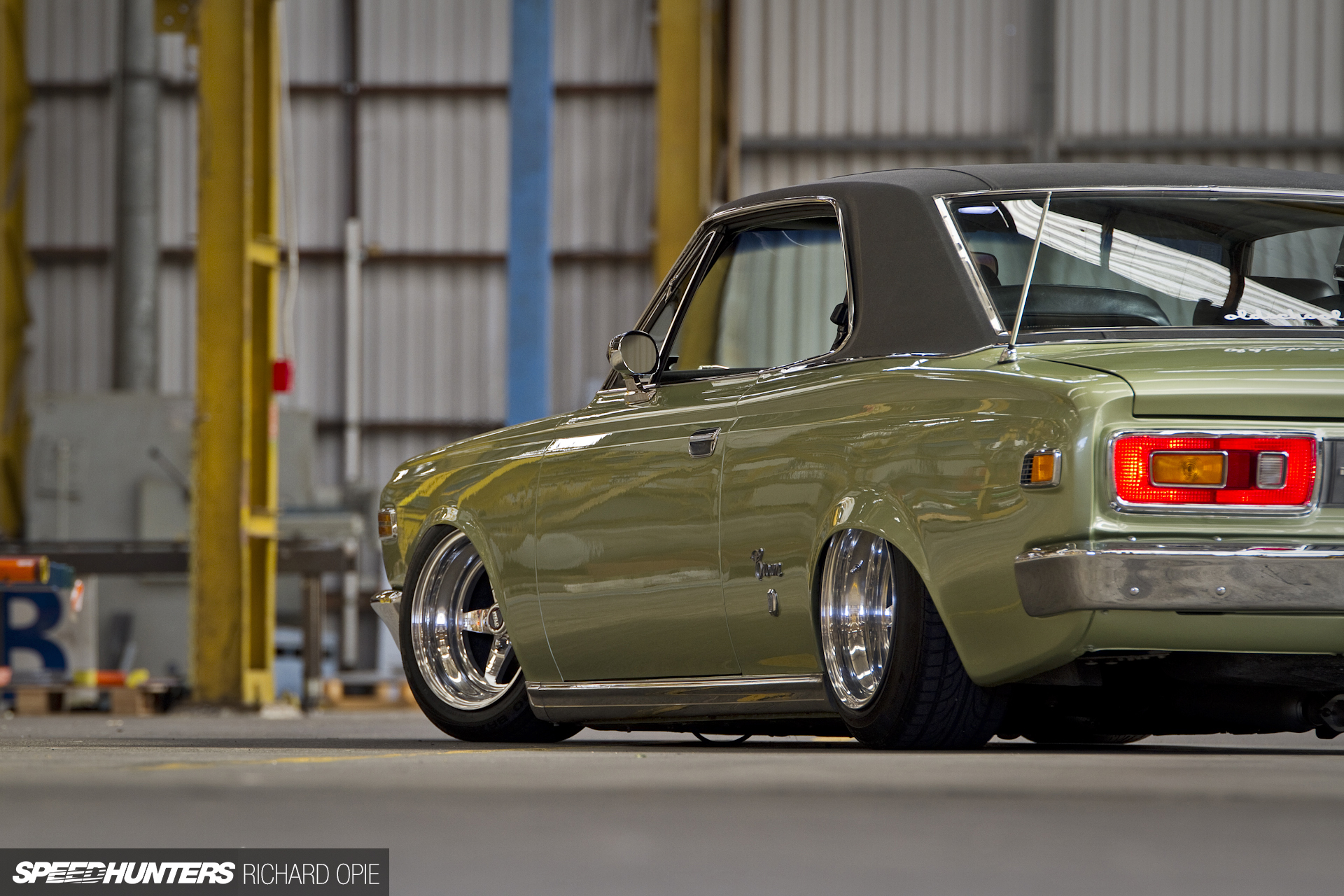
While these fussy, intricate little styling touches are so integral to the character of an MS51, the hardtop coupe style affords a psuedo-American aesthetic to the Crown, and the enduring visual theme that was to ultimately influence the flavour of the build.
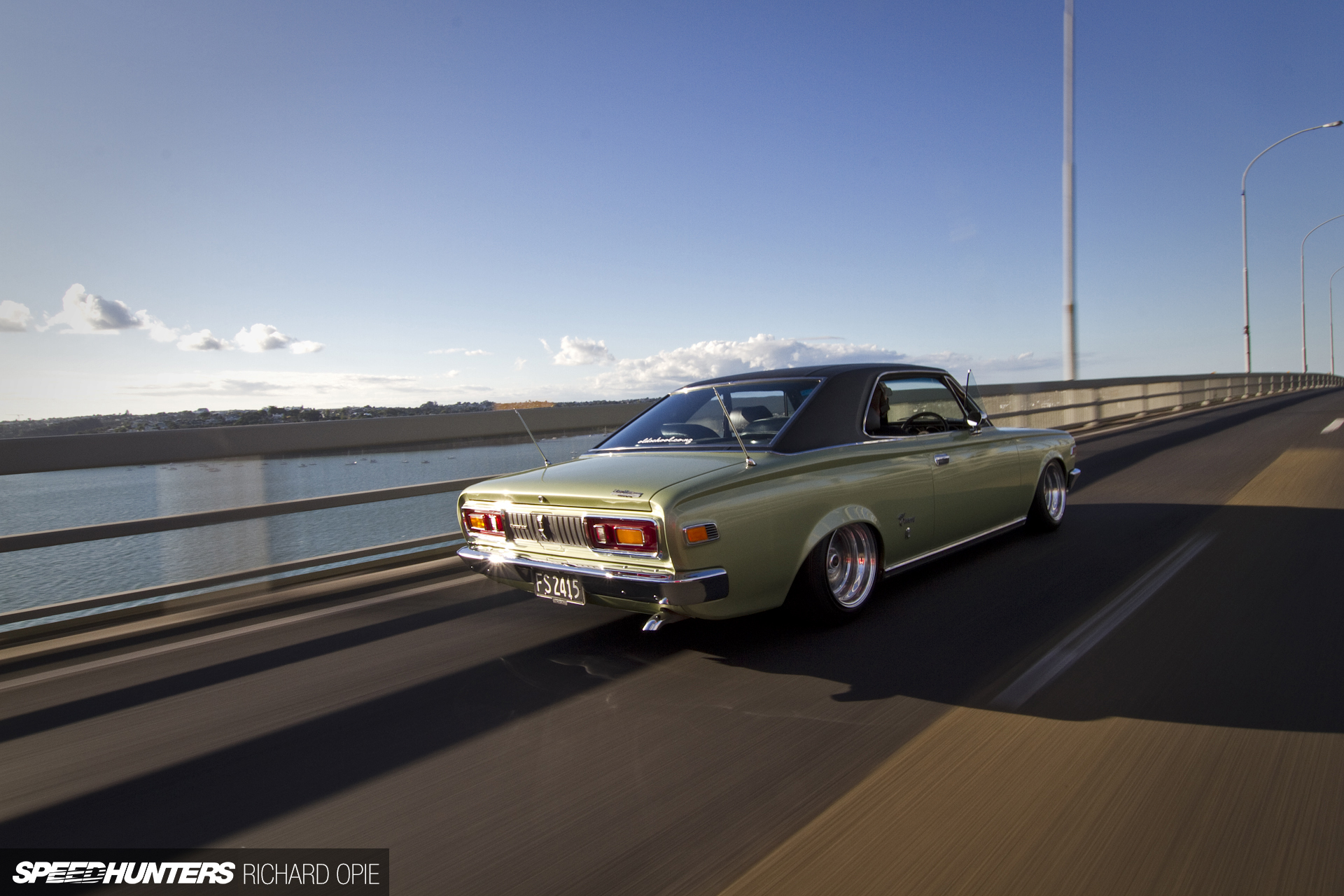
A solid, complete, barn-seasoned project base ripe for modifying? Check. With the important bits accounted for and the Crown safely tucked behind the locked garage door, yet another build was set to begin beneath the flickering lights of David’s garage; the pursuit of one man’s impeccable vision to build the perfect retro Japanese cruiser.
It’s Low Time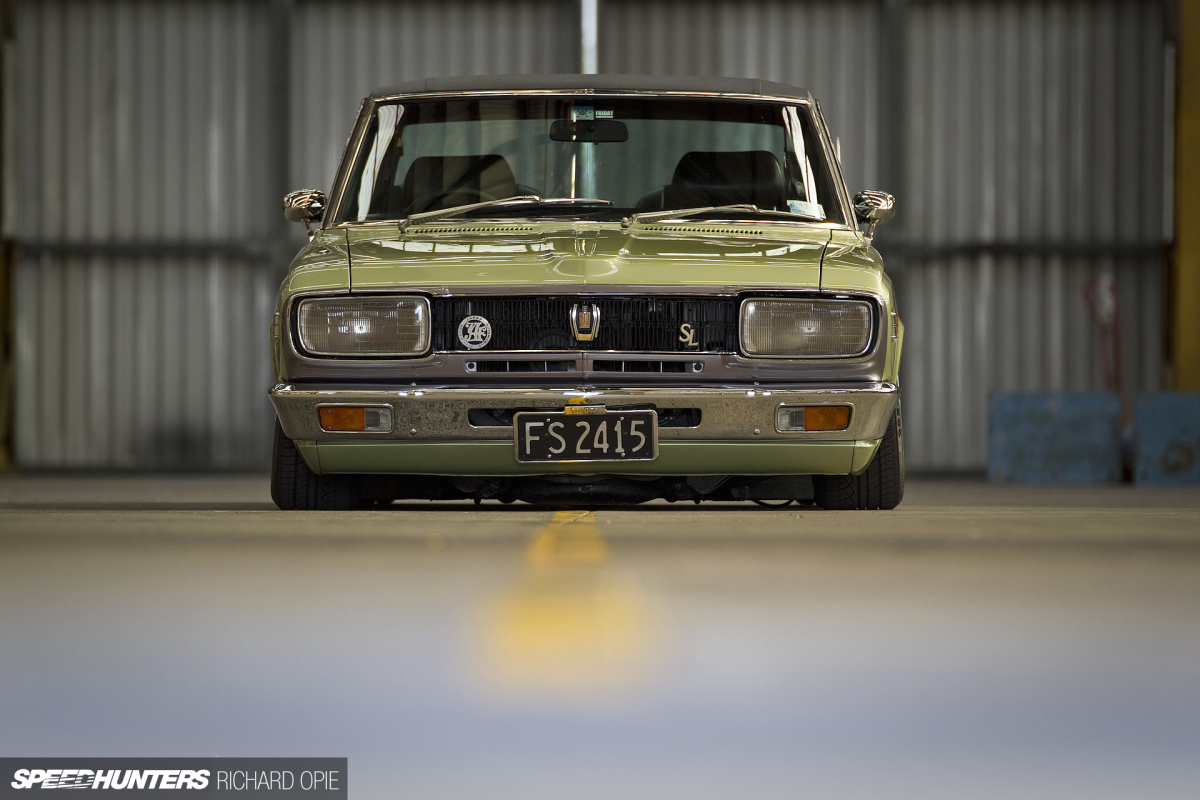
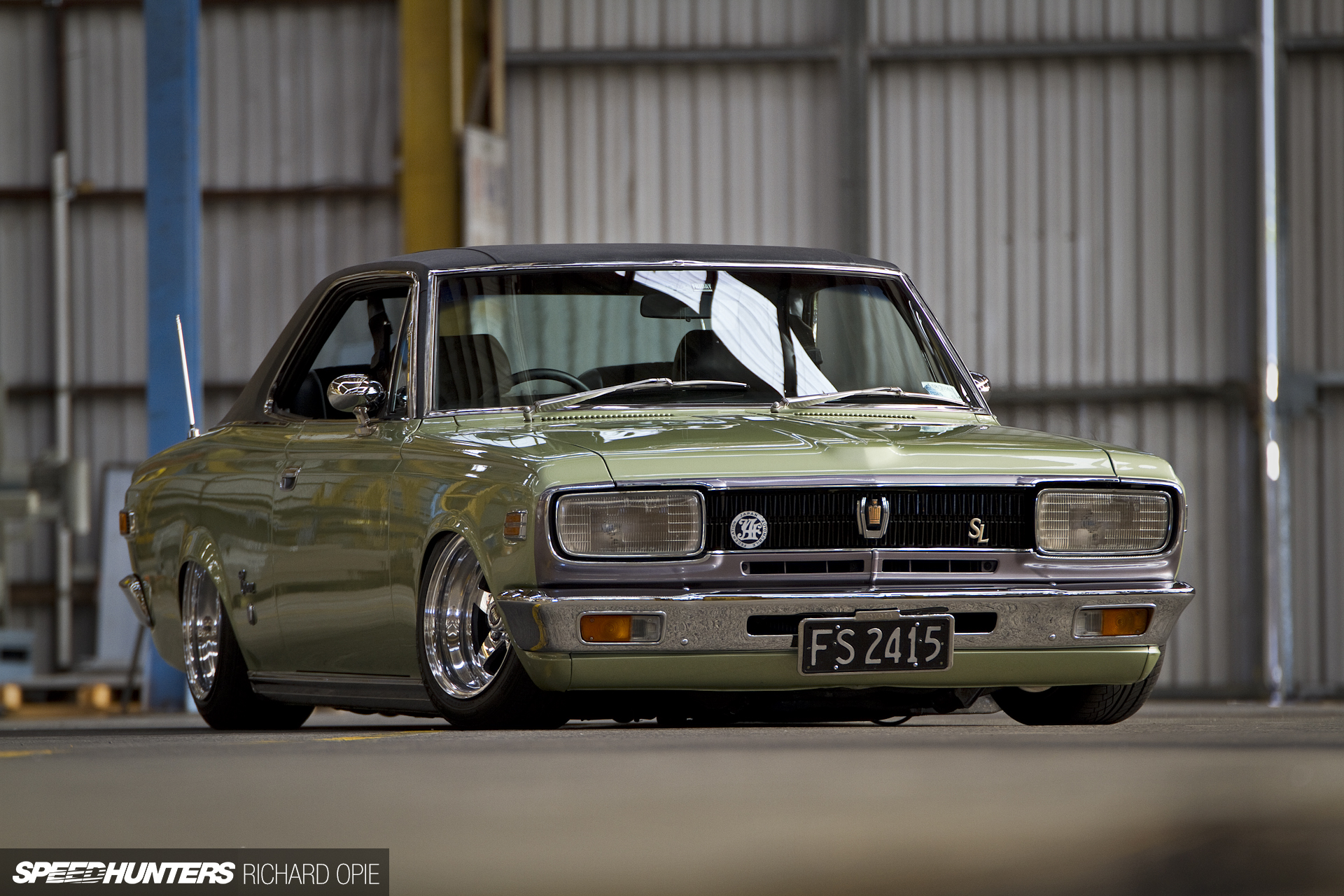
It’s entirely typical of Japanese designs of this period – especially relevant to the larger car segment – to employ styling trends influenced by the West. In the case of these particular cars, the American influence is strong, with bold chrome bumpers and highlights, intricate trim and heavy swage lines throughout the steelwork, all reminiscent of 1960s American automotive chic.
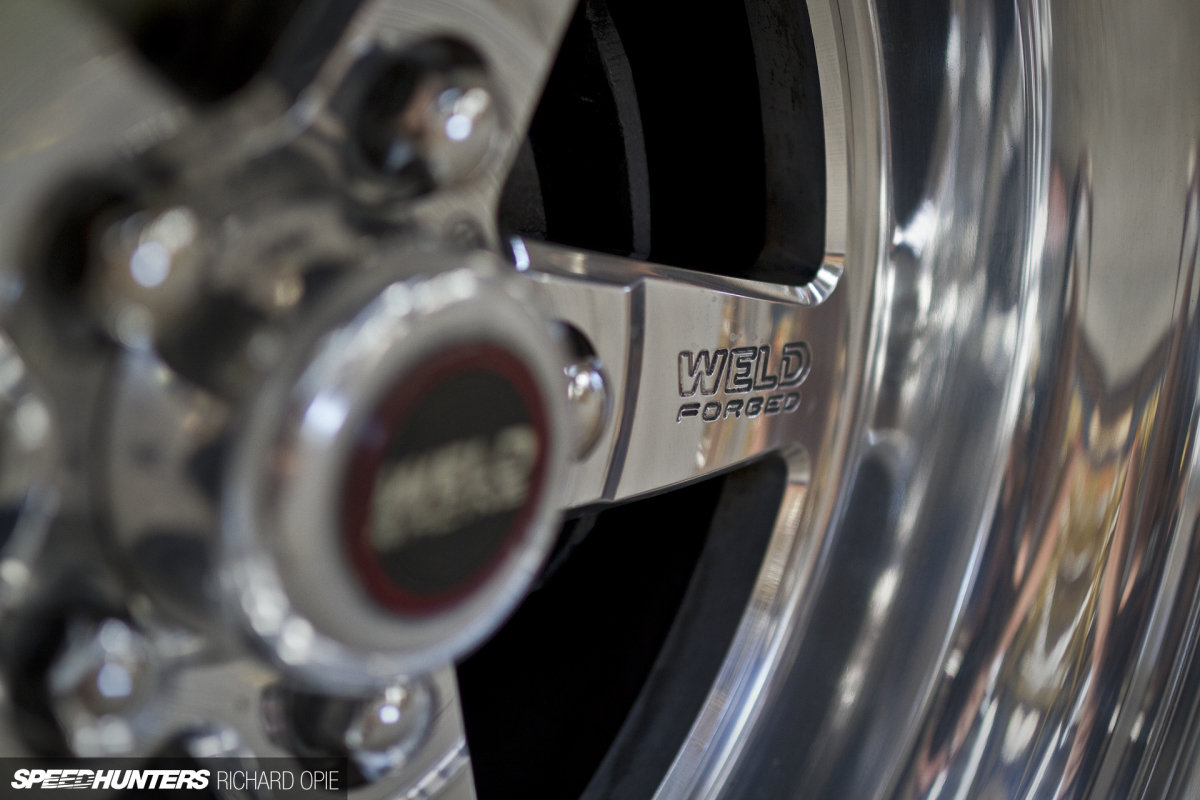
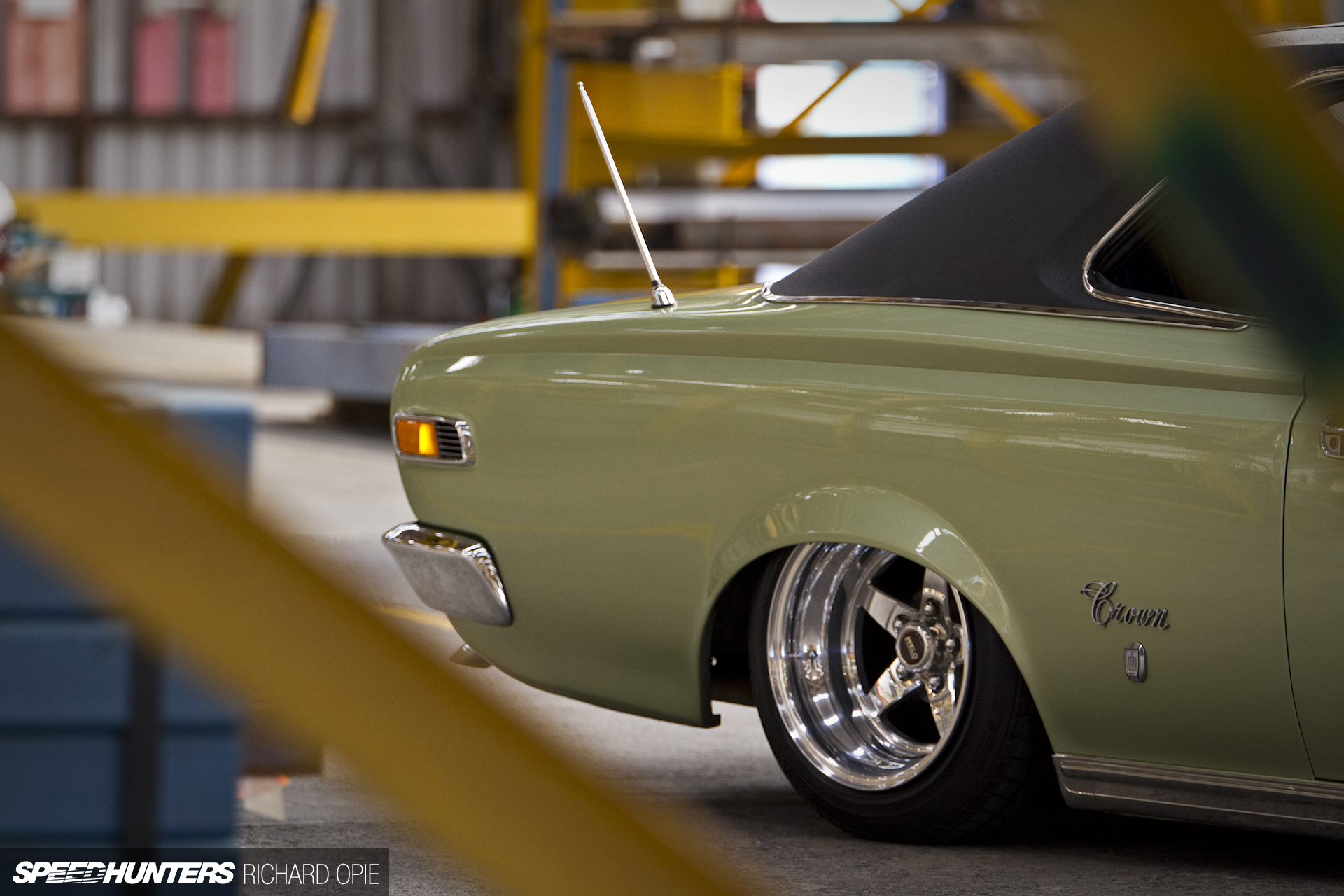
David’s Crown unashamedly embraces the styling nuances offered by the period, exclaimed no louder than through the use of rolling stock more often found gracing the arches of Detroit’s finest. Snuggled precisely under factory-looking panels is a quartet of custom crafted Weld Racing RT-S S71 P forged wheels.
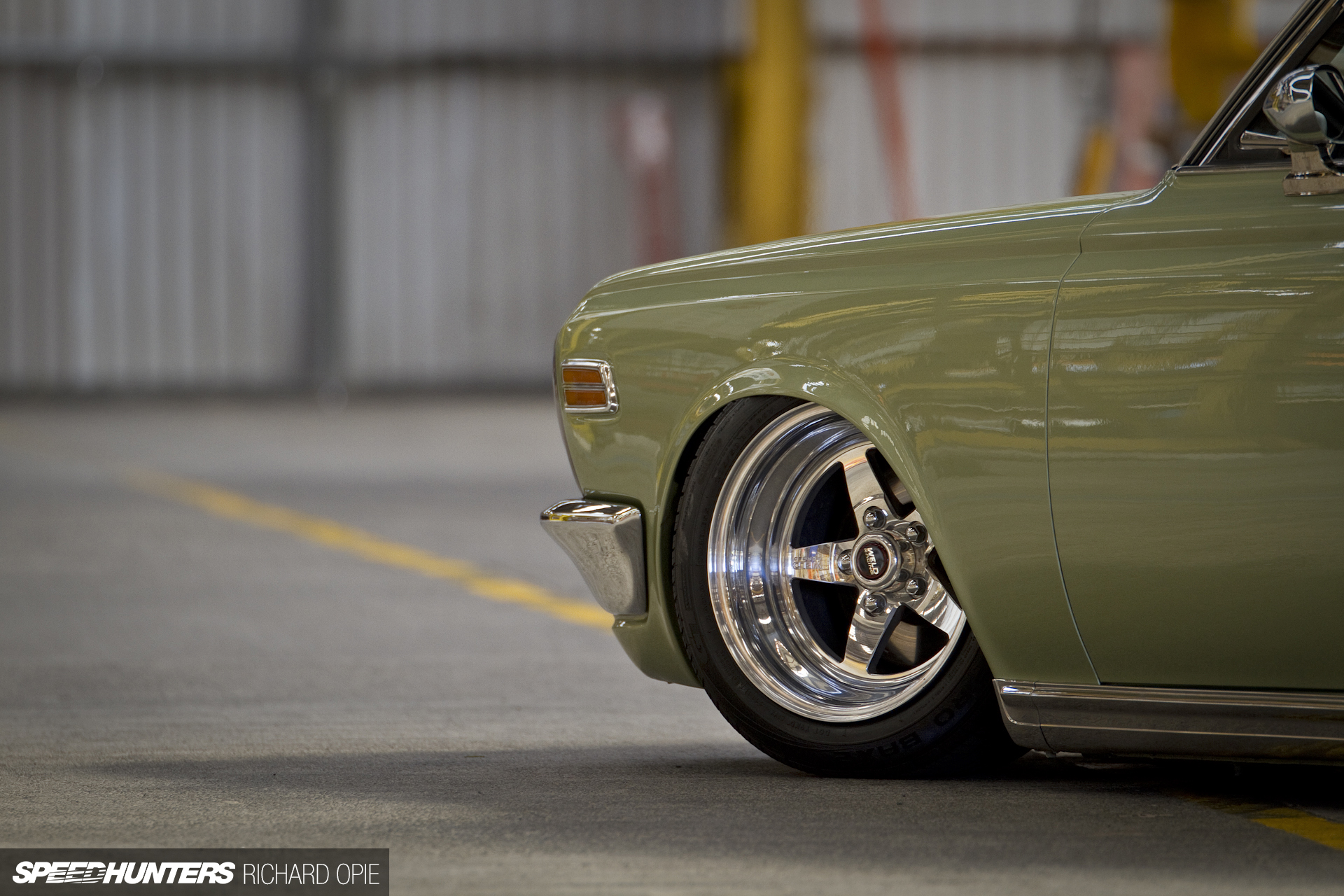
It’s this wheel selection that paved the way for the ultimate demeanour of the Crown. The Welds measure 15×8-inch at the steering end and 15×10-inch at the driving end, both with a dollop of negative offset well beyond their share. The wheel obsessors among the car community often utter, tongue in cheek, that the correct methodology of piecing together a build is to shape the car around the wheels.
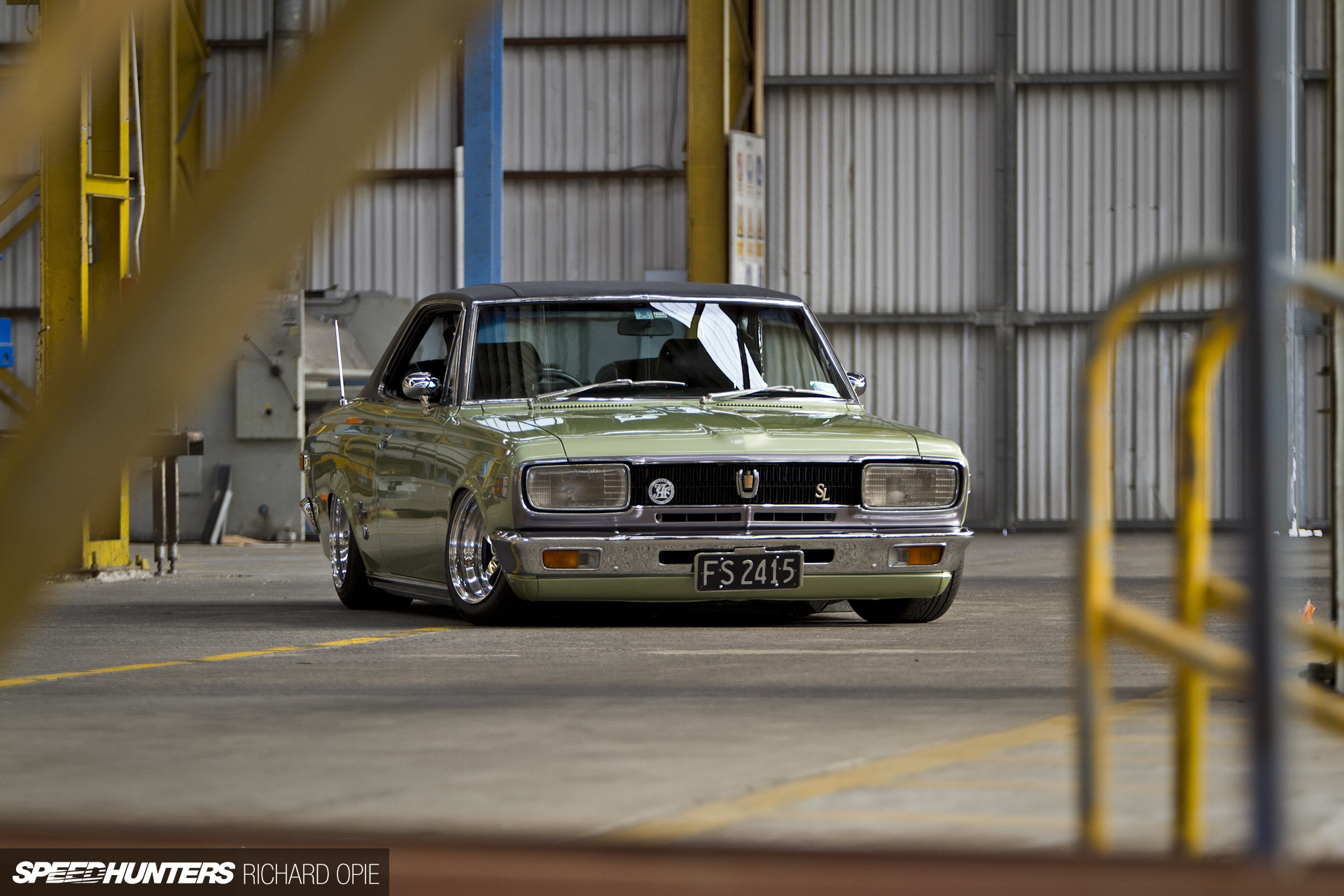
Tongue in cheek need not apply. The way those beautifully subtle Coke-bottle curves drape over the wheels isn’t achieved simply by bolting the wheels on, dropping the ride height and cruising off into the sunset. Months and months of long nights in the garage, armed with an arsenal of welding equipment, hammers, dollys, and the duration spent self-educating on the finer points of creating crisp, straight panelwork saw the Crown emerge into daylight with a quality rivalling chequebook restorations.
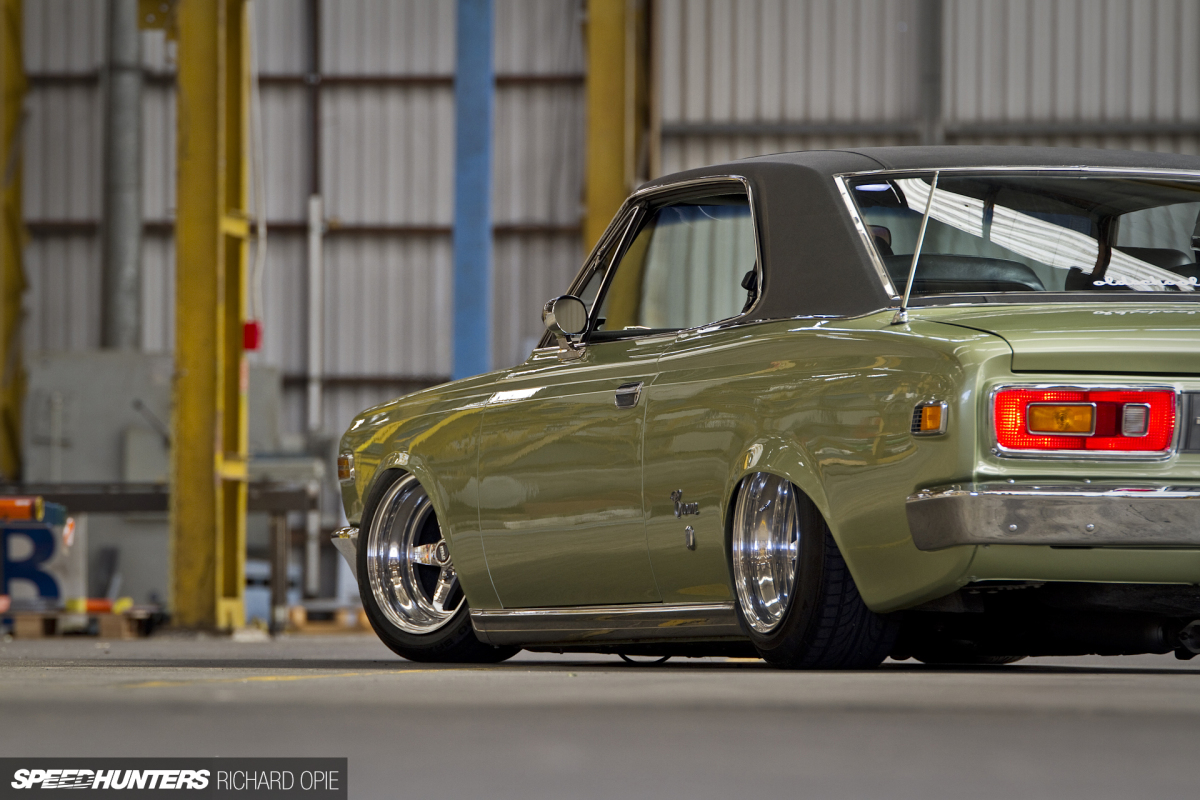
You may have noted I mentioned the panels were ‘factory looking.’ To the uninitiated the arches in particular may look as Toyota intended almost four decades ago. After an eternity of pulling, hammering, stretching and some cutting however, the all-steel arches now encompass the forged rollers to perfection – tucking deep into the bodywork while aired out, yet maintaining a perfect tread-to-lip clearance at ride height.
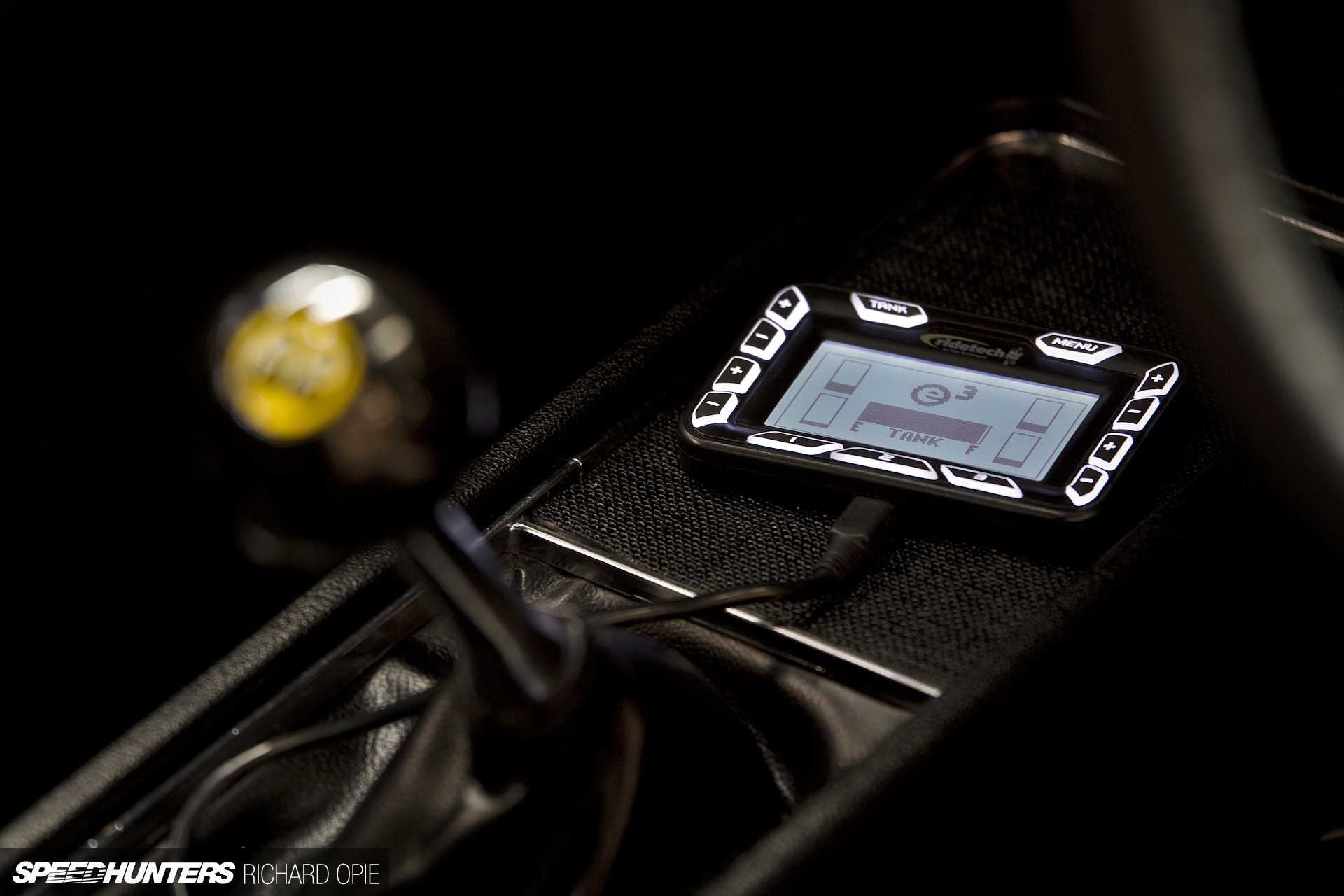
And what about that ride height? The underpinnings of the MS51 feature a heavily reworked suspension arrangement, retaining an upgraded disc-braked LSD live axle in the rear and utilising a double wishbone front end with relocated Bilstein shocks – again all constructed in the confines of the garage. Spring duties are taken care of by RideTech airbags fed from a boot-mounted tank and single compressor. RideTech’s e3 electronic controller keeps things on the level, working in tandem with the specifically valved shocks to offer a ride quality and handling capability far beyond what 1969 had to offer.

Flaring the guards is only half of the story when it comes to fitting the 10-inch wide rear wheels, and David tells the story best when he sums up the decision to go low: “It was on the ground or nothing. So I got the grinder out and started cutting.” Beneath the curves, the rear chassis rails have also been pinched to allow clearance, and permit the gearbox crossmember to sit on the deck.

Topping the exterior off is the addition of the unicorn-among-unicorns – a Japanese market only front clip, hard to find even in its homeland. A deep glossy coat of period-correct Toyota ‘Spring Green’ and a vinyl-covered roof finished with hand-beaten and chromed brass trims totally emphasis the elegant hardtop coupe styling.
Things That Make You Go ‘M’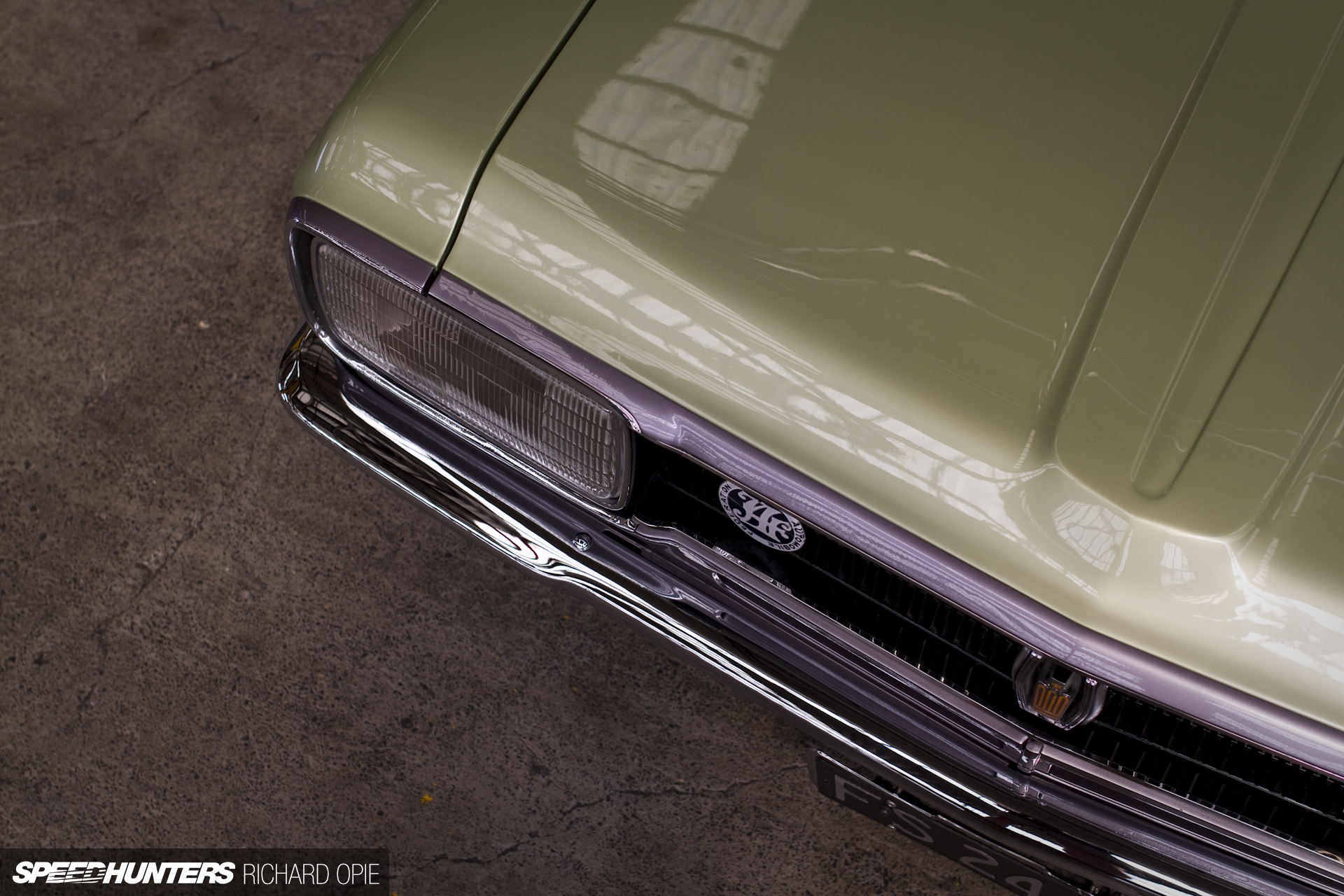
The Crown is a combination of finer details, but the finer details didn’t call for the 265ci Chrysler lump to stay beneath the bonnet. While the resultant changes hardly resemble something aimed even remotely at outright performance, the character afforded by the eventual engine choice can’t be overlooked.
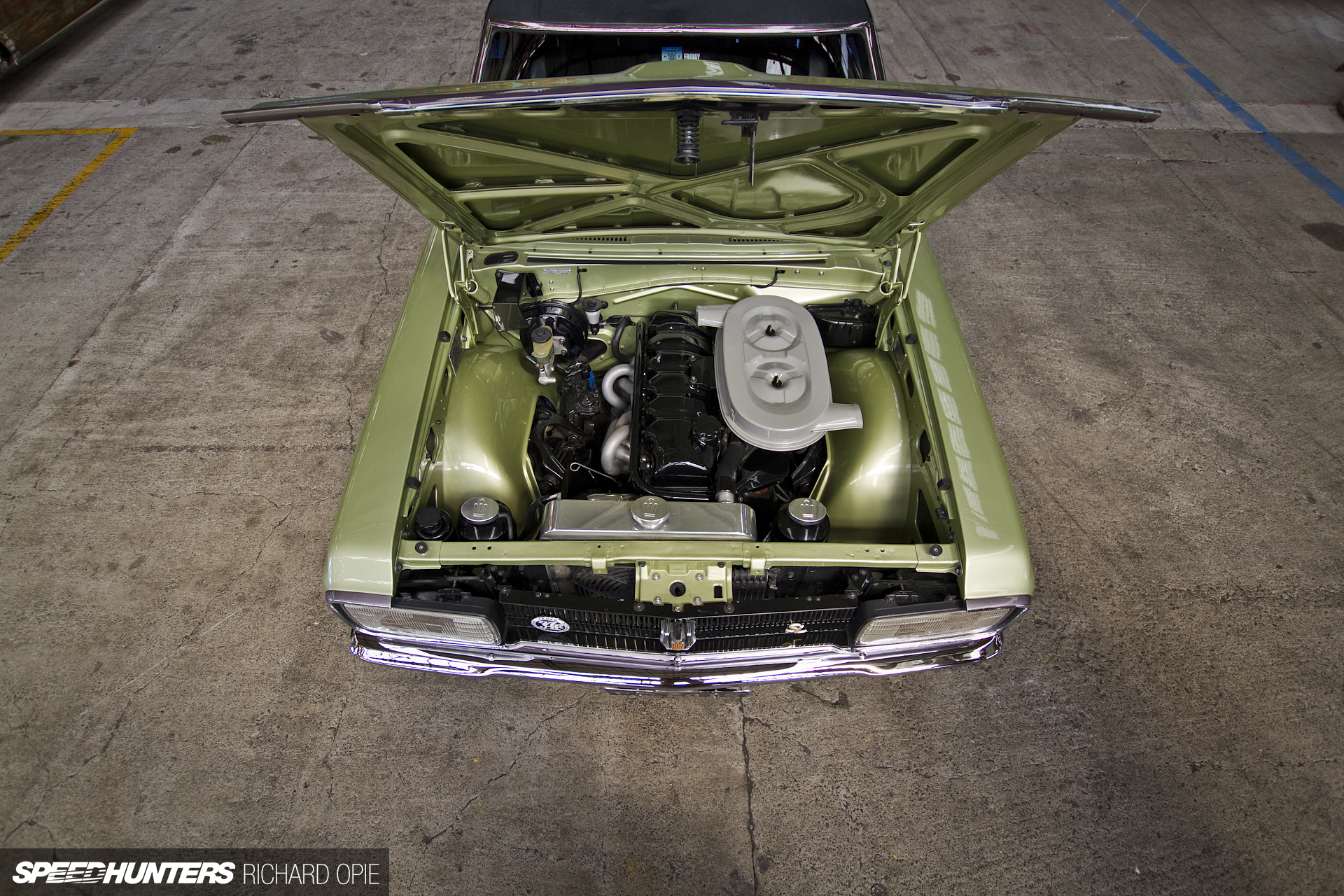
While these 50-series Crowns originally dragged mum, dad and 2.5 children along the tarmac with the aforementioned 2.4-litre 2M, David’s example makes do with the extra 200cc displacement afforded by a 4M lifted from a younger generation MS65.
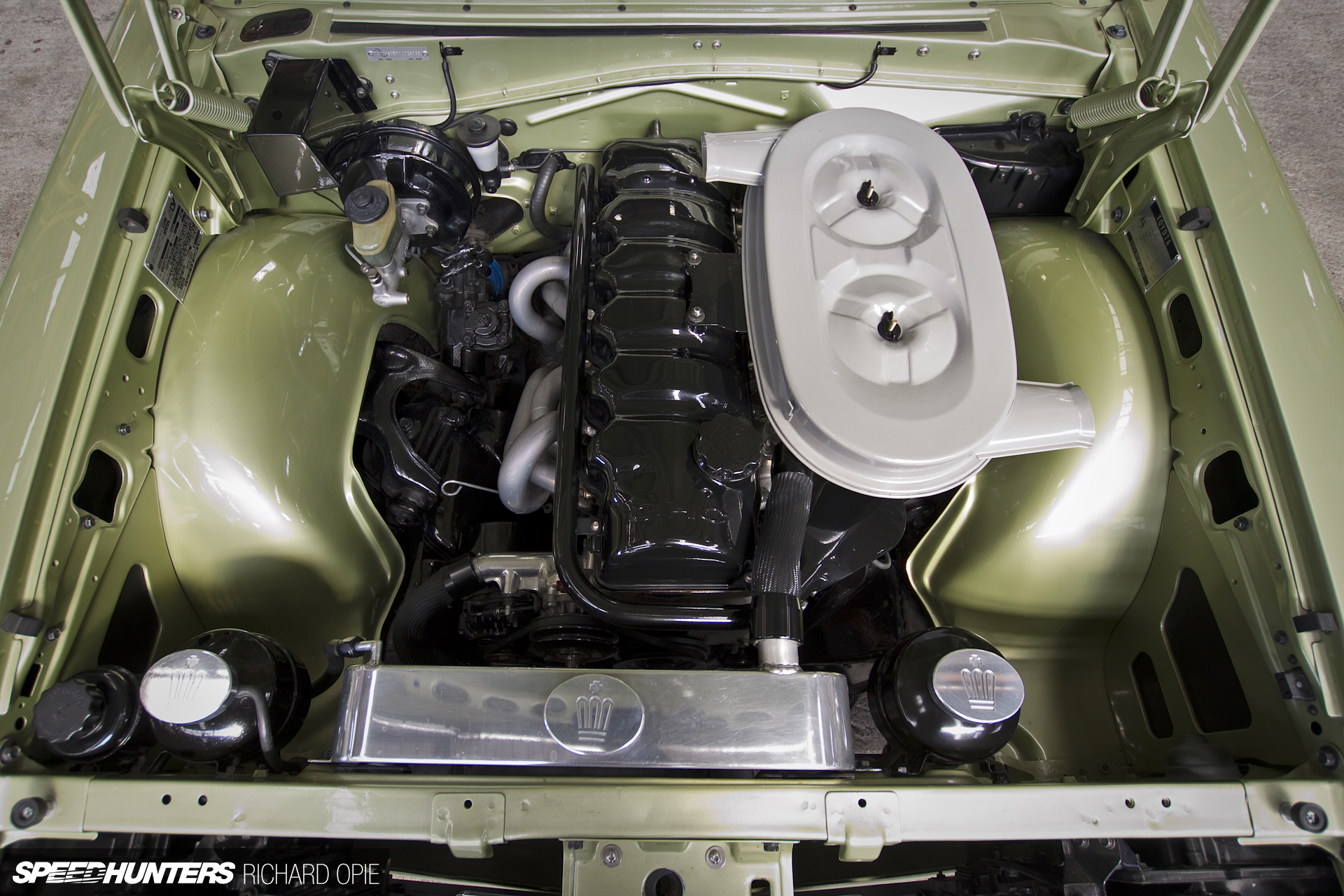
It’s tough to find a superlative more concise than ‘clean’ to accurately sum up the state of play in the engine compartment. What it lacks in performance, the 4M makes up in appearance with a handsomely curved rocker cover arcing over the straight-six engine’s single cam. Mirroring the curves, the filled and smoothed inner arches cascade neatly across either side, while small details such as the CNC-machined radiator, washer bottle and overflow caps (complete with Crown motifs) drive home the bespoke nature of the build.
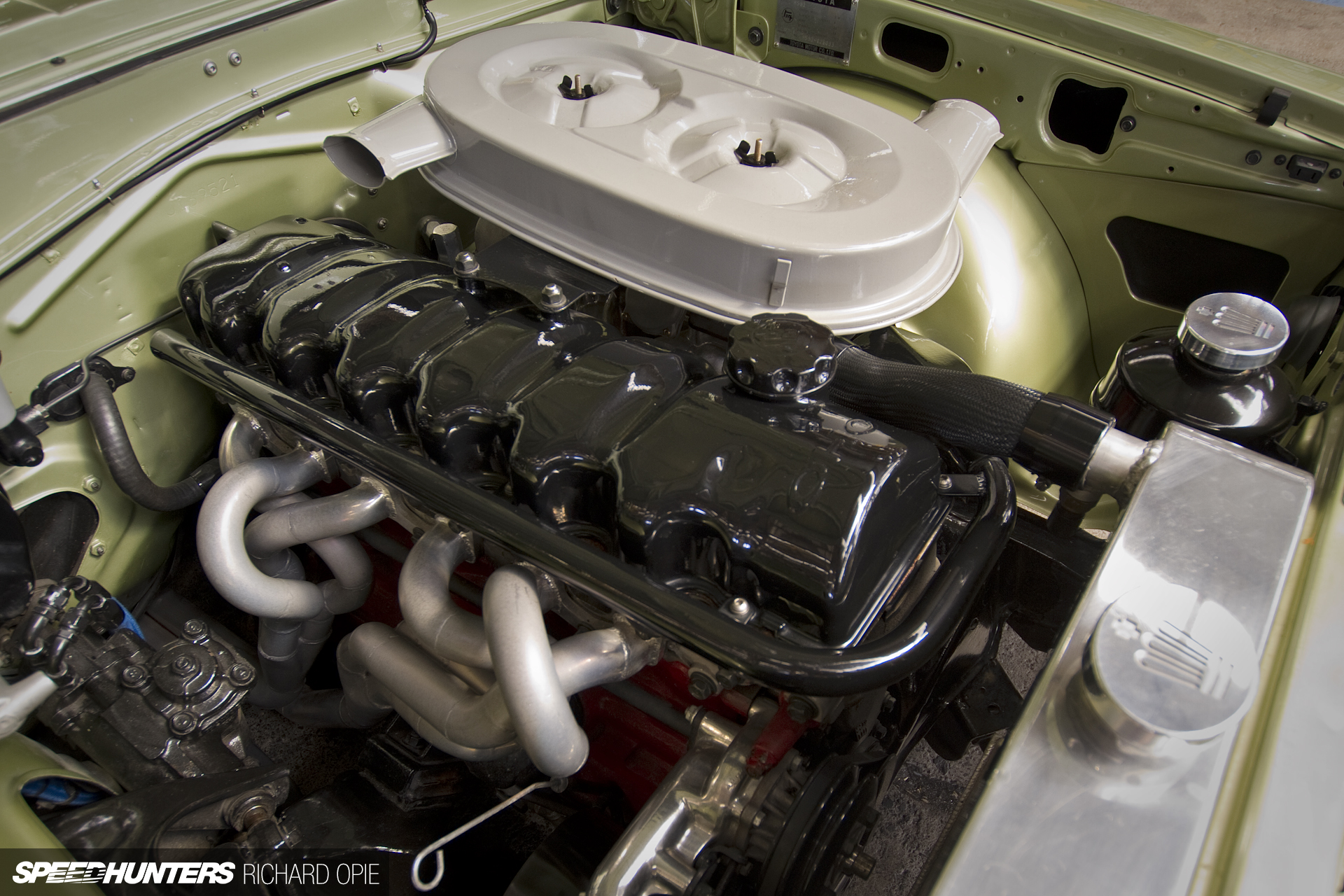
The engine bay’s visual is as timelessly elementary as the Crown’s exterior. A casual onlooker could be forgiven for thinking the wiring was non-existent, hidden away from view with even the plug leads being routed through a 1920s-influenced tube running from the distributor around the front of the head. A stock cast manifold was never going to cut the mustard, instead substituted for a one-off set of convoluted 6-2-1 headers running into a free-flowing 2.25-inch exhaust to the rear of the car which endows the Crown with an addictive crackle.
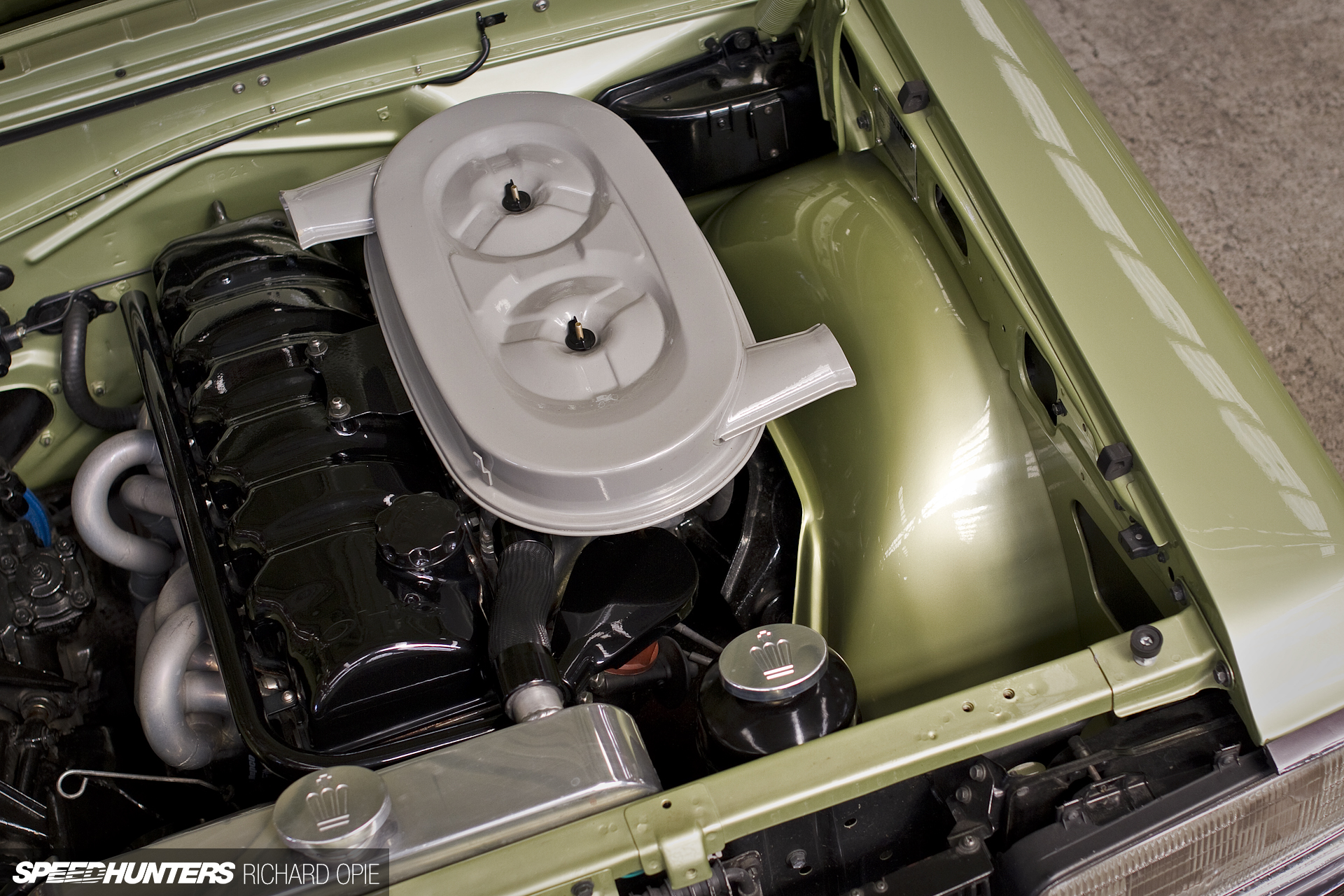
Beneath the large air cleaner housing resides another rarity – a genuine pair of factory-option twin downdraft Aisin carbs. They’re a further faithful nod to the Crown’s period and indicative of the high-spec ‘SL’ trim level aimed at those with deeper pockets.

Inside, it’s the late 1960s all over again, and a stark indicator of just how far advanced the large Japanese offerings were versus the staple Australian and British alternatives of the time. It’s a dignified place to be, surrounded in swathes of black, with tactile surfaces bearing the trademark embossings and fussy trim additions. Echoing every other facet of the build it’s tidy – not outlandish, not extreme – uncluttered and enduring.
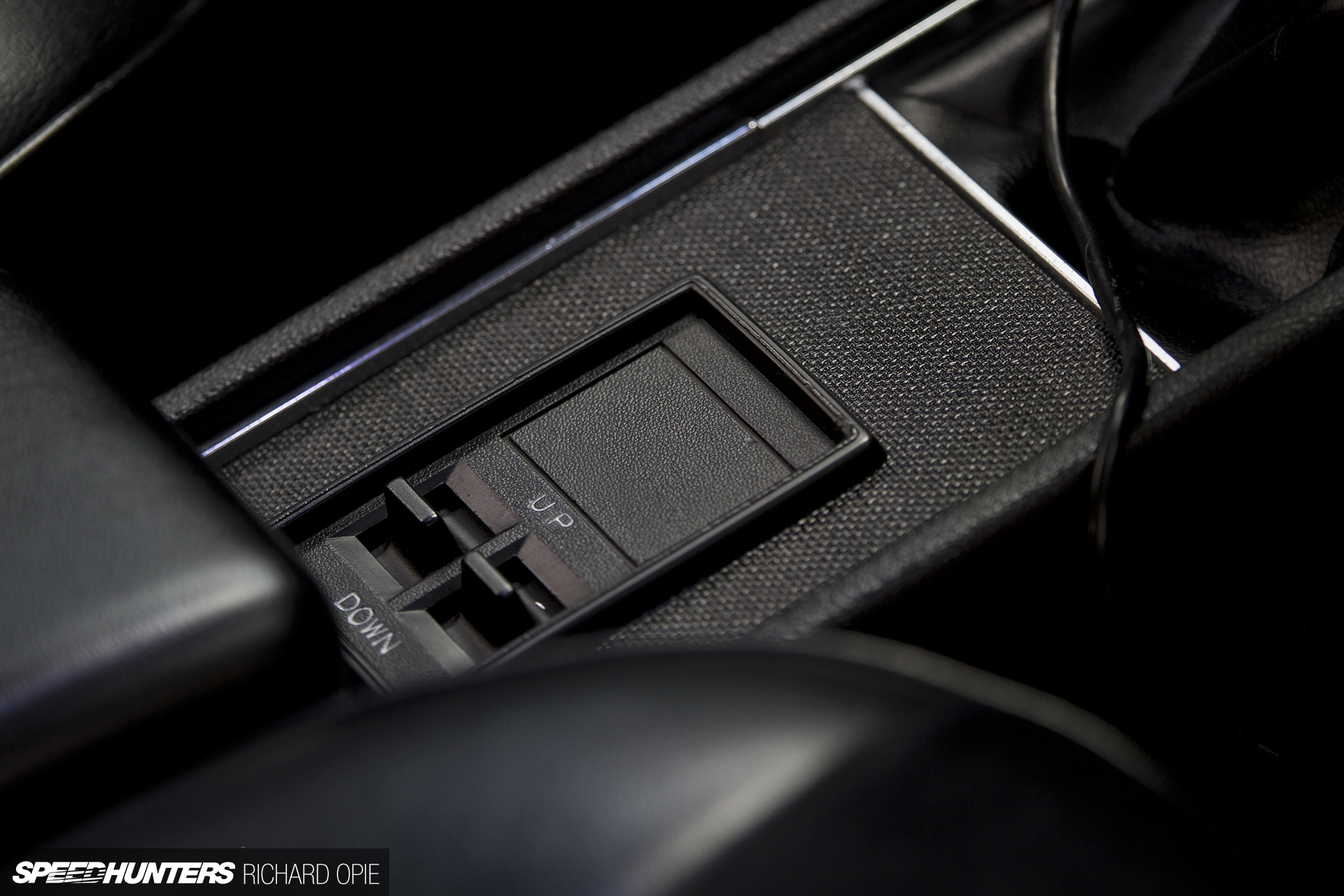
It’s these little details that draw the classic Japanese faithful in. So you want to open up that wide side glass area on the car? Simply hit the electric rear window switches, mounted neatly on the textured centre console just aft of the shifter for the W55 5-speed gearbox installed in place of the standard Toyoglide automatic.

The seats remain standard, albeit re-bolstered and reupholstered in vinyl and velour by local interior magicians Waikumete Upholstery who also handled the production of a new (from scratch) head lining and carpets – one of the few jobs entrusted to an outside source. Any retro Japanese cruiser is complemented perfectly with a 3-spoke Nardi Classic steering wheel, with the quintessentially American yet authentically Japanese (at least in Crown circles) Mooneyes logo adorning the shifter.
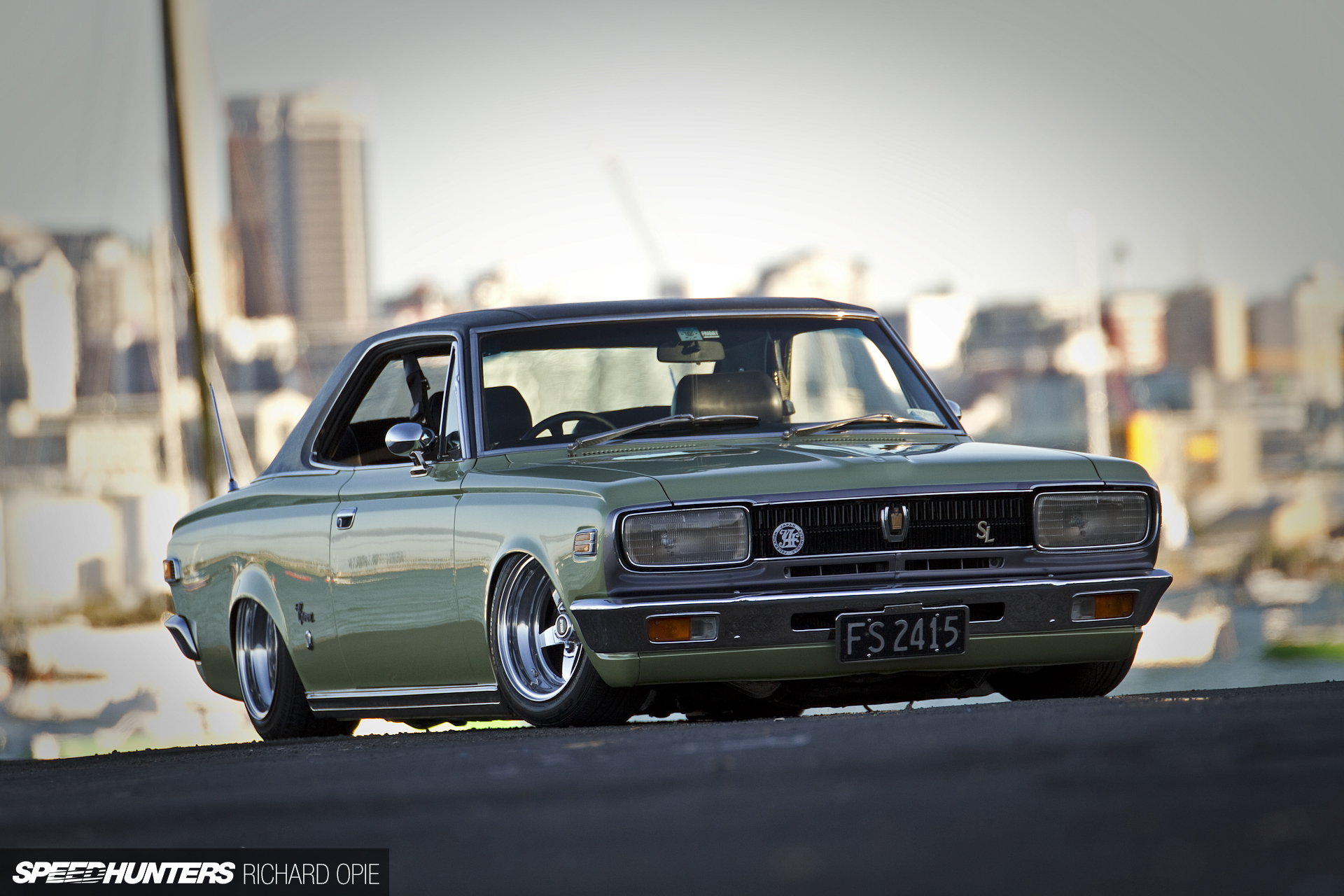
At rest among the dying light of a late summer’s day, the Crown is just one of those cars you can sit and take in for minutes on end. Representative of the ultimate expression of one petrol-head’s allegiance to a brand, rescued from a lifetime of certain negligence and transformed into a scene-transcending masterpiece, it’s difficult to envisage where David’s forays into Toyota-tinkering will head next. But rest assured, with the quality of each build leaping from good, to great to drop-dead gorgeous, I know we haven’t witnessed the last of his retro Toyota, garage-conceived re-imaginings.
Richard Opie
richy@speedhunters.com
Instagram: snoozinrichy
David Arthur’s 1969 Toyota Crown Hardtop (MS51)
Engine
Toyota 4M, 2.6-litre OHC inline-six, reconditioned factory option twin Aisin downdraft carbs, custom 6-2-1 header, 2.25-inch exhaust, de-loomed engine bay, hidden ignition leads, hidden distributor, custom aluminium multi-core radiator with electric fan, custom reservoirs with CNC-machined caps
Driveline
Toyota W55 5-speed gearbox, modified pedalbox to suit manual swap, custom driveshaft, shortened Toyota F-series diff, LSD center
Suspension/Brakes
Custom-valved Bilstein yellow shocks front & rear, custom front A-arms, chassis pinched & C-notched, custom rear airbag mount plates, RideTech airbags, RideTech e3 airbag controller, boot-mounted tank & compressor, LN106 Toyota Hilux 4-pot front calipers, Peugeot 505 vented rotors, rear disc conversion, MS85 Toyota Crown power steering box, SW20 Toyota MR2 electric powersteering pump
Wheels/Tires
Weld RT-S S71 P (polished) forged wheels, 15×8-inch (front), 15×10-inch (rear), GT Champiro 205/50R15 (front), 225/50R15 (rear)
Exterior
Toyota Spring Green paint, hand-beaten flared wheel arches front & rear, re-chromed original bumpers, JDM MS51 coupe front clip, vinyl hardtop roof cover, CNC-machined billet side mirror pedestals, refurbished & polished brightwork
Interior
Original black 3-dial dash & trim, reupholstered original seats, refurbished consoles/trim, Nardi Classic 360mm steering wheel, Mooneyes spherical shift knob, Alpine receiver, DLS component speakers, Fusion coaxial speakers, Alpine amplifiers