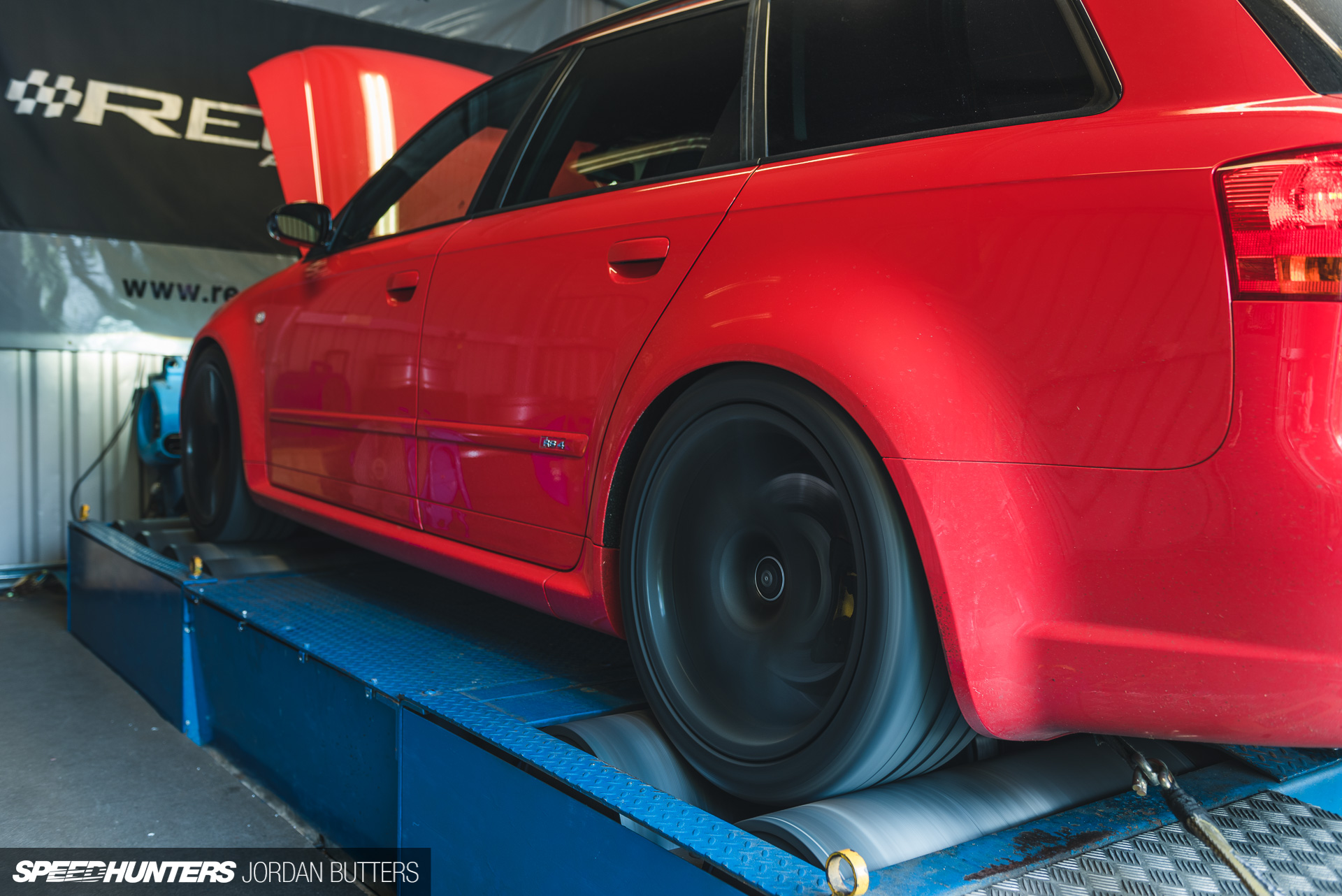
Firstly, I apologise for leaving the last update on a cliffhanger. It really wasn’t fair of me.
However, the reason for breaking the chronology of the story was because I wanted to not only present a direct before and after for the work that Regal had done on the RS4’s 4.2-litre V8, but I also wanted to use this opportunity to talk a bit about dynos.

It’s a common occurrence on Speedhunters that, whenever we talk about power figures, the comments section blows up with disagreements about what figures we should present. It’s a somewhat confusing topic too. For a start, there are various units of measurement which, although when converted do end up reasonably close to each other, are actually slightly different. Straight off the bat we have horsepower (HP) and brake horsepower (BHP), terms you’ll all be familiar with. For all intents and purposes these two measurements are the same – a clever Scottish bloke named James Watt (after which the watt was named) decided that a horse could produce 33,000 foot-pounds of force per minute and this became the standard by which we measure power across much of the world today. Nice one Scotland.
Although, to further confuse matters we then have PS (pferdestärke), a metric conversion of horsepower often used in Germany (it literally translates to horsepower), and kilowatts (kW), which is popular in backwards and largely uninhabitable places, like Australia. I joke; strictly speaking kilowatts is a valid metric measurement of power, but when 1bhp=0.7457kW and your 500bhp monster is now just a 373kW machine, you can see why everyone else prefers horsepower. The conversion for pferdestärke is 1PS=0.986bhp, so it’s roughly the same.
And no, I don’t know how to say pferdestärke out loud.

When measuring an engine’s power we have two ways of doing so – an engine dyno and a chassis dyno. Now, the most accurate way of measuring power is an engine dyno – here, torque is measured directly from the engine’s crankshaft and converted into horsepower. This is the way that a vehicle or engine manufacturer would measure engine power. The downside of this method is that because engine dynos measure power from the crank, they require the engine to be out of the car when tested, which is not practical for most aftermarket tuners.

Option two, and the more popular method of measuring engine power is using a chassis dyno. These measure power one of two ways – either using drums underneath the vehicle’s wheels, and take a reading directly from the wheels, or by bolting directly to the hubs. This power reading in itself isn’t specifically engine power, as the vehicle’s drivetrain plays a factor in the output. The figure produced is known as wheel horsepower (WHP).

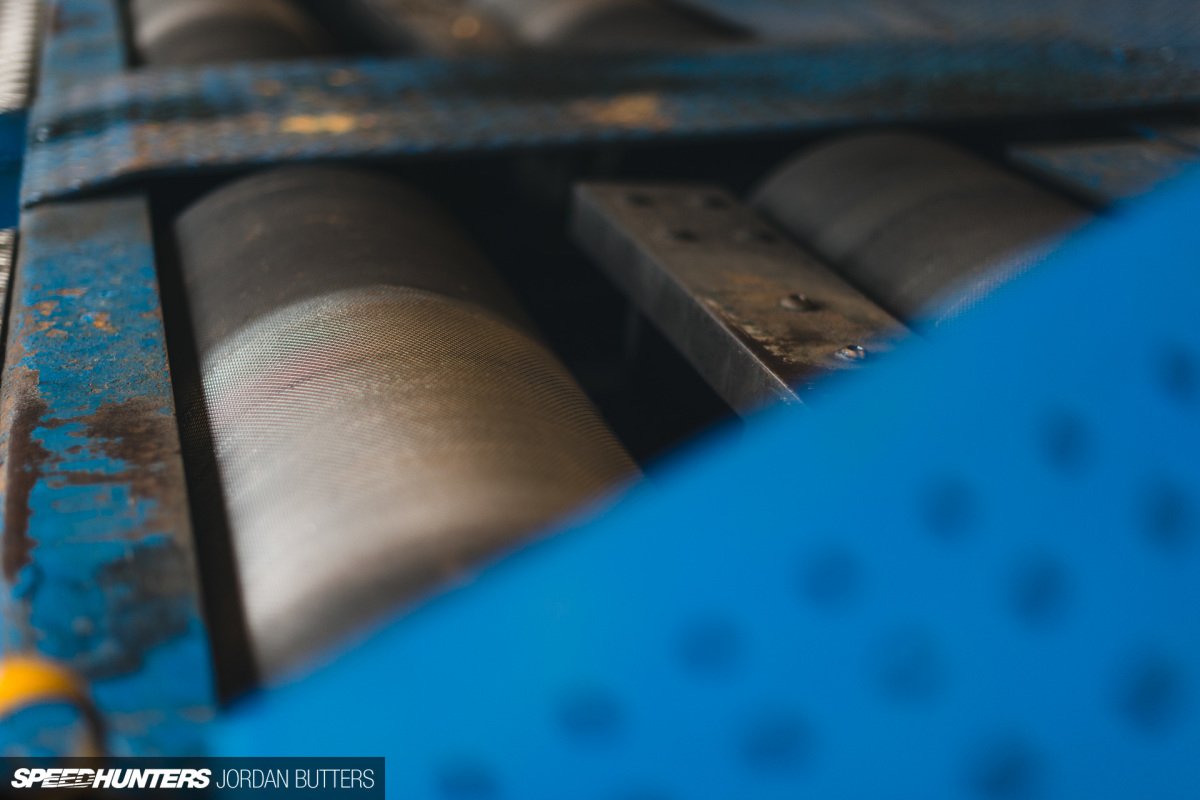
There are several different makes and models of chassis dyno, which often have shared characteristics. For example, certain brands of dyno are known to read generously, where others under-read or are more realistic. Generous dynos are great for impressing your mates, but not useful if you’re actually interested in facts over fairytales.
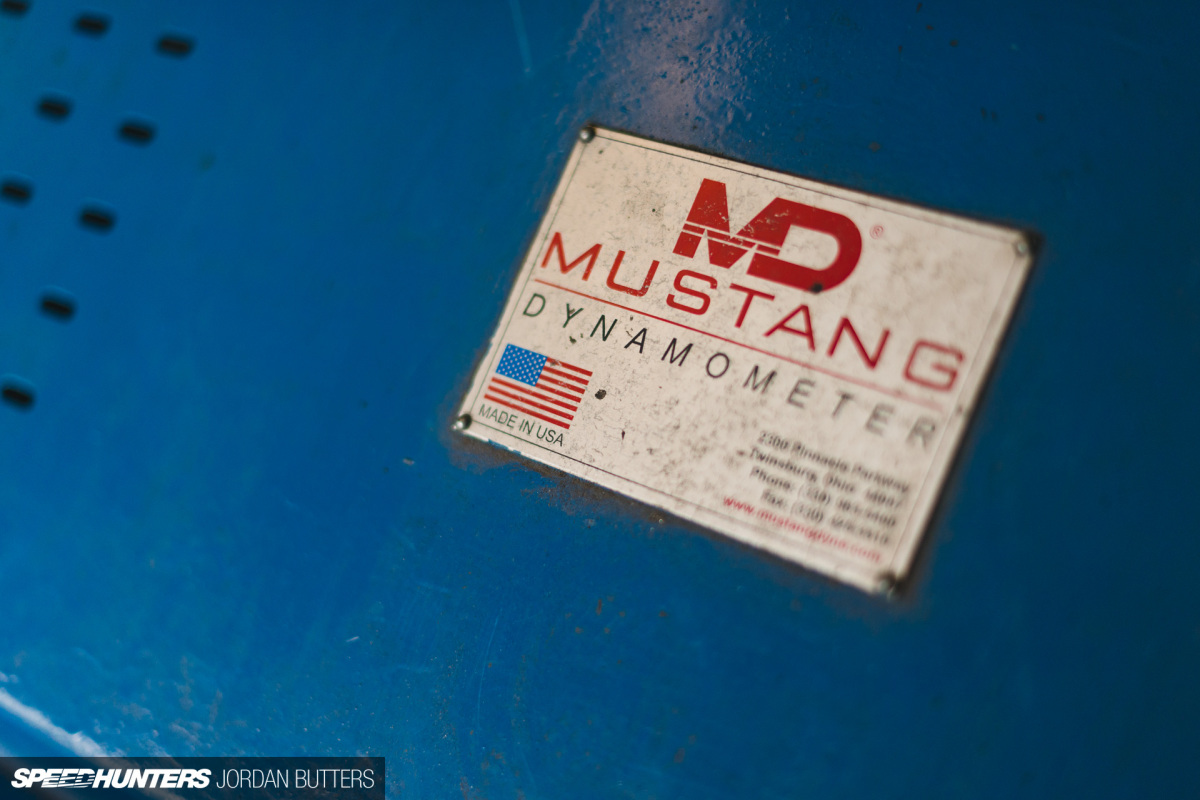
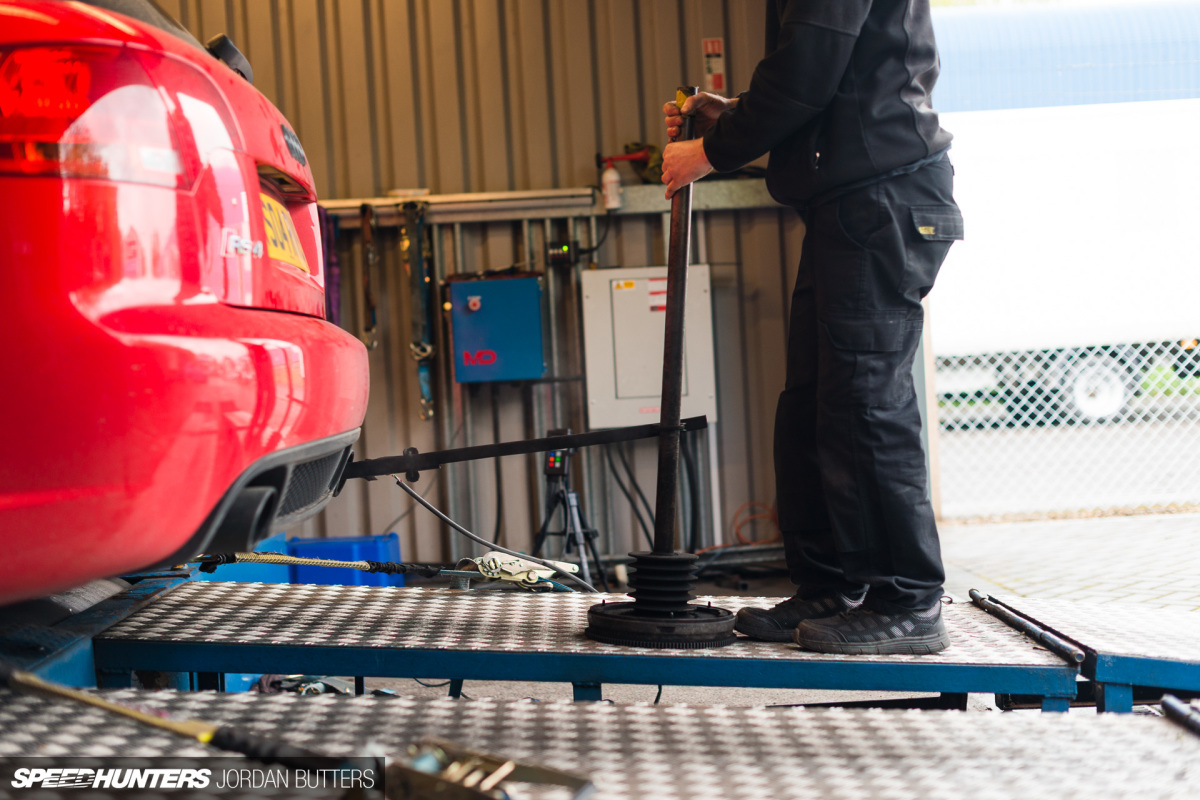
Specifically, Regal Autosport uses a Mustang MD-500 AWD setup. This is a mechanically-linked, strain-gauge type, dynamic load cell dyno that measures power by applying a variable load on the primary mover (in this case the drums), and measures the vehicle’s ability to move this.

The mechanically-linked part is important, because it means that it can be unlinked for 2WD testing. Many other AWD dynos are not mechanically linked, which can cause costly issues with cars that use a non-permanent clutch-actuated AWD system, such as like VW/Audi’s Haldex, Porsche Carrera 4/Turbo AWD and the Audi R8 or Lamborghini Gallardo and Huracán. In these instances, if the wheel speeds aren’t the same front-to-rear the clutch unit tries to compensate, dramatically increasing wear and reducing lifespan. This is why you’ll sometimes see AWD cars on dynos with the prop shaft removed so that only the rear wheels are powered. This avoids clutch problems, but I don’t need to explain why it results in inaccurate power figures. What’s more, some modern 2WD cars can be fussy about delivering full power/torque if all four wheels aren’t spinning, and a mechanically linked AWD dyno overcomes this.
Back to power figures… Much of the confusion arises in our comments section because of our international reach. For our US readers, you’ll be used to quoting power figures in WHP, as this is what is directly measured during a chassis dyno pull, however here in the UK and some of Europe, we still quote figures in BHP, even when using chassis dynos. Why? Well, it’s a cultural thing, but I guess it’s because we can then make direct comparisons to what the engine produced as stock, when measured by the manufacturer on an engine dyno. Converting measured WHP into BHP is usually done by estimating drivetrain losses in terms of percentage and then applying this figure to the WHP readout to give an approximate BHP figure. This is all well and good, and gives you a close idea of what power output the vehicle is capable of, but it’s obviously not 100% accurate.
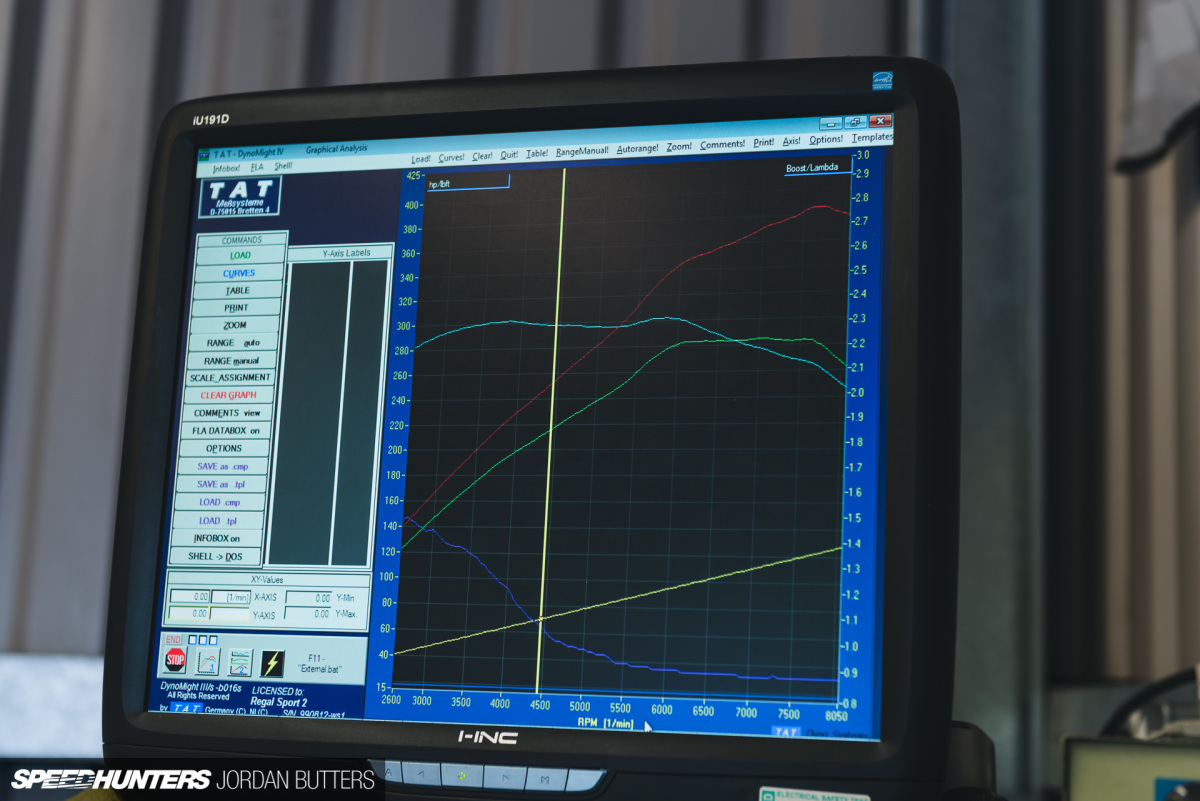

Here’s the clever part about Regal’s Mustang dyno – unhappy with this approximation of power, Regal approached TAT Messsysteme in Germany to develop a dyno software that would more accurately convert WHP into BHP. TAT develops dyno software for some of the world’s biggest race teams, and created a very clever system that delivers the most accurate results possible short of using an engine dyno.
Rather than assigning a uniform loss percentage to the drivetrain, which would obviously differ from vehicle to vehicle based on any number of factors, the TAT software measures run-down drag after each pull, taking into account factors such as parasitic losses of the dyno, the vehicle’s powertrain, and data from the built-in weather station, for example. What’s more, this measurement of acceleration is accurate up 0.0000002 seconds: two tenths of a millionth of a second. This data is applied through “quick maths,” to quote Big Shaq, to bring us to a highly accurate conversation to bhp.
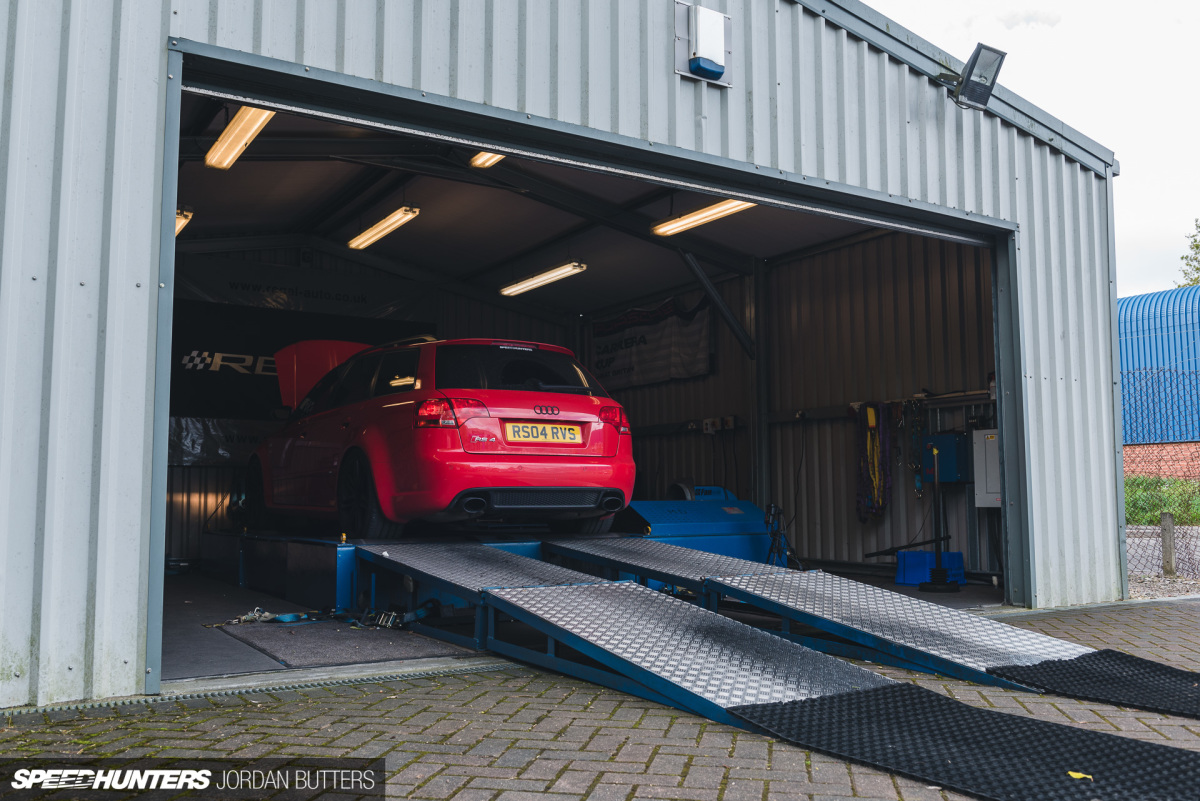
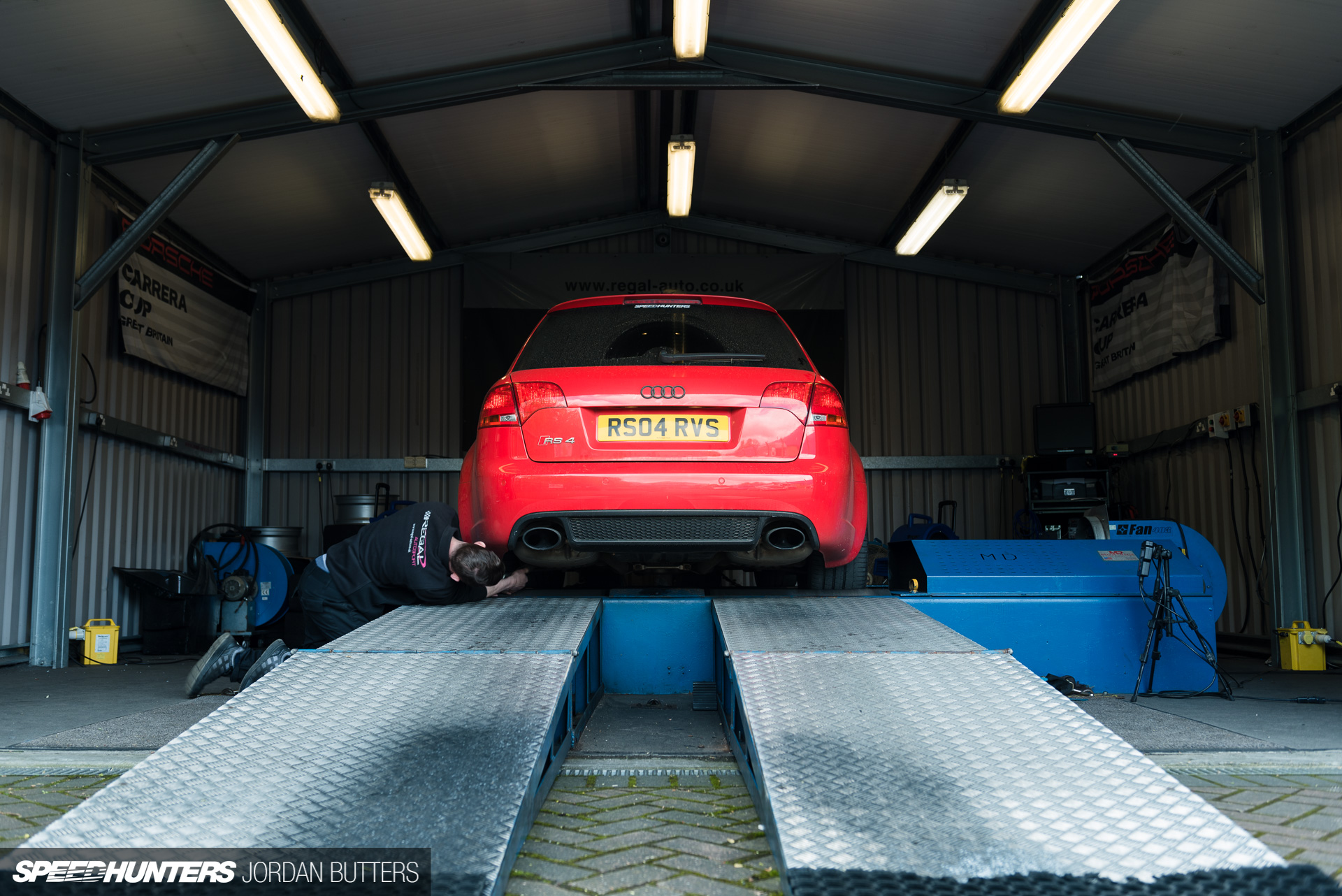
So, how about Project RS4? I’d previously had the actuated flap and vacuum system removed from the airbox and a BMC panel filter installed, but the engine was otherwise stock. There was also no record of a carbon clean being done prior to me picking the car up, so with just over 80,000 miles on the clock I was expecting it to be well below the stock power figure of 414bhp.
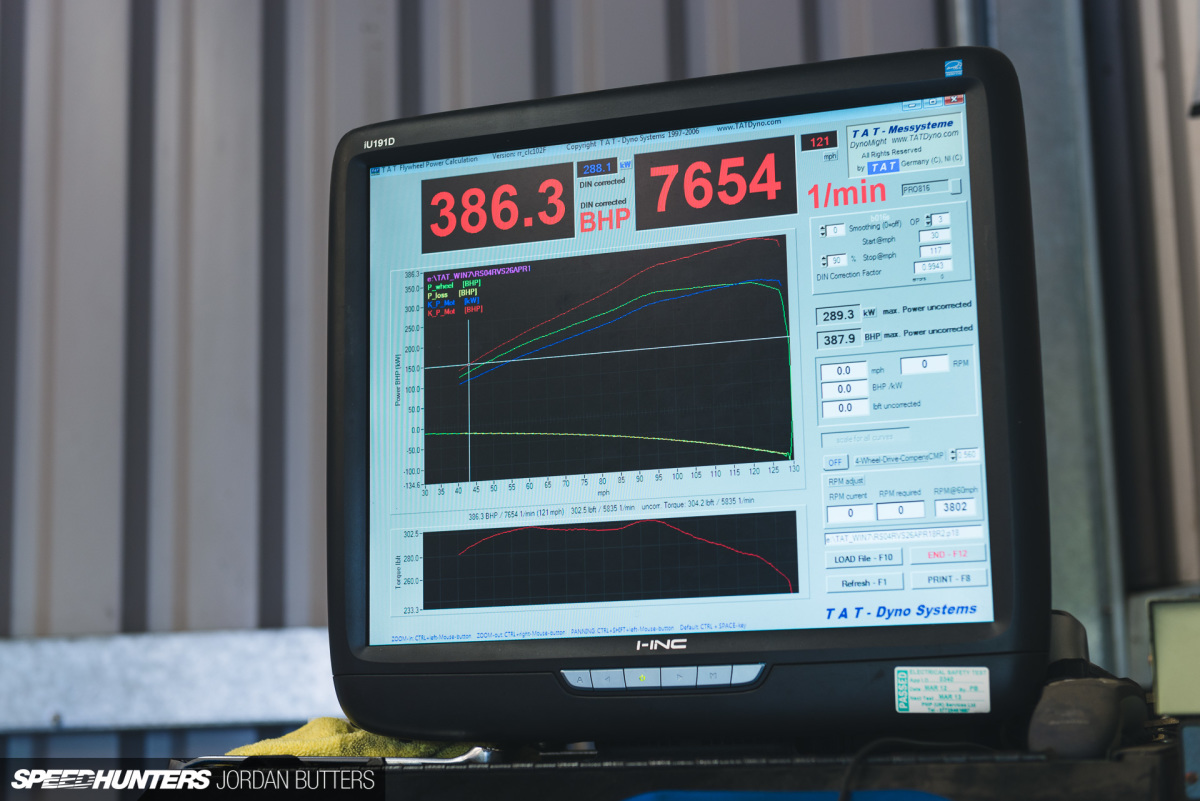
I was pleasantly surprised though; the ‘before’ runs delivered an average of 385bhp at 7,700rpm and a steady 300lb/ft from 3,500rpm through to around 6,000rpm. That’s a pretty healthy figure given the amount of coked-on carbon that we later found.

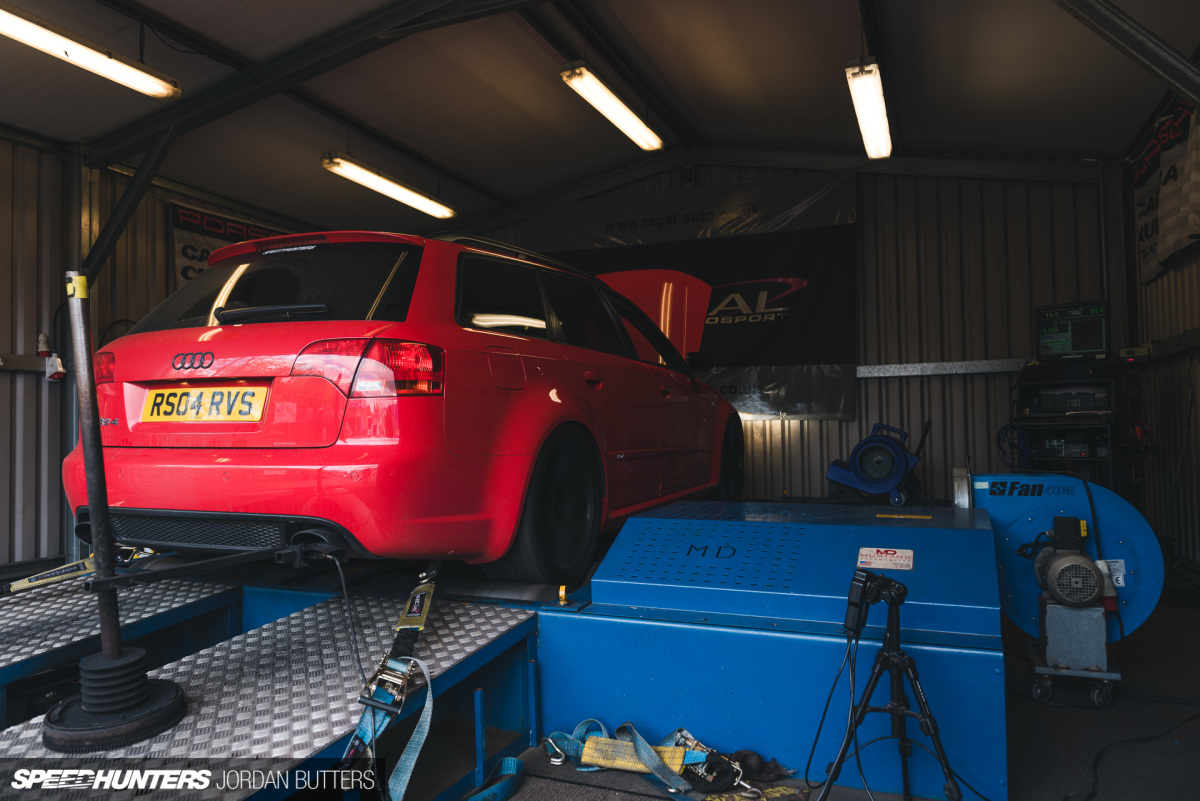
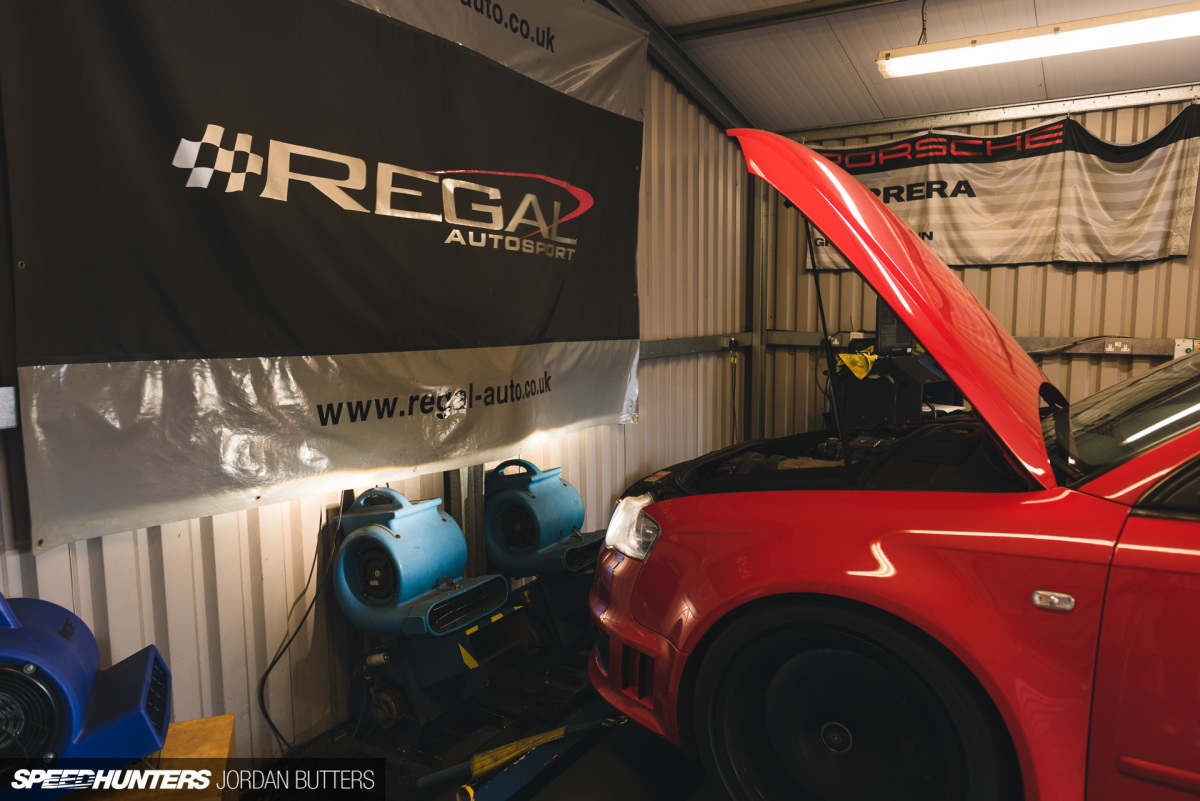
Work completed, and onto the ‘after’ run – I’d be lying if I said I wasn’t apprehensive. Heck, any time you’re standing alongside your car when its being wrung up to 8,000+rpm after engine work your wallet is bound to start twitching. With these engines being highly tuned from the factory, I wasn’t expecting a big leap from removing the intake manifold flaps and mapping, however I was intrigued to see exactly what clearing out all that crappy carbon would do.

The results: 419bhp at 7,900rpm and peak torque of 321lb/ft at 5,800rpm. On a dyno that reads comparatively conservative to others I’m incredibly happy!
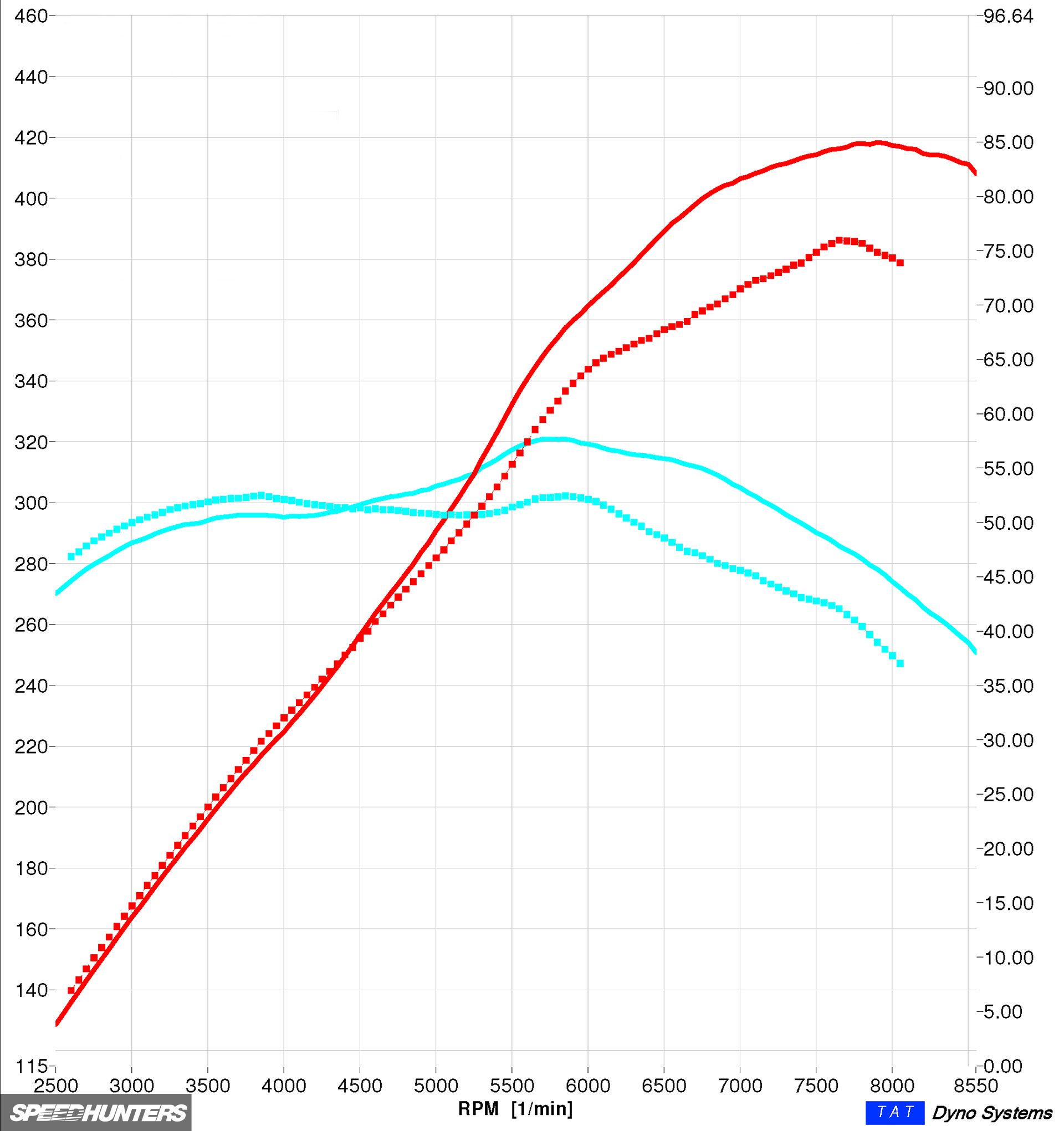
Here’s a chart plotting the before and after runs. The solid lines are the ‘after’ run and the dotted lines, ‘before’. Red is BHP, post conversion, and teal is torque, measured as lb/ft.
The results pretty much mirror what I expected would happen with the carbon removed and the manifold vanes removed – a loss of around 4-5lb/ft up to 4,250rpm (1.5%), but then a hike of 28lb/ft (around 9%) right through to redline. Peak power is up 34bhp too. It’s hard to say what can be attributed to the de-vaning and what can be assigned to the de-coking, however I’d guess that the vanes seem to help airflow at low RPM, but then become restrictive (coupled with the carbon) at higher RPMs.

It’s easy to get tied up in dyno figures but here’s the caveat to all of this information – it doesn’t really matter on the road. Dyno runs are a very specific test of one vehicle under varying test conditions. There are so many variables that can alter the results, from the make and model of dyno to the software, the operator, the weather, the tyres, the oil in the drivetrain and so forth. Comparing figures from two dynos is akin to comparing apples and… koala bears; they both hang from trees, but after that the two are irrelevant alongside each other. That’s why it’s important that, if you need to know what exacting difference changes make to performance, both before and after runs should be done on the same dyno in as similar conditions as possible.
When it comes down to it, and past this comparative information, dyno results are pub talk (or forum talk if you’re not participating in the outdoor world). What really counts is how your car delivers that power on the road. I’ve had a couple of weeks to put some miles on Project RS4 and I’m pretty stoked with the results. Aside from the extra oomph, where the power used to falter and drop off at the top end it now feels relentless – I’m definitely finding myself at the rev limiter more often than I used to!
With a slight adjustment in driving style the power is more usable too. Whereas previously I was working the V8 in a somewhat lazy manner from low down, now I find myself downshifting before accelerating, knowing that from 4,500rpm onwards it’ll just keep going.

So, engine in a good place, I’m now looking at where we go from here. The car needs some exterior and interior TLC in the next month or so to prepare it for summer, and there are a couple of maintenance bits that I need to do too. After that it’s on to more exciting stuff – maybe an exhaust – and I think I might have decided on a set of wheels at long last…
Jordan Butters
Instagram: jordanbutters
jordan@speedhunters.com