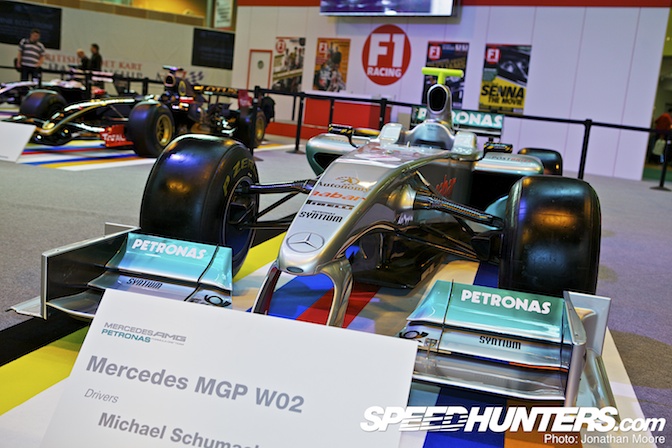
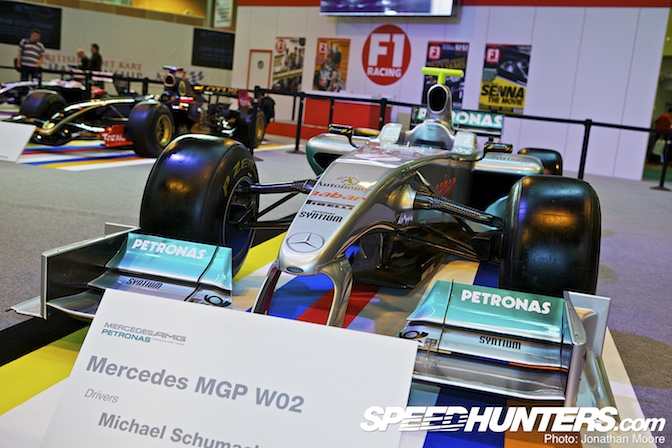
One of the highlights of the International Racing Car Show is always the Formula 1 Grid: a rare opportunity to examine up close an almost full-house of current F1 machines – and perhaps the only way without having some very well-connected friends and a whole neck-full of passes.
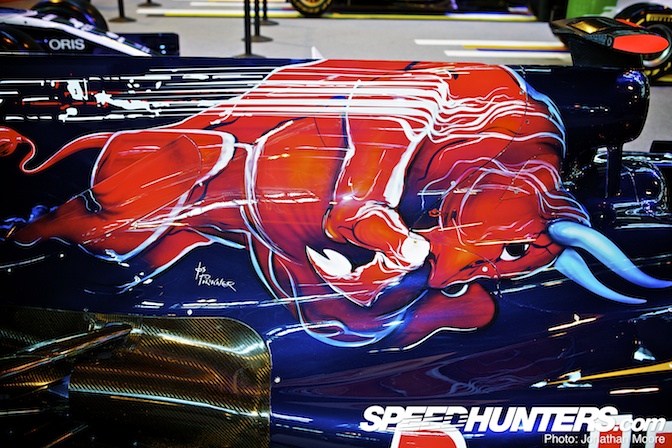
Even dedicated racing magazines and sites only infrequently show close-ups of the detailing of the cars, so I found it very interesting to be able to see for myself the surprisingly large differences between the current crop of racers.
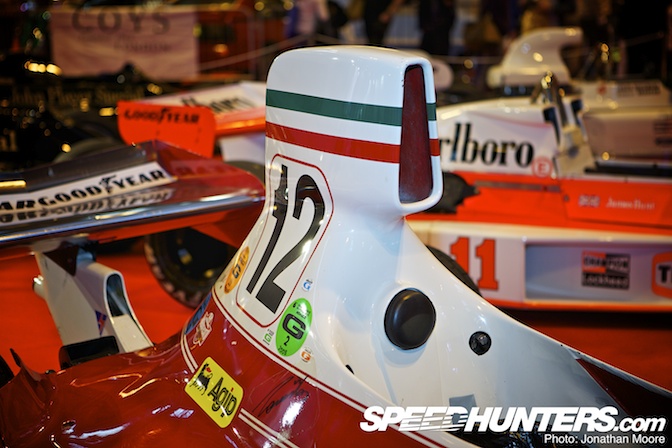
For the true fan, what takes ASI to the next level is the fact that you then have the opportunity to compare a whole host of F1 cars from across the years in one hall, to really get an appreciation of how far technology is pushing the sport – for aesthetic good and bad.
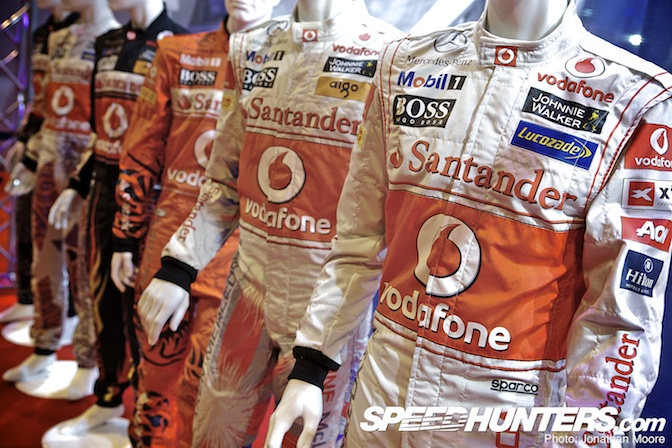
Speaking of the latter, some of McLaren's various race-suits that they forced upon their drivers in practice and qualifying last year could be seen on McLaren's merchandise stall. Strangely, they were the only team not to have a 'current' car on display, though there were several historic McLarens around the halls, plus a pair of MP4-12C sportscars.
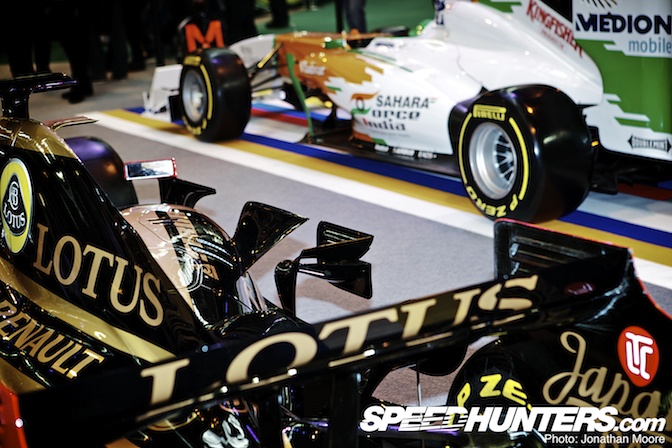
Of course, these days aerodynamics are the key area around which a Formula 1 car succeeds or fails. The new rules package introduced in 2009 brought in a whole raft of changes that changed the fundamental look of the cars: front wings grew, rear wings shrunk and were higher. Extraneous appendages were theoretically banned in an effort to reduce both the impact of the 'dirty air' spewing out behind a car and their frankly ugly appearance – but designers are designers, and already they're creeping back in. Just check out the air formers on the side of the Lotus-Renault – another mock up that pre-dates the 2009 changes…
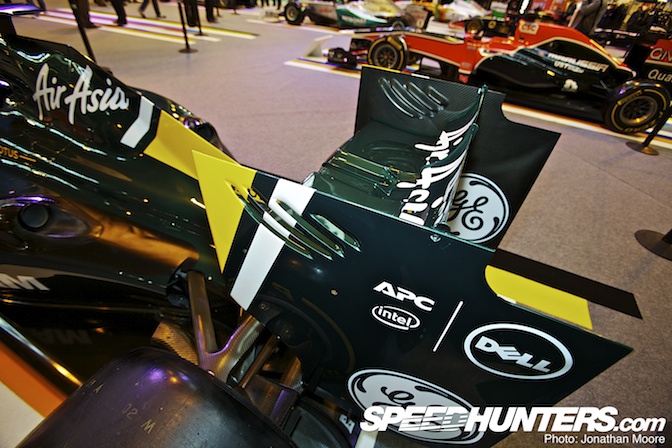
I remember thinking how ugly new F1 cars looked in 2009, with their bulbous noses and skinny little rear wings. The cars of last year appear a bit more pleasing to my eyes, though the rear wings are still hardly things of beauty. Although the show cars on display had various bits of aero from the parts bin on them (and yes, admittedly not all of them are actually the 2011 cars under the skin, though they have all been painted in 2011 liveries), the almost sheer rake of the moveable DRS plane in its closed position on the rear wing is very apparent.
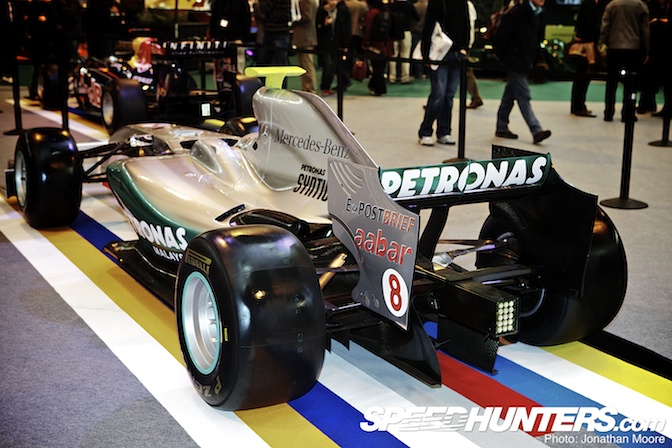
The Mercedes MGP-W02-alike was demonstrating a very different configuration with its incredibly low-slung wing, massively lower than the other cars on show. Naturally teams don't put on the latest development parts on these show-cars, so this might even be the original launch wing from the beginning of the season. Also, from this angle it rather looks like a Honda that Ross Brawn might have unlocked from his factory's storage cupboard, but let's not split hairs…
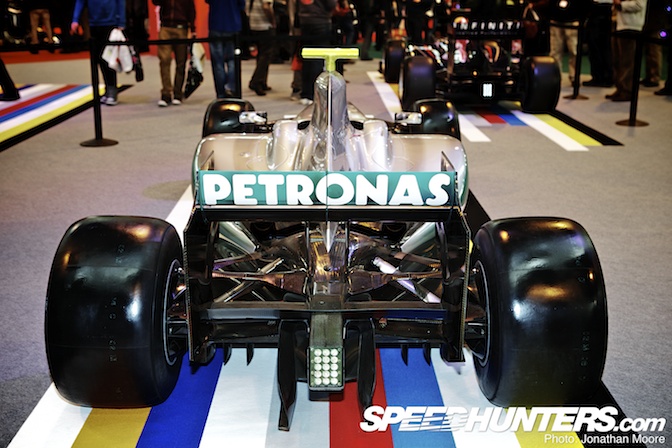
With their tightly enclosing bodywork, the only angle where you can get a sense of the engineering complication of a modern F1 car is from the rear. They're all a riot of interwoven carbon struts and aero parts.
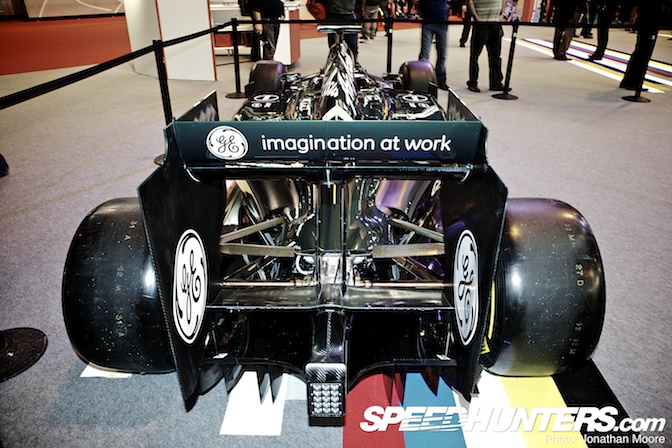
It's a funny thing when you compare a front-runner to a back-of-the-grid car like the Lotus T128 – to the untrained eye there's the same complexity and apparent application of principles: but of course, the devil is in the detail. Everything – literally every part – must work together in perfect aero and mechanical harmony. It's no wonder some get it wrong.
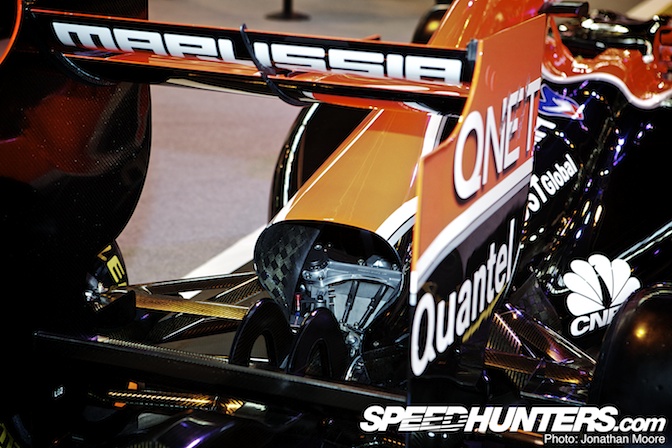
Along the same lines, when you see a part on one car that's not on another then it's usually one of two things: either the thing that is making that car win (as was the case with the Brawn's double-diffuser in '09) or holding it back. The Marussia Virgin MVR-02 had plenty of obvious differences to it, like the big rear outlet from the airbox and the nose piece that looked like someone had sat on it… And it was the slowest car out there.
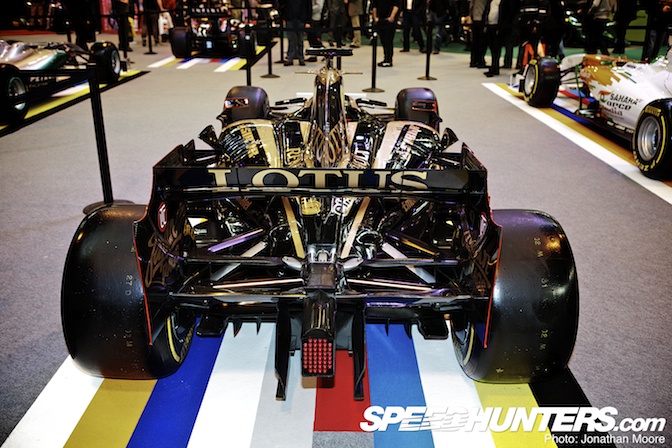
The Lotus-Renault R31 started the year with promise: its trick aero and front-exiting exhausts gave the impression that it might have stolen a Brawn-like march on the rest. But it wasn't to be… Unreliability and smokey ends to races clipped the team's wings and problems with getting the best out of the tricky arrangement meant the year didn't end on a high for the team. Just looking at the back-end of the car it's clear just how complex the interaction between the various parts of the aero package is on an F1 car.
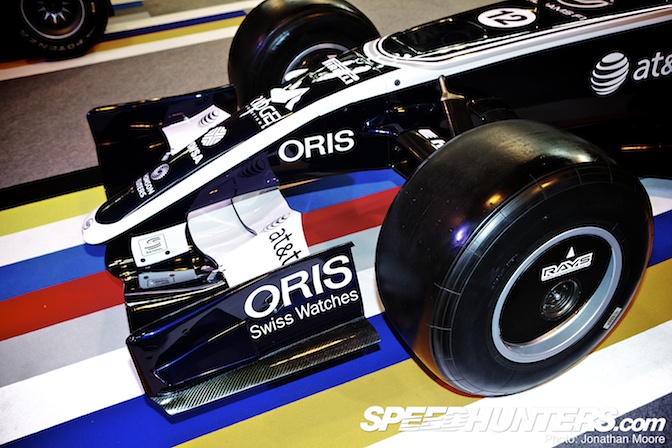
Moving to the front of the cars is where you see the biggest variants in approach. Again, at ASI there were no consistent aero pack on all the cars, but it was still interesting to see the different front wings that were on show.
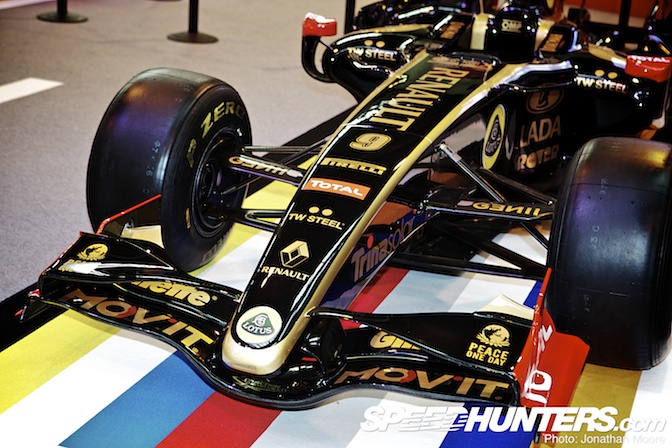
Lotus-Renault's older wing was positively sculptural, with its sinuous top chord and continuing use of the scooped central shaping.
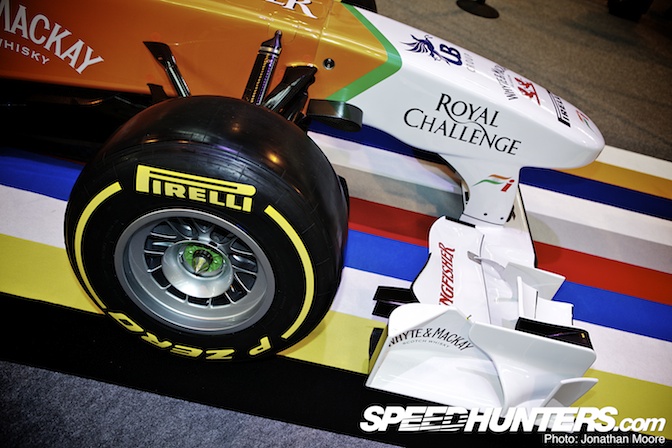
The Force India VJM04 was architectural in comparison: boxy, functional and simplistic looking (in aesthetic if not in aerodynamic terms) and effective rather than overwhelming.
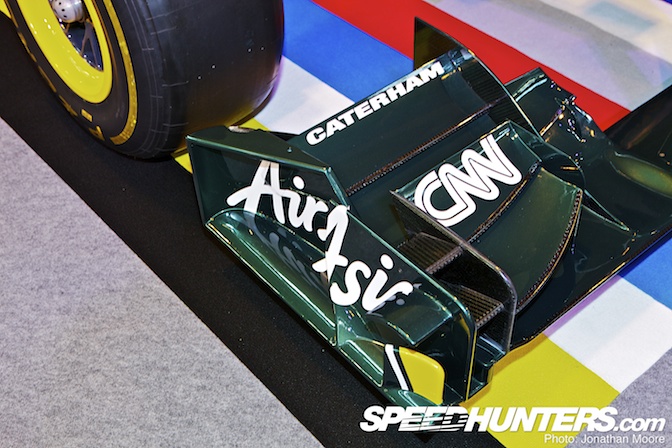
Lotus-Caterham had obviously put a lot of effort into their assembly, as the end pieces were massively complex, replete with a cascade of winglets, fences and formers.
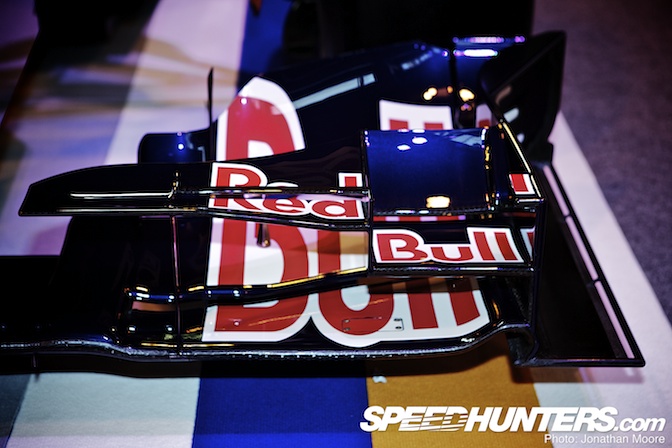
But of course, the masters were Red Bull with the RB7's front wing. Another theme-park ride of a wing, but demonstrably the most effective on the grid.
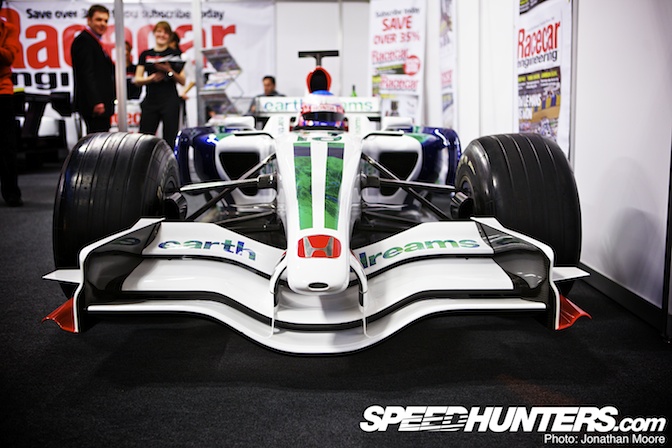
Walking through the halls you could then thread your way through the evolution of F1 aero. This Earth Dreams (Nightmare?…) Honda RA018 from 2008 was sited in the Engineering Hall, an example of the previous generation of car with its big, three-plane wing mounted high off the ground.
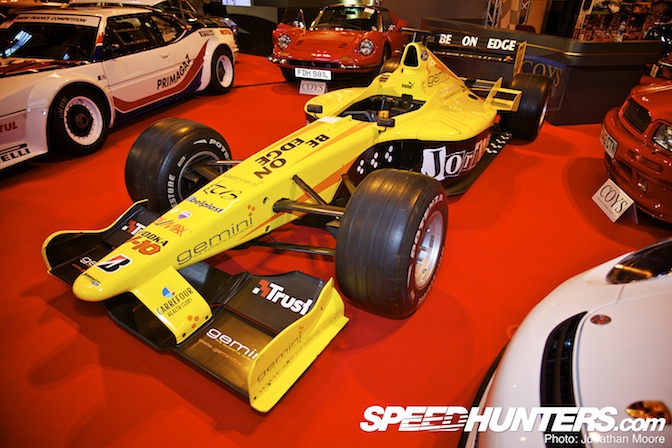
Jumping back to the beginning of the decade was this Jordan Grand Prix EJ13 show car in the Coys Auction. A slump year for the ailing team, nevertheless this model did score a win with Giancarlo Fisichella at the wheel during a chaotic Brazilian GP. This car has an aero look that isn't that unrelated to the late-90s cars: deep, simpler two-plane wings and straight-on end-plates, mounted on (in this case quite extreme) v-shaped brackets low-down and close to the ground.
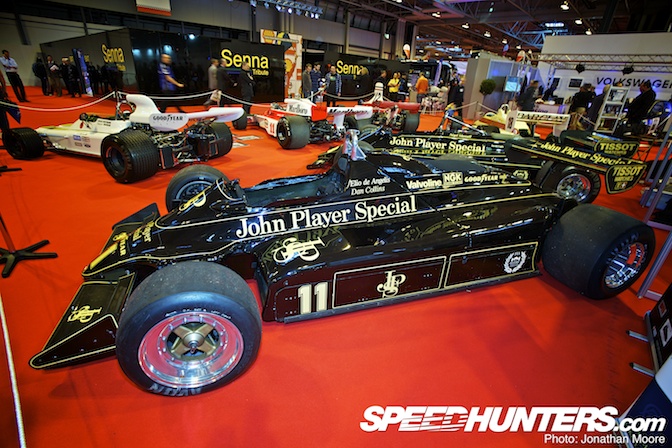
The Senna exhibition had some perfect example of late '80s and early '90s designs: perhaps the rawest, purest era for Formula 1 cars with their unadorned bodywork and enormous rear tyres. The FIA Historic Formula 1 series put on a fine display of cars from the previous period that race in its championship: the ground-effect Lotus 91 was campaigned in the 1982 season by Elio De Angelis and Nigel Mansell in two configurations: with (like this 91/B) and without the front wing.
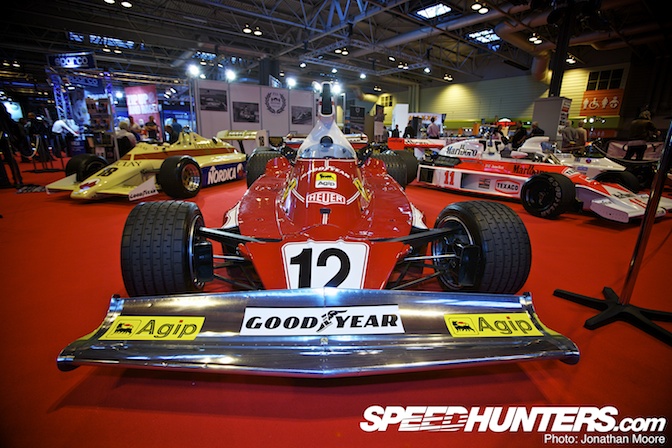
The Ferrari 312T of 1974/5 is from an era where all the cars were easy to differentiate, with or without iconic liveries. The high airbox and gleaming metal snow-plough front wing make it instantly recognisable (as would its screaming flat-12 engine). It's a great looking car – and was successful too, #12 propelling Niki Lauda to the title in '75.
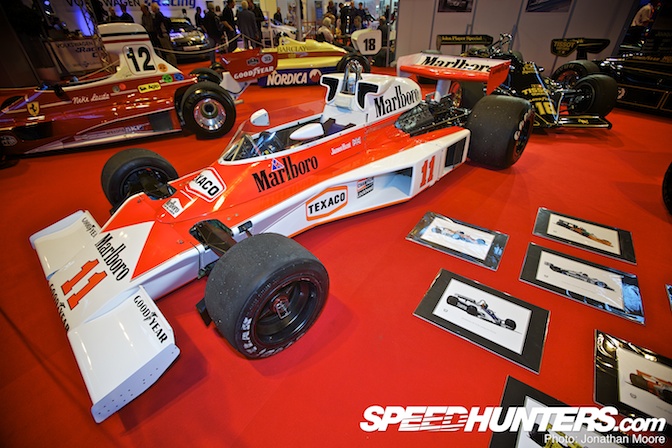
The McLaren M23 of 1973/4 featured a simpler, more angular nose wing but is again typical of the wider front bodywork used at the time.
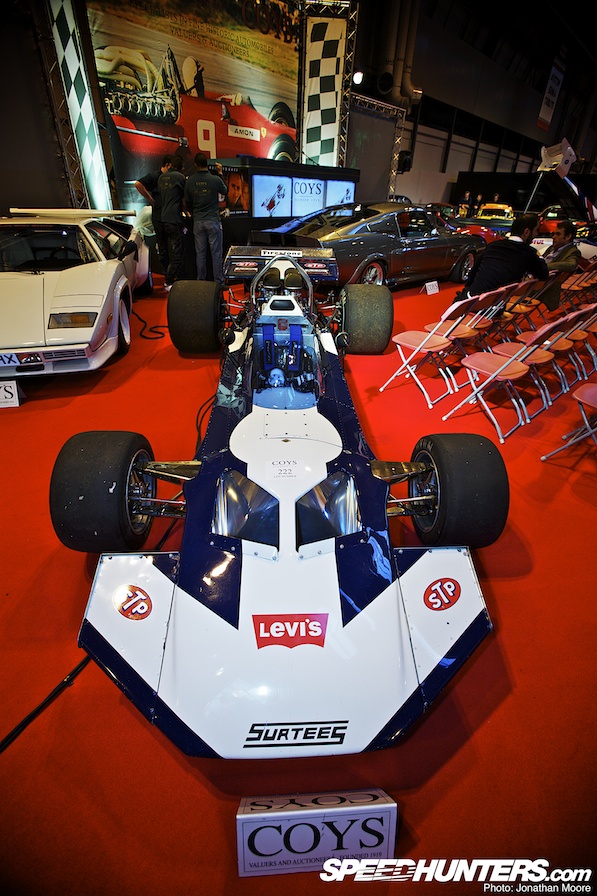
Another great shape and striking livery: the arrowhead front of a 1971 Surtees TS8, campaigned in F5000.
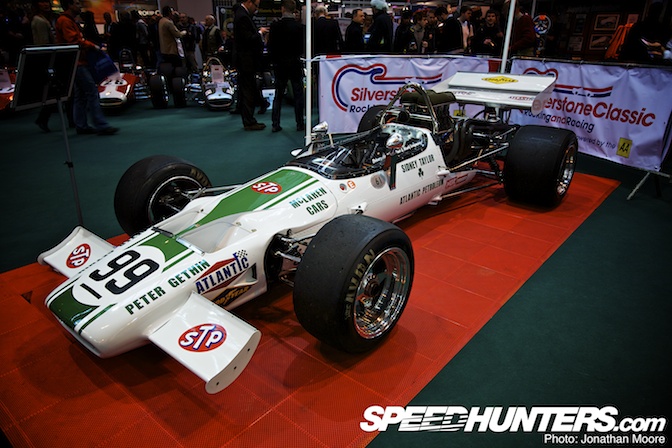
And finally a McLaren M10B, also raced in F5000 series in 1971, a car where you can see that the fundamental car shape is little different from the previous generation of cigar-bodied '60s racers, just with the addition of basic wings.
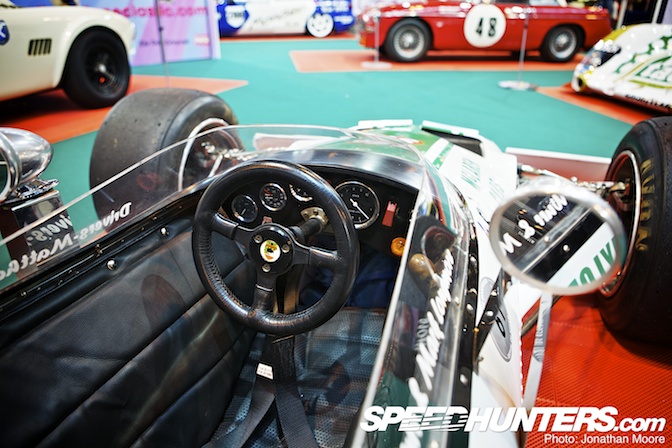
Of course, where the driver sits and what he has in front of him has changed just as much as aero over the years. Here's the almost sumptuous leather interior of the McLaren. Some pressure dials, a tach, fire controls and that's pretty much it.
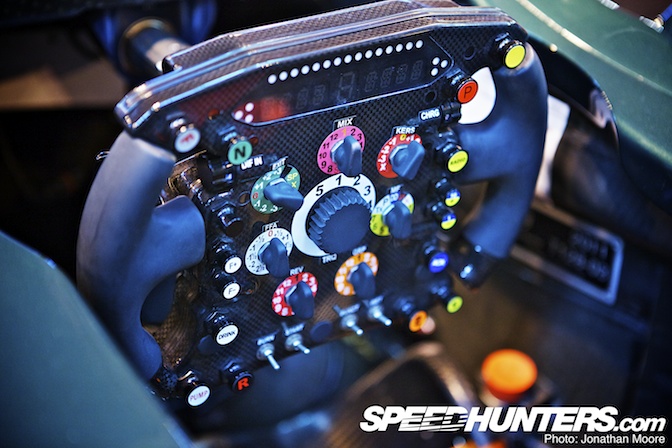
Now check out the steering wheel from the Lotus T128 F1 car from 2011. More buttons, dials and switches than a normal person could possibly deal with whilst driving at 200mph…
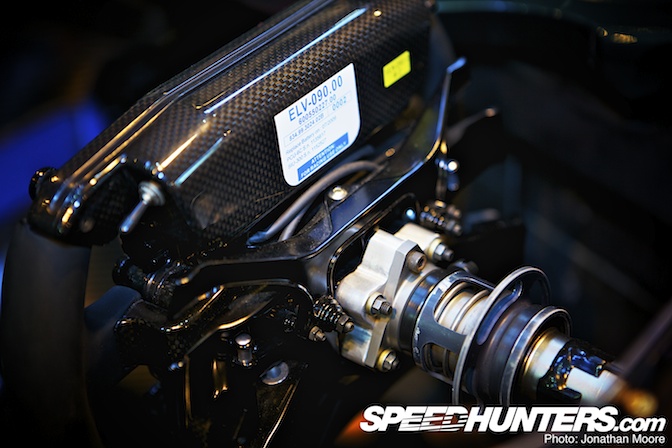
Even the rear is a marvel of carbon and lightweight metals. But it's still incredible to think that just this wheel can cost over £50,000…
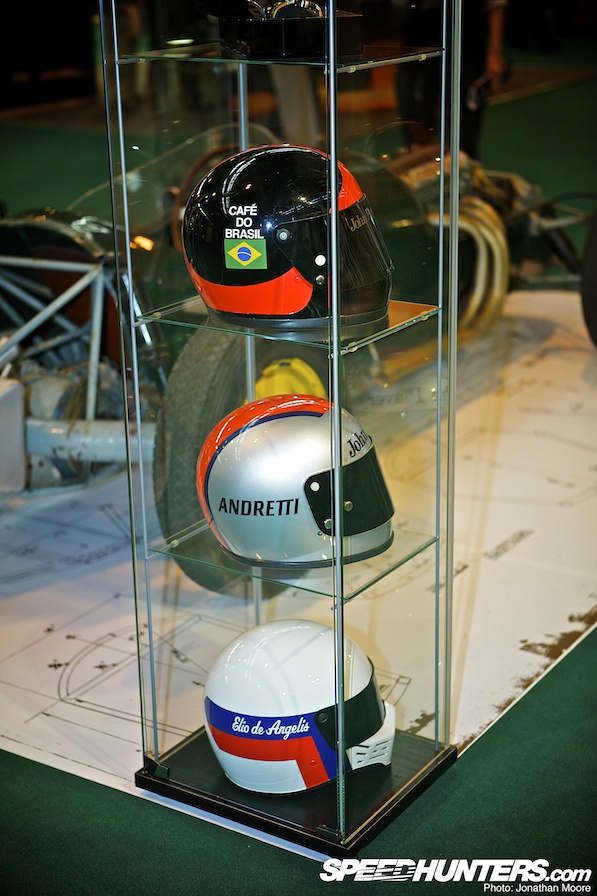
I'll finish up with two interesting displays I came across. Classic Team Lotus prepare and race a stable of old Lotus cars for clients, and the heritage of the cars is proudly displayed. Some of the legends raced for the team in its heyday, and here you could see the old helmets of Emmerson Fittipaldi, Mario Andretti and Elio De Angelis.

Finally, a reminder that although Bernie Ecclestone might get bad press for his love of the dollar, it's things like this that remind you that racing is in his blood. This is the 500cc Cooper MkV F3 car that he raced in 1951. He really was there at the beginning!
Jonathan Moore