In February of 2011, the city of Christchurch was shaken by an earthquake of disastrous proportion. Measured as a magnitude 6.3 and striking from an epicenter a mere 10 kilometres from the central business district, the quake caused widespread destruction on a scale not seen in New Zealand for a number of decades. In the aftermath of the catastrophe, the city has largely begun to move on – to rebuild, reimagine and rebirth.

While the infrastructure, buildings and environmental aspects of the Christchurch area took a beating, the resolve of the local community resonated vividly throughout the lingering dust and scattered debris. A resolve focused on resurrection, to create a new beauty from the ruins of the past.

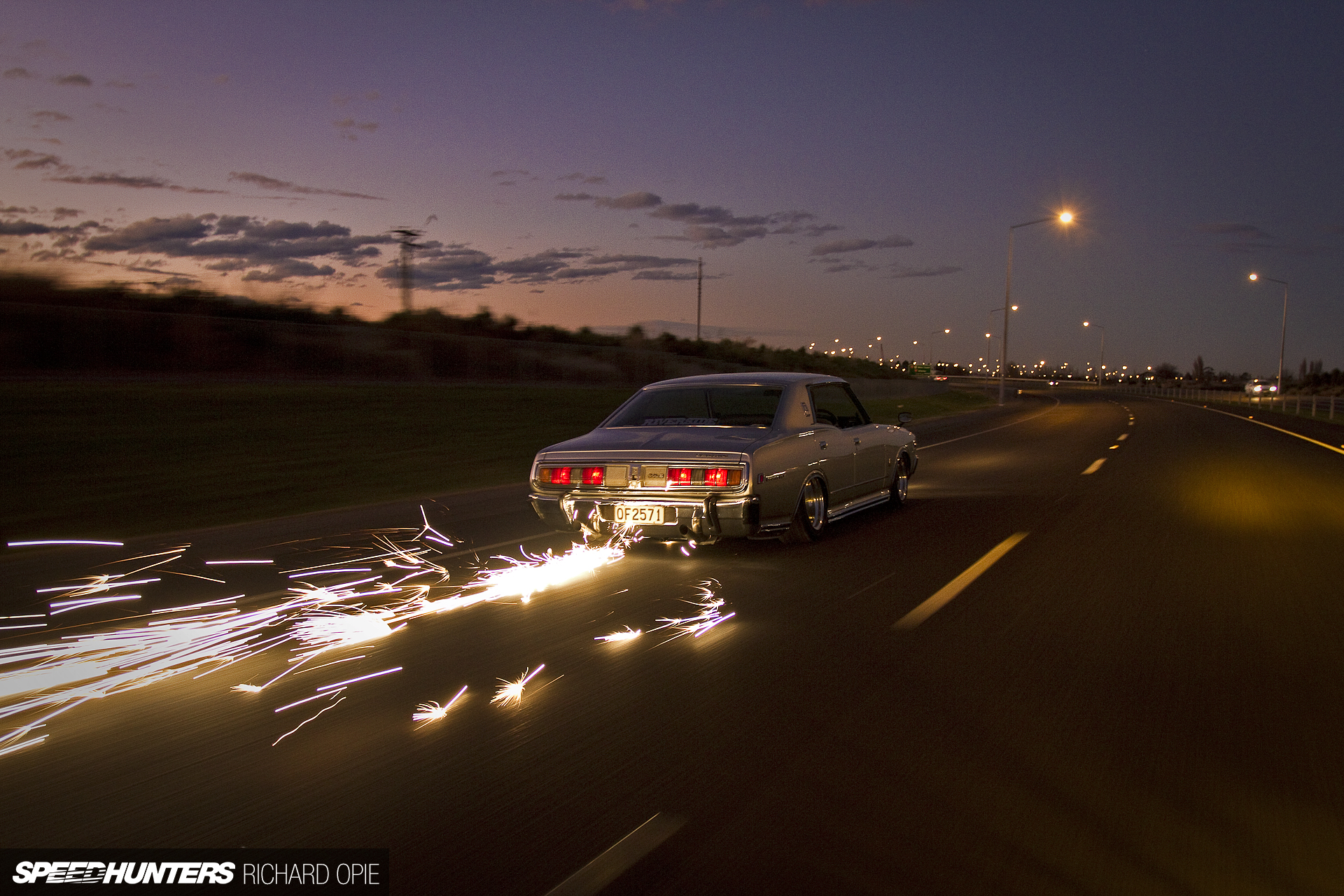
Among the multitude soldiering on with life in typical Southern New Zealand fashion, this strong-willed attitude is likewise evident within the automotive community of Christchurch. Despite the major setback of a substantial natural disaster, the scene remains tight-knit, maintaining a characteristic unique to the area, visualised not least in the swooping form of John Van Beek’s 1978 Nissan Cedric.

Emerging as a beacon of creation amongst an environment of destruction, John’s example could well serve to provide inspiration on just how to reimagine an old classic. It retains period character by the truckload, all the while taking advantages of the benefits afforded by a raft of cleverly conceived improvements. Things weren’t always this rosy for the big-body Nissan though, and the story of this particular car begins in 2008.

Following the completion and subsequent sale of a previous build – a KB110 Datsun 1200 coupe sporting a supercharged CA18DET (obviously the T substituted for a blower) – John’s curiosity towards the pillar-less silhouette of the H330 Cedric hardtop was piqued by the internet discovery of an example in Japan, owned by one Ishibashi-san.

Sporting a small block Chevrolet powerplant and an air ride system, exact details were scant, but the few images of Ishibashi-san’s low-slung silver sled declared the proverbial thousand words. An H330 Cedric hardtop was elevated to ‘must-have-in-the-shed’ status, prompting John to search for the right car to kick off a new project.

Even though New Zealand is something of a ‘lucky country’ (to steal a term purveyed by our neighbours across the Tasman sea) when it comes to an eclectic selection of Japanese market automotive delicacies, an H330 chassis in hardtop form is a rare beast. Fortunately, the internet came through again, turning up an example roughly 1000km further North on the East Coast of the North Island.

Reveling in the swathe of gadgets and knick-knacks Nissan saw fit to throw at the flagship SGL-E trim Cedric, John completed the home journey faultlessly – if not breathlessly.

Supermodel level the Cedric wasn’t. The 1970s American-esque body lines so characteristic of the Japanese motor industry of the period wore a 30-year-old coat of factory brown, beneath which the factory sheet metal retained a largely solid composure in lieu of the dreaded tin-worm. But save for a set of lowering spring, the car was complete and unmolested – an important consideration when dealing with such an unconventional starting point.

With Ishibashi-san’s H330 in mind the scene was set and a blueprint was laid. The Cedric was going to be low, running on air ride. The trusty L20E was to make way for a bent-eight of Japanese persuasion, and the cherry on the top was to be shade of silky silver enveloping the exterior surfaces.
To The Floor
Having mapped out the vision for the car, John set about the first of what he termed, three separate projects within the build itself. Namely, the creation of a bespoke airbag suspension setup, the fabrication required to slot in a VH41DE at the pointy end, and of course the massaging and prep work needed to bring the bodywork up to scratch and contain a yet-to-be-decided-on set of period rolling stock.

Amidst a plethora of carefully considered modifications it’s tricky to single out an area of the Cedric as a defining feature. Considering the air-bagged theme, it’d be rude not to start with the suspension, which although tucked away unseen is possibly the aspect that shines the brightest.

Initially planning (and starting the build of) a fairly conventional 5-link rear end setup utilising a disc-braked live axle, plans soon changed. Following a trip to Japan and exposure to domestic VIP builds featuring hearty dollops of negative camber, it didn’t take long for cogs to start turning and ideas to germinate.

Good old fashioned peer pressure from friend Nick eventually persuaded John that the live axle needed to go, and an independent rear setup was the future. Initial considerations included full subframe swaps from donor vehicles, however the comparative lack of space and associated need to hack up more of the shell to accommodate such a swap soon gave way to the wild creation slung beneath the rear haunches of the Cedric.

You see, Nick’s a bit of a dab hand using CAD in order to dream up bespoke solutions to problems car builders haven’t even thought of yet. And John, well he’s an accomplished fitter/turner with a solid understanding of CNC machining. Between the two minds, the resulting cantilever setup took shape, first on an LCD monitor (with a full stress analysis simulation to satisfy local certification requirements), then inside a machine room with John at the controls.

Custom CNC-machined carriers sit outboard, with tubular A-arms bottom and hefty billet machined top arms acting on a set of inboard mounted RideTech ShockWave adjustable shocks featuring a bag-over-shock style Firestone airbag. Contained within the tubular subframe is the viscous LSD equipped R200 diff sending torque through a pair of R32 Skyline half-shafts.

Although the front utilises a somewhat more conventional state of affairs, things are no less custom. Requiring a completely custom cross-member to support an engine swap slightly more serious than a tired old L-series, the opportunity presented itself to redesign the front end geometry to suit a lower ride height, as well as conform once again to strict road compliance rules.

New tubular A-arms take control of the front end, again skirting a pair of RideTech shocks featuring a bag-over-shock type arrangement. A conversion to rack and pinion from the archaic recirculating ball setup instructs CNC-machined, one-off front hubs which way to steer. Again, CAD simulation ensured the reconfigured geometry functioned flawlessly without danger of excessive bump-steer.

Last but by no means least, the air-ride operates under the command of an AccuAir e-Level controller – an addition John vehemently describes as the pinnacle of the car’s air ride system. Ride height and pressure sensors on all four corners ensure ride quality is kept in check. Say what you will about airbags – a well setup air system is definitely of no detriment to comfort or handling in a street application.

Peering at the underside, many further concessions to ride height have been designed to insure against problems occurring as a by-product of running close to the tarmac. This is evident in the 90x45mm oval section exhaust running the length of the floorplan following the exit of a block-hugging pair of tailored 4-1 headers.
Indoor Outdoor Flow
Upon rotating the ignition key clockwise, the twin up-swept stainless tail pipes loitering out the back of the Cedric emit an unmistakeably V8 burble on idle, rising to an aggressive crescendo with judicious application of the right foot.

Like his inspiration from the motherland, John’s also shoehorned eight cylinders beneath the expanse of the Cedric’s bonnet. But unlike the cast-iron pushrod small block GM unit retrofitted by Mr. Ishibashi, an aversion to cross-breed engine swaps led to the use of Nissan’s own contemporary V8 powerplant – the quad cam VH41DE more commonly found between the strut towers of a Nissan Cima or Leopard.

With previous experience dropping a VH41 into a Z32 300ZX, the attraction of an overhead cam, rev-happy V8 from the Nissan stable proved irresistible. Internally the engine remains as Nissan manufactured it, save for the addition of a set of aggressive camshafts to improve breathing and better utilise the striking addition nestling between the cylinder banks.

Anyone familiar with the VH41 will be aware of the sprawling intake plenum these engines are blessed with from the factory. Resembling a cast aluminium arachnid, once the V8 was lowered between the smoothed and tubbed front arches it became evident the intake was going impede fitment of the bonnet. Solution? Create a lower profile inlet by way of adding an ITB arrangement.

Akin to the H330 itself, the VH41 also suffers from a dearth of aftermarket support. True to fashion, John created his own ITB setup, dubbed the JBR ‘Octothrottle.’ Delving deep into his skill-set, a wooden buck was first formed, giving way to eight individual sand-cast aluminium throttle bodies. Machine-finished and fitted with a set of (yeah… you know) – one-off carbon fibre trumpets, the end result is as visually stunning as it is aurally pleasing.

And it works! Following a dyno session tuning the Link G4 Extreme ECU in charge of the whole setup, John netted a respectable 268kW (360hp) at the rear treads, spinning the VH41 to an ear-splitting 8.000rpm. It’s a noise I can quite happily say sounds exceptional resonating throughout the still, dusk Christchurch air.

With a contemporary mechanical package, a desire to retain the 1970s character of the Cedric resulted in subtle, yet consistently thorough approaches to the interior and exterior of the car. Maintaining a premium feel inside, a re-trim in black leatherette and Alcantara cohabitates with the full SGL-E feature set. All original gadgets remain intact (and working), as do original door trims and all the little finicky styling cues so typical of ’70s-era Japan.

Outwardly, the aesthetic impact offered by the hardtop body style is unmistakeably. Sweeping disjointed waistlines from the rear and front, reminiscent of 1971 Buick Riviera, underline the gaping aperture of the passenger compartment. Keeping the Nissan theme running strong, the glossy metallic silver tone has been lifted from an R34 Z-Tune GT-R, although to no detriment of the period feel.

The re-plated lustre of the heavy chrome front and rear bumpers complement the tone, tubbed rear arches encompassing yet one more custom touch. Period-perfect August Feroce 3-piece wheels sink into the body, but while the fronts measure 15×7.5 inches, the 15×10-inch rears required the custom touch. Here, in a display of commitment to get things ‘just right’, John formed his own die to spin new barrels.

Cruising the broken streets of Christchurch in the Cedric, you can’t help but wonder just what the local community is going to make of the rebuild of their shattered city. If the drive, imagination and will to see something truly special through to completion is inherent, the city – much like John’s Cedric – has the potential to rise from the dust and stand proud at the pinnacle of its game.
Richard Opie
richy@speedhunters.com
Instagram: snoozinrichy
John Van Beek’s 1978 Nissan Cedric SGL-E (H330)
Numbers
268kW (360hp) at wheels
Engine
Nissan VH41DE 4.1-litre V8, stock bottom end & cylinder heads, Kelford race cams, JBR sand-cast independent throttle body setup, custom linkages, carbon fibre velocity stacks, custom cross-member, custom equal-length headers, custom 90x45mm oval section exhaust with ‘X’ pipe, 370cc CA18DET injectors, Walbro 500hp in-tank fuel pump, custom alloy radiator, full engine bay de-loom, Link G4 Extreme engine management system
Driveline
Nissan 5R01 5-speed automatic, Compushift II transmission controller (manualised), Nissan R200 viscous LSD diff
Suspension/Brakes
Custom front crossmember, rack & pinion steering conversion, custom tubular front A-arms & shock mounts, urethane bushes, uprated anti-roll bar, custom front hubs, custom tubular steel IRS subframe, custom rose-jointed tubular rear lower arms, custom billet rear cantilever arms & shock cradle, custom billet rear knuckles, RideTech ShockWave shocks with Firestone bag-over-shock arrangement front/rear, Nissan R32 GTS-t front 4-pot disc brakes, Nissan R32 GTS-t rear 2-pot disc brakes, Nissan R31 Skyline half shafts, titanium skid plates
Wheels/Tyres
August Feroce 15×7.5-inch, Toyo T1R 195/55R15 (front), August Feroce 15×10-inch, Toyo T1R 225/50R15 (rear)
Exterior
Tubbed front & rear arches, notched front inner guards to clear top arms, Nissan R34 Skyline Z-Tune silver paint (code KY0), re-chromed bumpers, new-old-stock badges & emblems, standard SGL-E grille & trim options
Interior
Standard seats re-bolstered & trimmed in black leatherette and Alcantara, standard door trims, illuminated resin shifter


