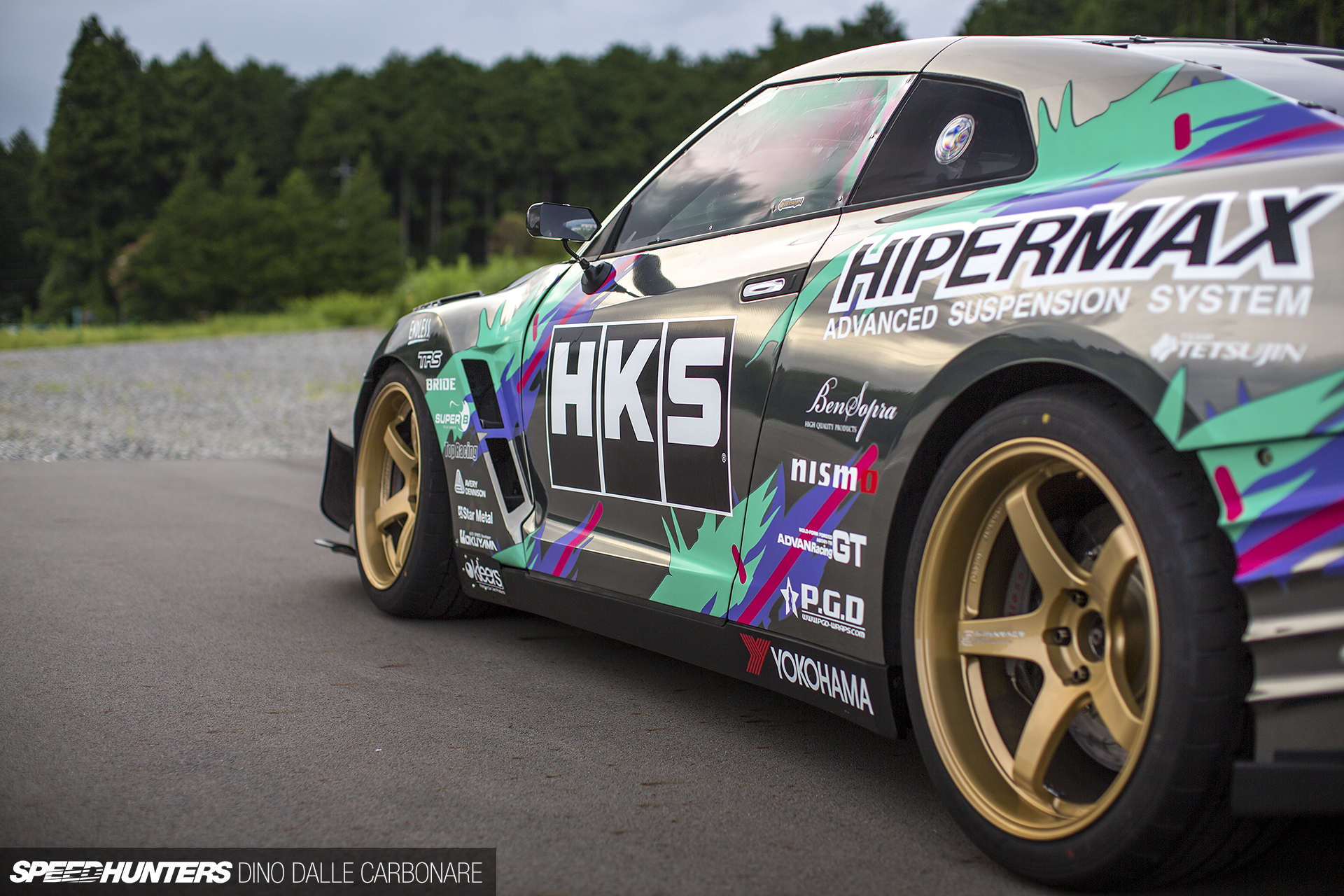
This is HKS’s time attack GT-R and it’s currently the fastest R35 to ever lap circuits like Fuji Speedway and Sydney Motorsport Park. It’s quite an interesting creation in that it has reached these accolades without much use of aero – something that over the last few years has completely taken over the time attack scene at both a pro and amateur level. Could the car go faster if it had a dedicated aerodynamically-sculpted exterior? Most definitely. It would probably go much faster…

But that’s besides the point. HKS is a company that specialises in making engine and tuning parts, and therefore its demo cars must first and foremost show what these components are capable of. Downforce doesn’t enter the equation – it’s all about raw power, and when it comes to this R35 – quite a lot of it.

The whole GT1000+ project, as it’s known, was designed to compete on the international stage – specifically in the R35 GT-R class of the World Time Attack Challenge in Australia. Last year, against some tough competition, it won the division with a 1:30.838 lap time.

With HKS located only an hour away from Fuji Speedway, the iconic racetrack has served as the place to test and setup the car. At the same time, setting the GT-R benchmark here became a secondary goal for the team. It was earlier in the year at the HKS Premium Day where Nob managed to post the fastest GT-R time around Fuji yet, making this R35 another successful project to come out of the company’s Fujinomiya factory.

But then again, that really sums up HKS pretty well. If it isn’t going to win, or at least be in with a chance to be the best, it won’t even bother embarking on a project. HKS come, conquer and then they leave. It’s the way things go with this company, and one of the reasons we never saw the CT230R return, even though it could have easily challenged Under Suzuki’s time at Tsukuba and taken on the top cars at WTAC.

For this very reason the R35 may have reached the end of its operational life. There might be a few more outings for development purposes, but otherwise it has achieved everything it was ever supposed to achieve. And that makes it the perfect time to take a closer look – there are no secrets and no area of the car is off limits.

This is how I found myself spending a very enjoyable day at HKS HQ along with Saito-san, the man behind the project and pretty much every other cool thing that the company gets up to. After checking out a bunch of new and old stuff over the course of the afternoon (yes, you can expect a few more features to come out of my visit), it was time to drive the GT-R out to the back of the massive property that HKS owns at the base of Mt. Fuji.

After seeing this overpowered beast being manhandled by HKS’s driver of choice, Nobuteru Taniguchi, it’s nice to be able to soak in every detail, ask Saito questions and hear about all the challenges that the build threw up.

Let’s talk a bit about the aero first. Like I touched on earlier, things are pretty basic in this department, starting with a BenSopra bumper and spoiler section that keep the front wheels planted on the ground – even at the 200mph-plus speeds the engine can push the GT-R to on the Fuji main straight. The bumper is joined by wider and vented fenders which swallow up the massive 20×11-inch wheels.

The long partnership between HKS and Yokohama has continued on this project with a set of Advan Racing GT wheels. Advan’s GT-R-specific performance tyre – the A005 – which looks more like a cut slick used in rally tarmac stages than a street compound, wrap around the forged rims. With the pace this car accelerates at, HKS ensured Nob always has a reassuring and potent brake pedal by fitting 6-pot monoblock Endless calipers at each corner along with E-grooved Endless floating rotors. The calipers are an endurance-spec model and accommodate brake pads which are easily twice the size of regular street equivalents.

And then we have the rear end…

BenSopra’s rear bumper and diffuser treatment certainly makes the R35 stand out, and if that doesn’t, the Miura-special, bumper-mounted GT wing certainly does.

HKS extended the diffuser’s fins to accentuate the effect it has at high speed, and cut out a small part from the center section so that the custom single-exit exhaust could poke through inconspicuously.

HKS’s main focus was on stripping weight from the GT-R, so on top of the carbon roof, the engineers also ditched the heavy rear glass and replaced it with a much lighter an FRP cover. And in case you are wondering, not, it’s not transparent, so Nob can’t see anything out the back.

He doesn’t need to of course, as the GT-R is usually the fastest car on track when it’s out there. But just in case he needs to, Craft Square carbon side mirrors are more than sufficient.
A VR38 Like No Other
HKS’s goal was to build the entire car’s success on power, which required them to push the VR38DETT to power levels that they had never reached in a time attack car before.
Here’s a video that HKS released last year after the R35’s outing at WTAC, also touching on the main points of the project.

1200PS is what this motor pushes out. And now that I’ve quoted the power figure, I’ll just stop you right there. Yes, we all know there are GT-Rs pushing out several hundred horses more than HKS’s 1200 – but those are drag cars.

The whole idea of building the motor for this GT1000+ was to create something powerful but at the same time reliable, so that it didn’t need to be rebuilt after every outing.

At the center of it all is a 4.1L stroker kit, made up of top-of-the-line and coated bottom end components that are able to take the abuse of 2.0bar (29psi) of boost for sustained periods of time. With the stroke increased to match the 95.5mm bore, it makes this engine ‘square’, and it runs a 9.0:1 compression ratio. To flow the required boost, the heads were given the appropriate attention and matched to the best cams that wouldn’t impact response and mid-range punch in any way. In fact, there’s 130kgf-m of torque available – a number which truly defines what this engine is all about.

The bigger volume and better-flowing HKS intake plenum feeds each of the six cylinders, and at the same time provide mounting places for the additional six injectors that are used in the setup. Apparently using a dozen 575cc sprayers was the best solution for keeping electric throttle response, as they are far faster reacting than bigger capacity squirters would be. Engine management is handled by an HKS F Con V PRO with the cabin-mounted EVC 6 boost controller keeping the GT1000 turbochargers pinned at maximum boost.

That response is definitely something I remember noting earlier this year at the HKS Premium Day. Shooting trackside, I could hear how the engine just exploded with acceleration every time Nob got back on the throttle and made his way through the final section at Fuji.

But then again, when you have this much power and torque on tap, the rest of the driveline is going to suffer. The GT1000+ is actually the reason that HKS’s strengthened gearbox upgrade was developed. Previously, the car kept snapping gears. The much stronger, and in some cases wider billet gears are able to take up to 1400PS – and that goes for the upgraded twin-clutch assembly too, which not only employs much better friction material but has more plates per stack for slip-less changes. Saito-san showed me the gearbox in all its beautiful details so I’m going to have to nerd out and dedicate a entire post just to it and its components. Check back for that soon!
In the video above, which I shot quickly during the shoot, you can hear what the gearbox and engine sound like when I jumped in and Saito-san moved it from the garage to the shoot location.
As Stripped Down As It Will Go
The next area of interest is Nob’s office.

HKS has thrown a lot of carbon fiber at this car, and along with the bonnet, roof and other components, the two pieces that really helped drop weight were the doors. These are also mated to Lexan windows that make the assemblies weigh no more than a few kilogram on each side. That helps to drop the entire weight of the car 210kg to 1,530kg.

With all trim and carpeting stripped, it’s easy to see just what a well-designed chassis the R35 hides under beneath. To this, HKS fabricated a serious cage for rigidity and safety.

Here you can see more carbon to seal off the cabin from the trunk area.

The GT1000+ runs the exact same carbon dashboard that Daigo Saito uses in his Formula D GT-R. It’s extremely thin and light, but hides away all the nasty wiring that the R35 is laden with.

It’s quite funny to see the transmission, suspension and stability control switches still intact. But the way in which the GT-R – like all modern and complex cars – is wired, it’s necessary to keep this part of the electronics wired in.

Since the R35 is meant to be driven by Nob – and only Nob – the Bride full race bucket has been mounted in a fixed position, doing away with heavy seat rails.

It’s almost a given that when Nob was asked to choose a favourite steering wheel to fit in the GT-R, he picked a leather Nardi. This is the wheel he’s had in all his cars, so why change now?

In addition to the F-Con V PRO engine management system some more modules were fitted – something we are all used to seeing in Japanese tuner cars. The important one is the AFK on the left that monitors A/F ratio throughout the RPM range and boost loads.

One of the most crucial requirements of a time attack car of this caliber would have to be the suspension – another area that HKS developed in house. The Hipermax IV are a refined version of the adjustable coilover system that HKS has been evolving along with the car, and as the times show they do an impressive job of getting the most out of the engine’s capabilities and the grip of the Advans.

Back in January at the Premium Day was when Nob set the fastest ever lap time at Fuji for a tuner car, and a GT-R. To put it into perspective, the 1:37.773 makes the GT1000+ just as fast as the Nissan GT-R GT3s used in the Super GT GT300 championship.
A GT3 racer uses lighter weight and a significant aero package, while the HKS car is all about brute power. Same result, different path.

Much like every other demo car that HKS has built, the GT1000+ will do down in history as something pretty special. But it’s not time to turn on the tears quite yet – there are still some outings planned for this car and it will continue to serve as a development car for HKS’s technical department. There’s also a planned trip to a time attack event in Sepang in October and then Nob will drive the GT-R at the Motorhead Hill Climb event in November.

I get what HKS has tried to do with this car, but deep inside I can’t help but wonder just how fast it would actually be if it had a worthy aero package. GT500 times would probably be more than a possibility. Too bad HKS won’t go there, but we can’t all help but wonder, right?
Dino Dalle Carbonare
Instagram: speedhunters_dino
dino@speedhunters.com
HKS GT1000+ GT-R
Power
Max Power: 1200PS, Max Torque: 130kgf-m, Max Boost: 2.0bar, Weight: 1,530 kg
Engine
HKS 4.1L stroker kit (4,10 cc), HKS 95.5 mm forged pistons, HKS H-section connecting rods, HKS crankshaft 95.5 mm stroke, HKS 0.8mm metal head gaskets, 9:1 compression ratio, HKS ported & polished heads, HKS camshafts 270in/278ex 11mm lift, HKS exhaust manifolds, GT1000 turbo kit, HKS Racing single-exit titanium exhaust system, HKS intake pipes with SPF filters, HKS R Type GT1000 Spec intercooler, HKS piping kit, HKS blow-off valves, HKS high-flow intake plenum, 12x HKS 575cc injectors, 3x Bosch Motorsport fuel pumps, HKS F-Con V PRO Ver.4 engine management system
Driveline
HKS billet reinforced transmission, HKS GR6 reinforced clutch pack with added friction plates
Suspension/Brakes
HKS Hipermax IV Fuji Spec adjustable suspension kit, Endless monoblock 6-pot calipers front/rear, Endless 2-piece floating rotors 400m (front), 387mm (rear)
Wheels/Tyres
Yokohama ADVAN Racing GT 20×11-inch +5 front/rear, Yokohama ADVAN A005 290/710-20 front/rear
Exterior
BenSopra front bumper, BenSopra front under diffuser, BenSopra front ear fenders, BenSopra rear wing, BenSopra rear diffuser, HKS carbon bonnet, carbon fiber doors
Interior
Stripped-out cabin, custom rollcage, carbon fiber dashboard, Bride Maxis III NOB SPL seat, HKS EVC 6 boost controller, HKS Knock Amp meter, HKS Circuit Lap Counter, HKS ATSC, Nardi steering wheel