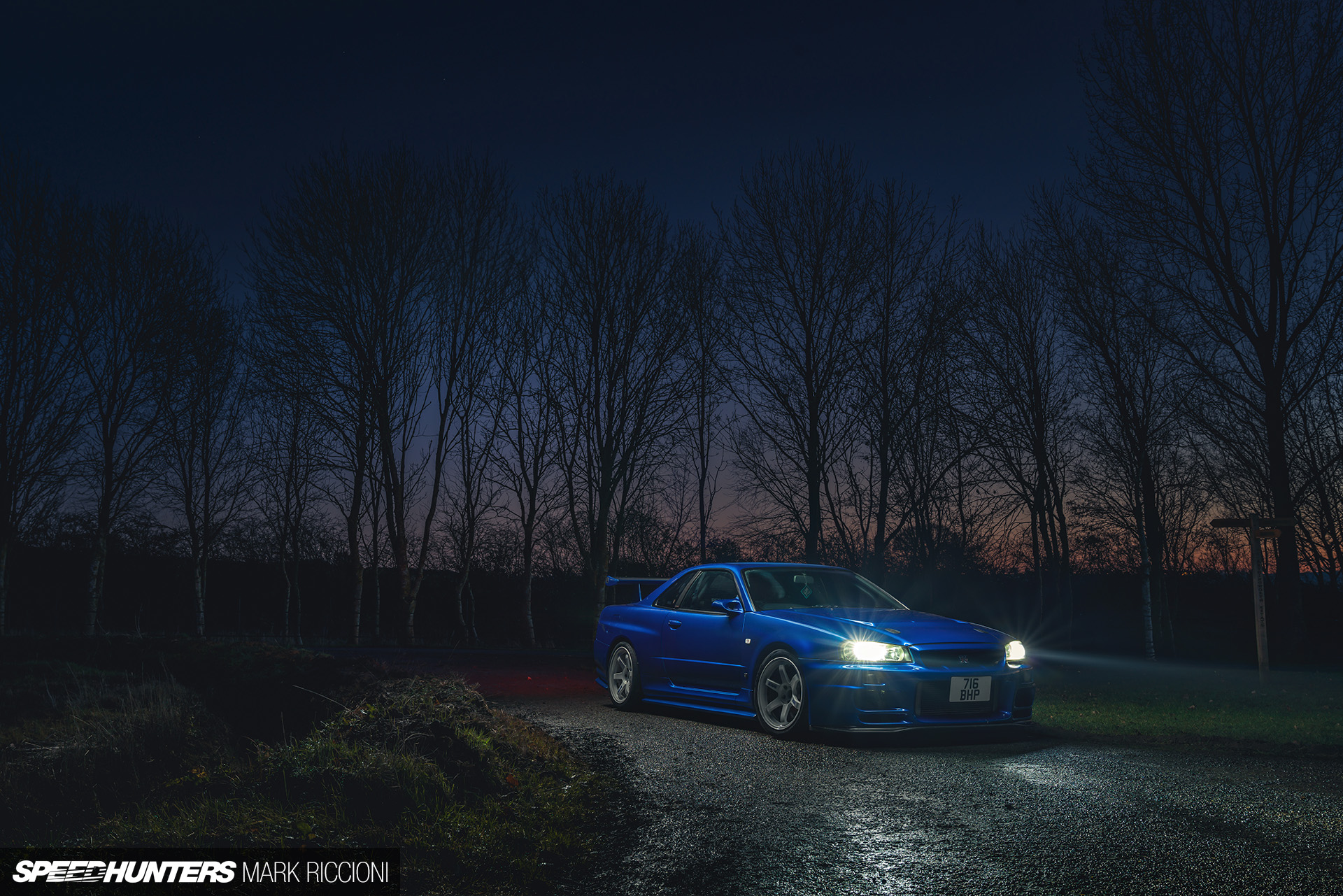
If Project Thirty Four were in a sitcom, it’d have slept with its brother’s wife, robbed the local church, and ended up in hospital having been ran over by a disgruntled vicar.
The GT-R’s show really should’ve been cancelled months ago, but so impressive are the viewing figures that our Speedhunters producers have already renewed its contract. So here we are, in what feels like the 12th season in as many months, wondering what cliff-hanger lurks around the corner next.
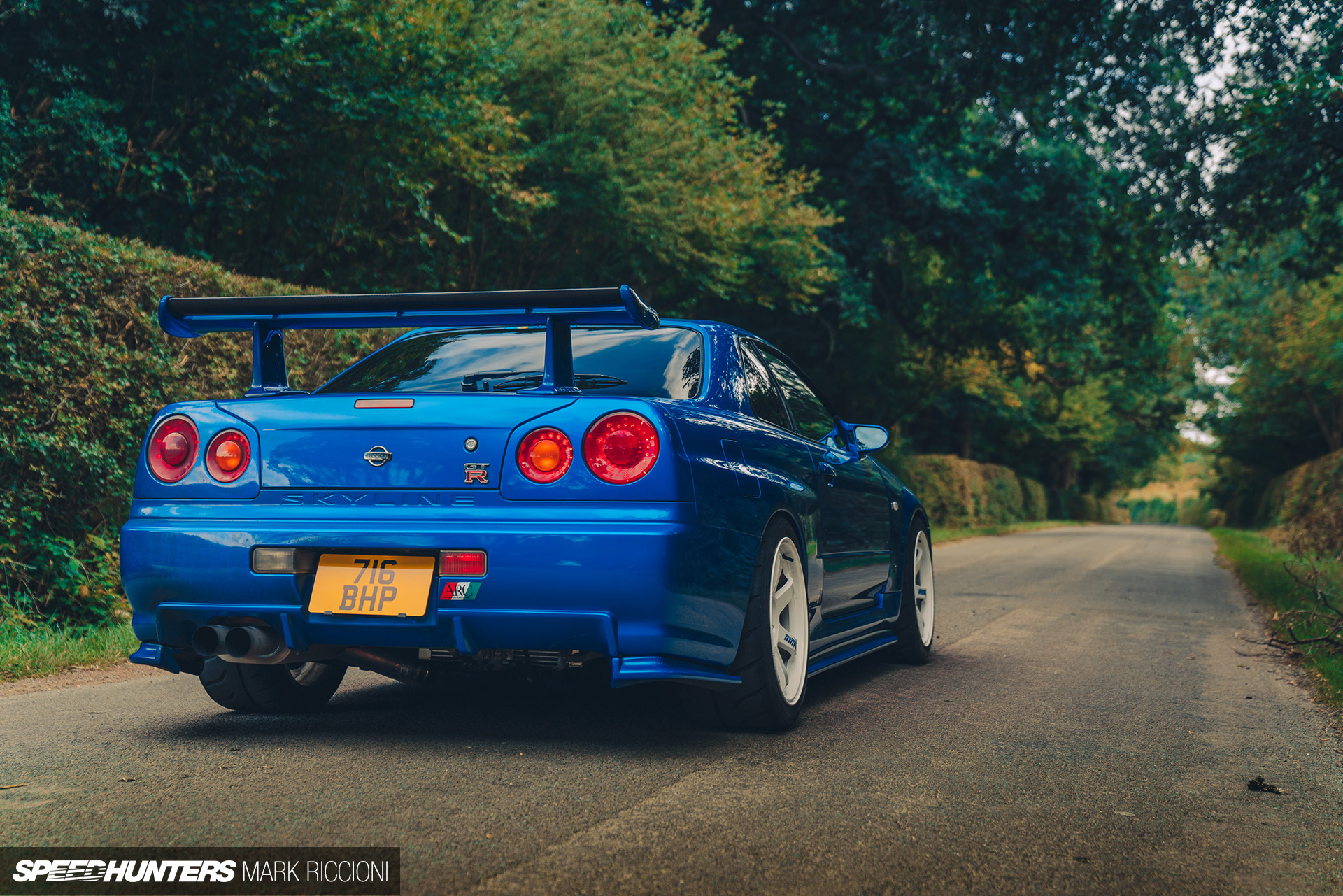
If you’ve been following the Skyline’s progress, you’ll be surprised to see I haven’t committed harikari, nor have I covered it in sardine oil and fed it to the tigers. To say its ownership has been eventful would be like saying the Titanic sprung a small leak. However, unlike that sunken boat, this one’s being rebuilt.
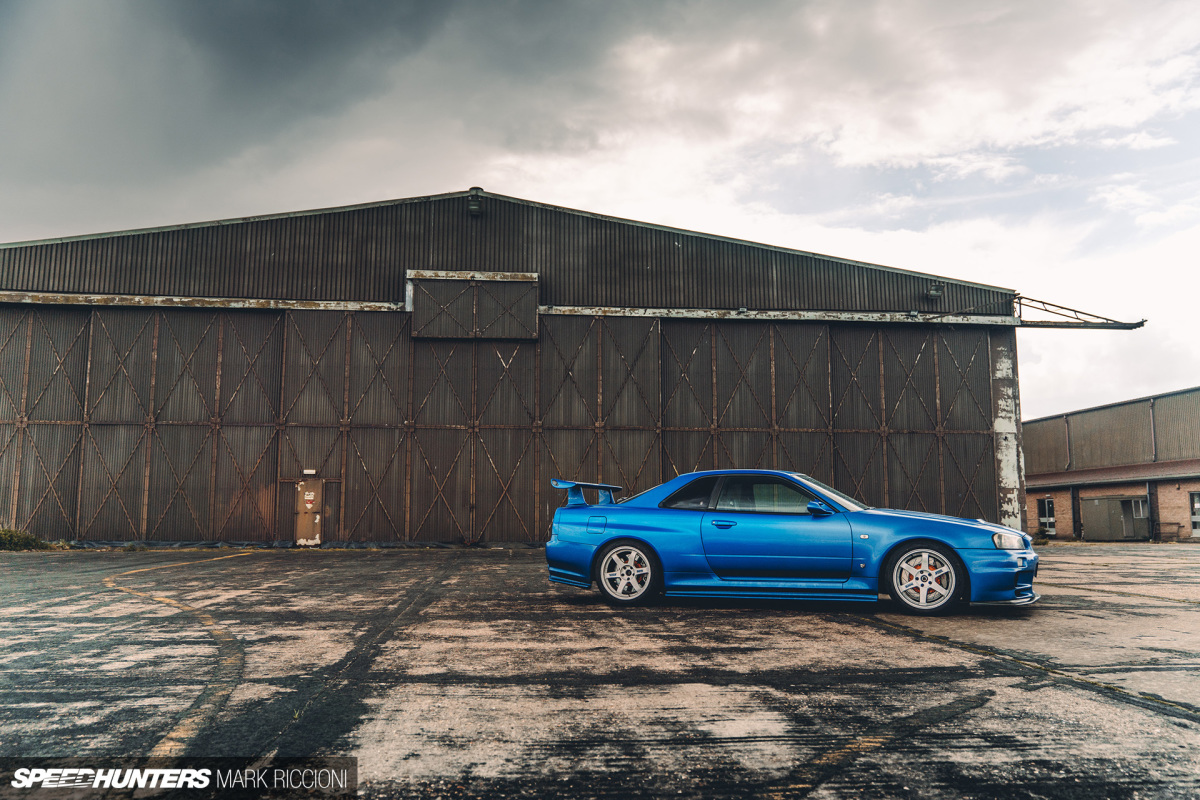
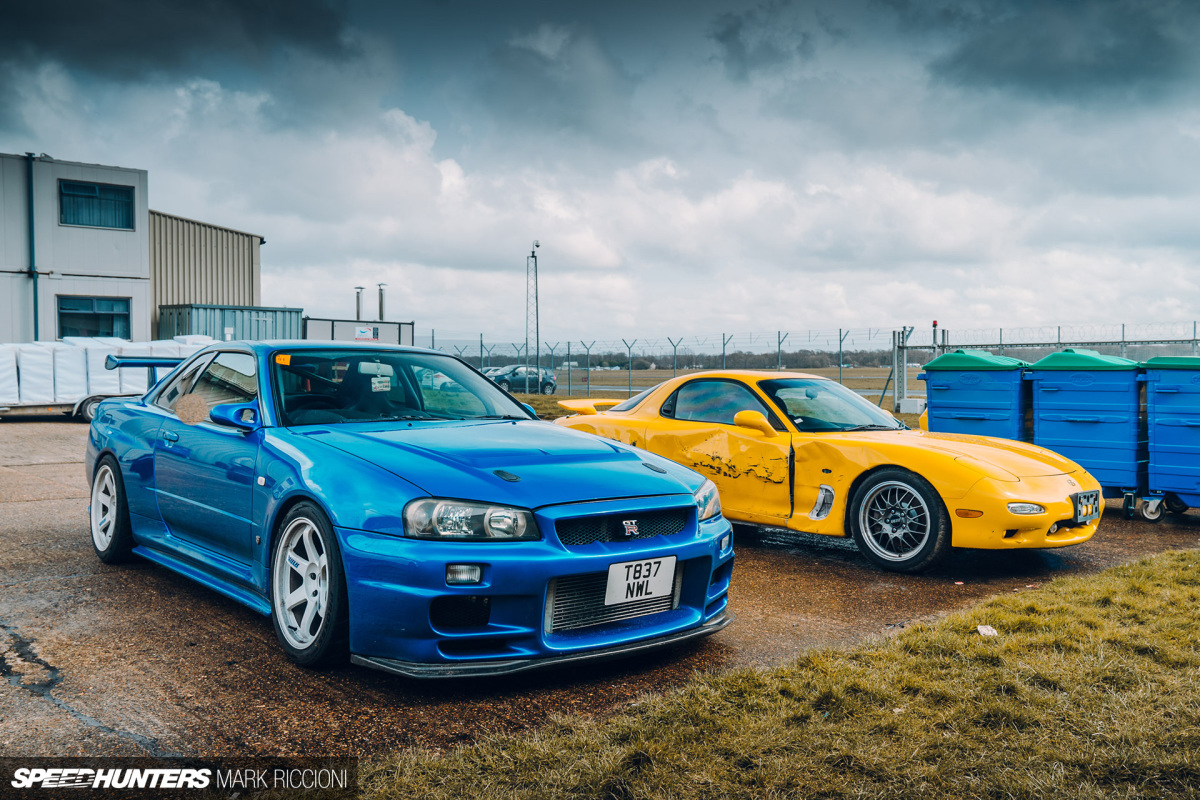
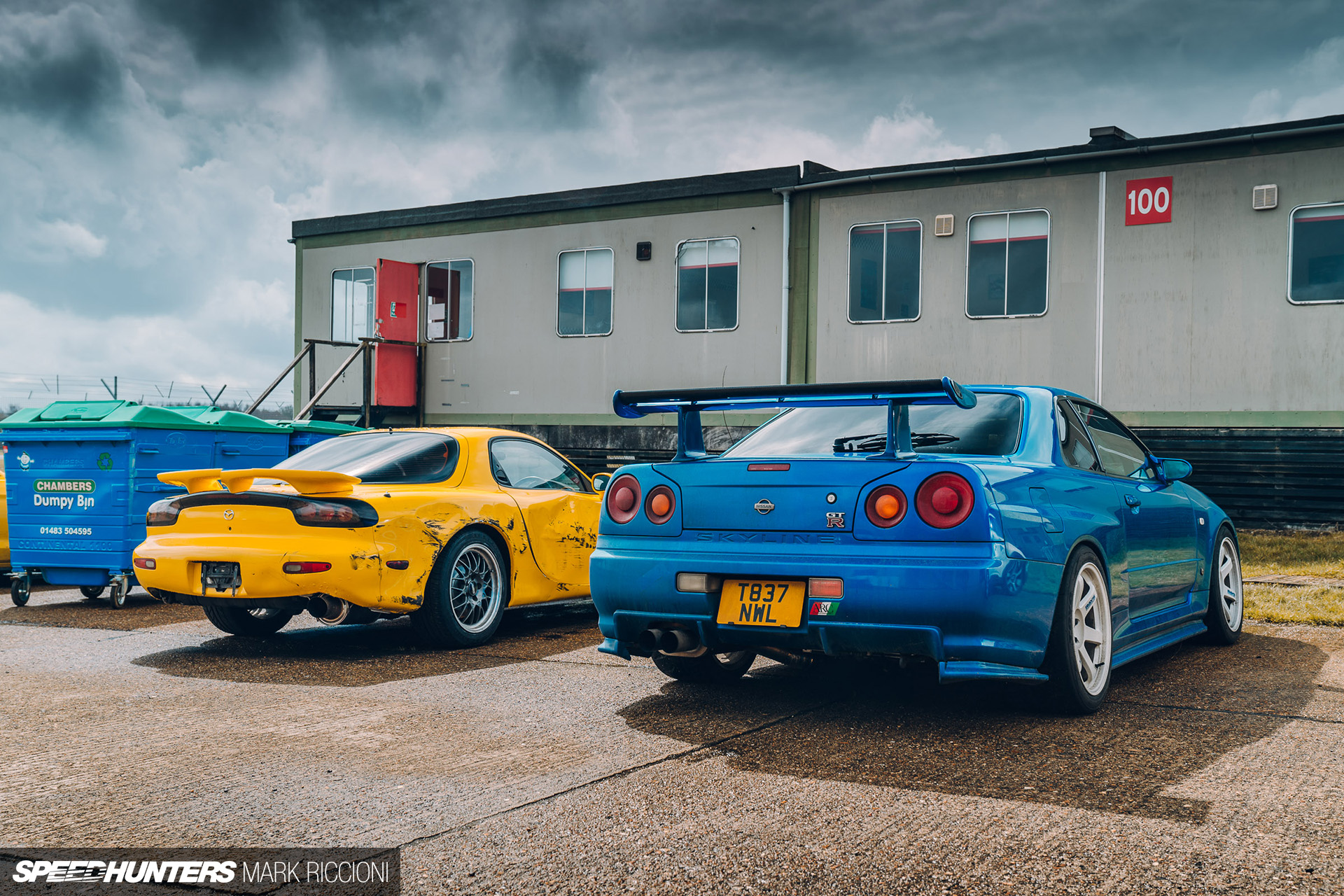
Not many calls send a shiver down my spine for the simple reason I try and answer as few as possible. However, at the top of this list is my dad. I moved out over 13 years ago, but I’m still paranoid he’ll call asking if I know where his tools are. He knows exactly where they are; they’re in my garage. Second on this list is the police (for obviously reasons), and a new entry at number three is RK Tuning. But only in the 24 hours immediately after dropping a car there.
“Hello mate, it’s Ron. Right, where do you want me to start?”

I’d always assumed the oesophagus and arsehole were two separate muscles, but the realisation of an engine failure can miraculously forge them into one. Asking Ron if he’s alright is a moot point; the man hasn’t missed a day of work in over 30 years. Short of some lunatic taking an interest in bat soup, nothing will stop him from picking up the spanners. With this in mind, I’ve learnt it’s best to simply rip off the Band-Aid and unleash all the pain at once.
“You’ve snapped an exhaust valve. That’s now lodged within your piston. It’s made a hell of a mess of the cylinder head in the process. Did you stop the engine after it happened? I’ll check the crank, rods and block, but at the very least we’ll need a new head, valve and piston.”
Explaining to Ron I’d driven nearly 10 miles home with said valve embedded in the piston felt counter-productive. Because much like my dad’s toolbox, Ron already knew the answer.
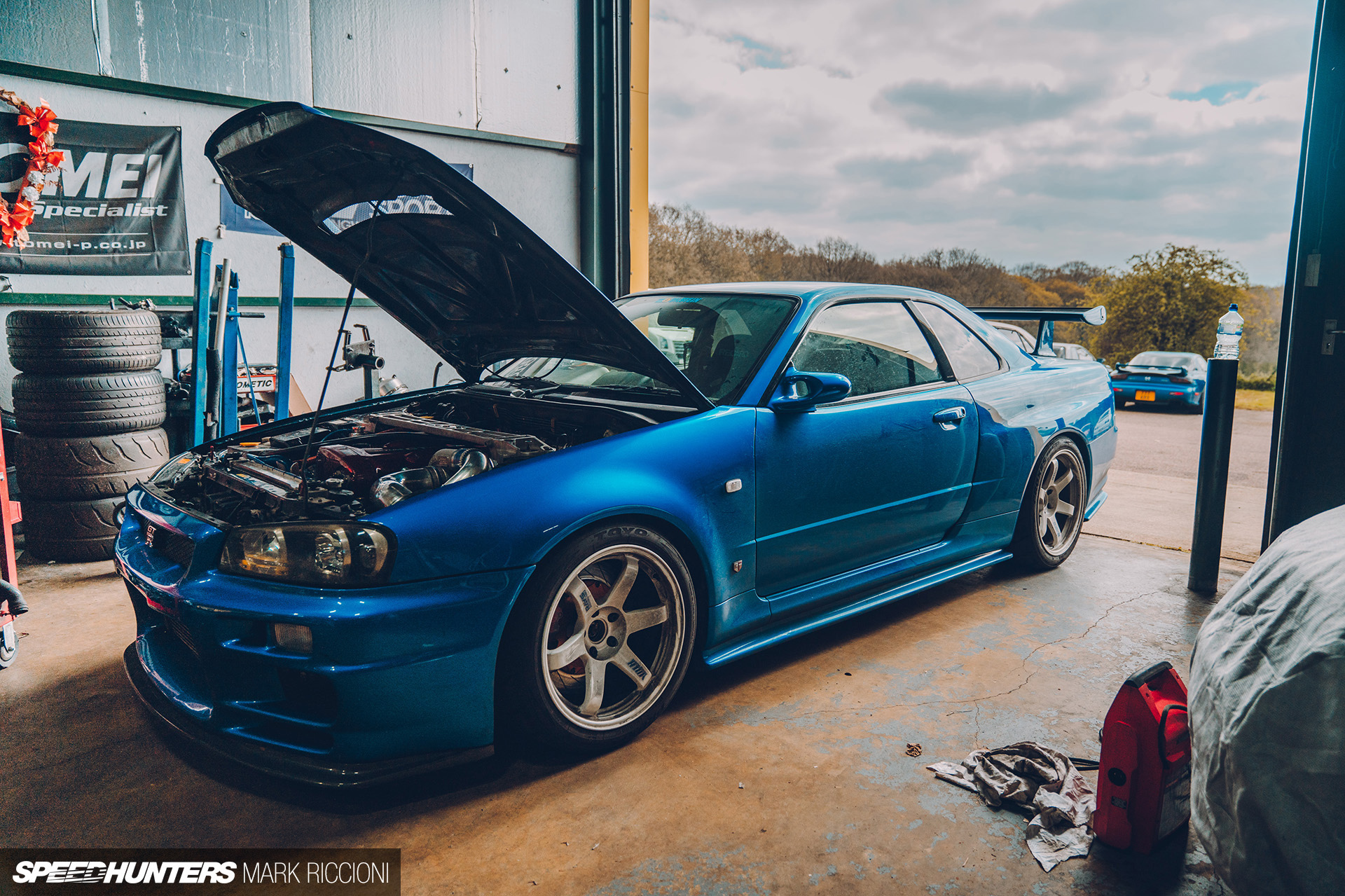
I don’t know if there’s an automotive equivalent of ‘Stockholm Syndrome’, but ‘Skyline Syndrome’ definitely exists. Because my first thought upon hearing this news wasn’t to scream and rip my hair out. It was more a facial expression of ‘not bad’ (see Obama meme for reference) as there was a chance the block and HKS crank might be alright. That’s the beauty of GT-R ownership; so conditioned are you for the worst-case scenario that anything less feels like a positive result.
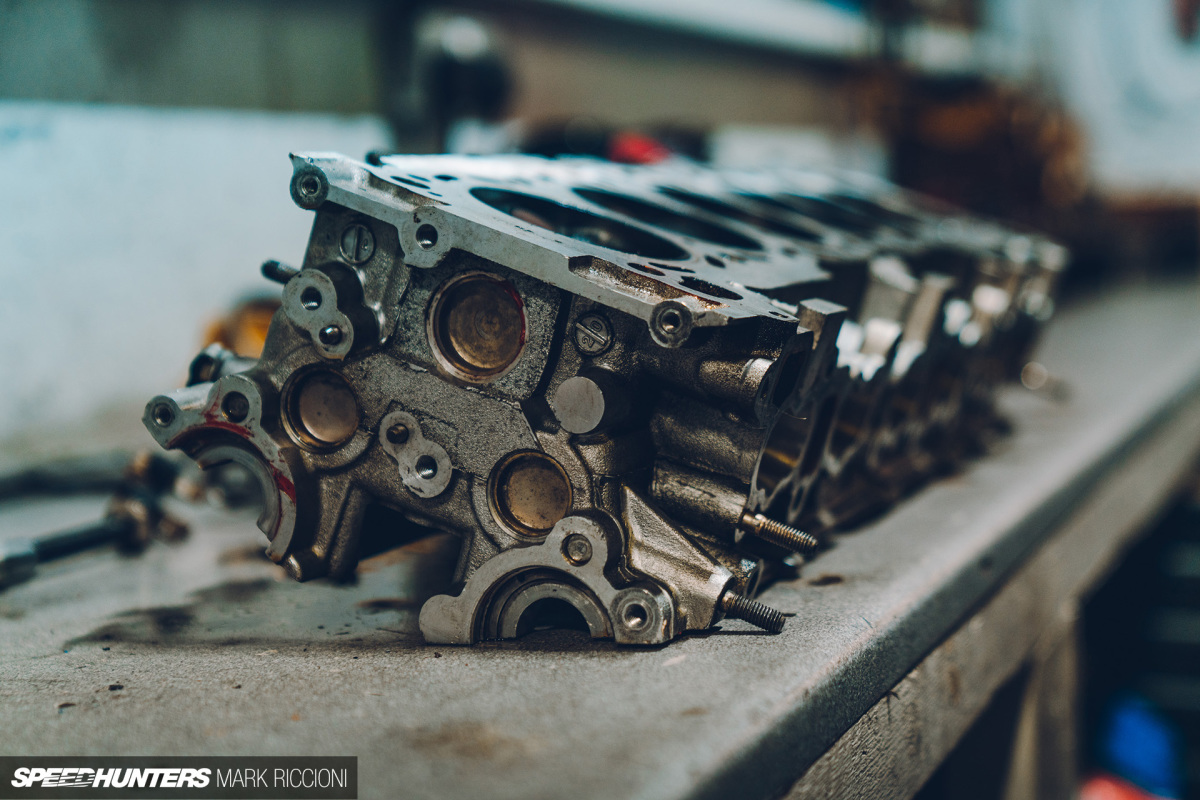
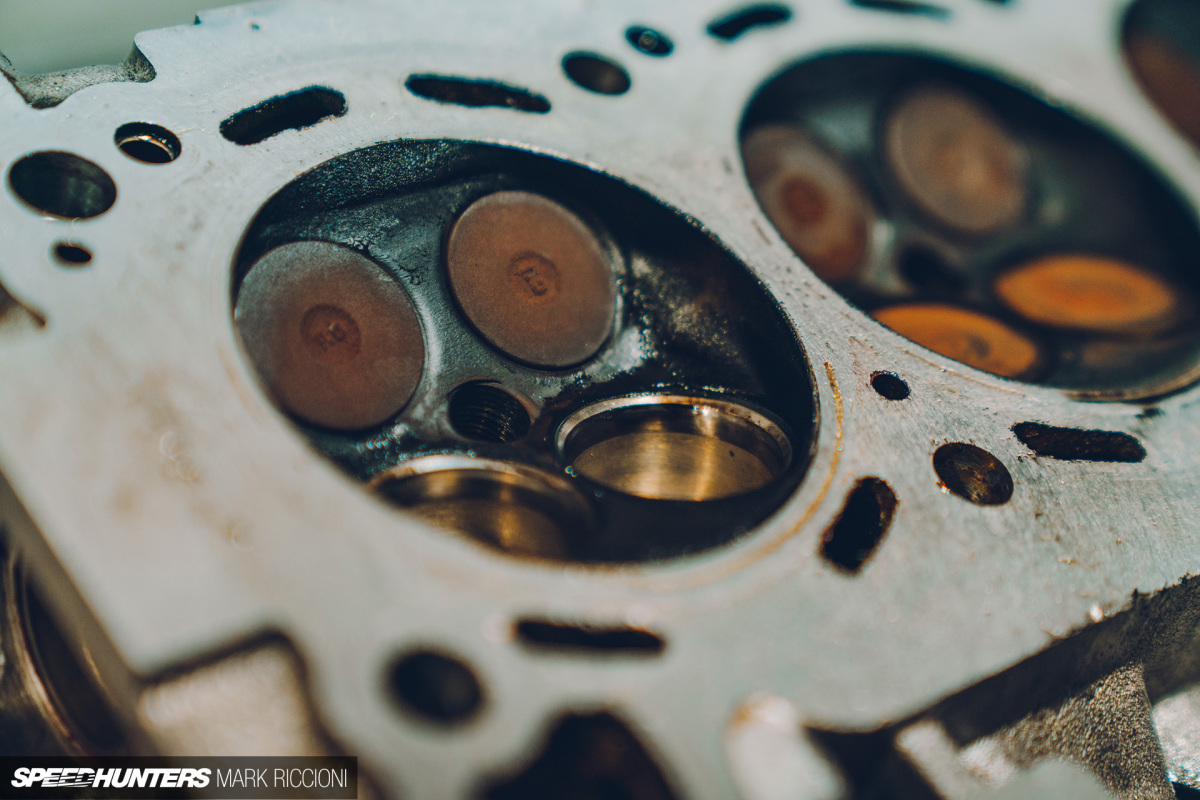
That’s not the only reason, though. I know I’m in safe hands with RK Tuning as demonstrated by Ron’s calmness throughout. He won’t leave you in the dark to figure out a solution, nor will he insist you only use certain parts in a certain way. Instead, Ron presents a kind of good, better and best scenario factoring in budget and performance goals. Some parts will be non-negotiable, and any old parts being re-used will come with their own risks. But he’s happy to entertain either the bare minimum to get you back on the road, or a full strip-down rebuild so he never has to see you again.
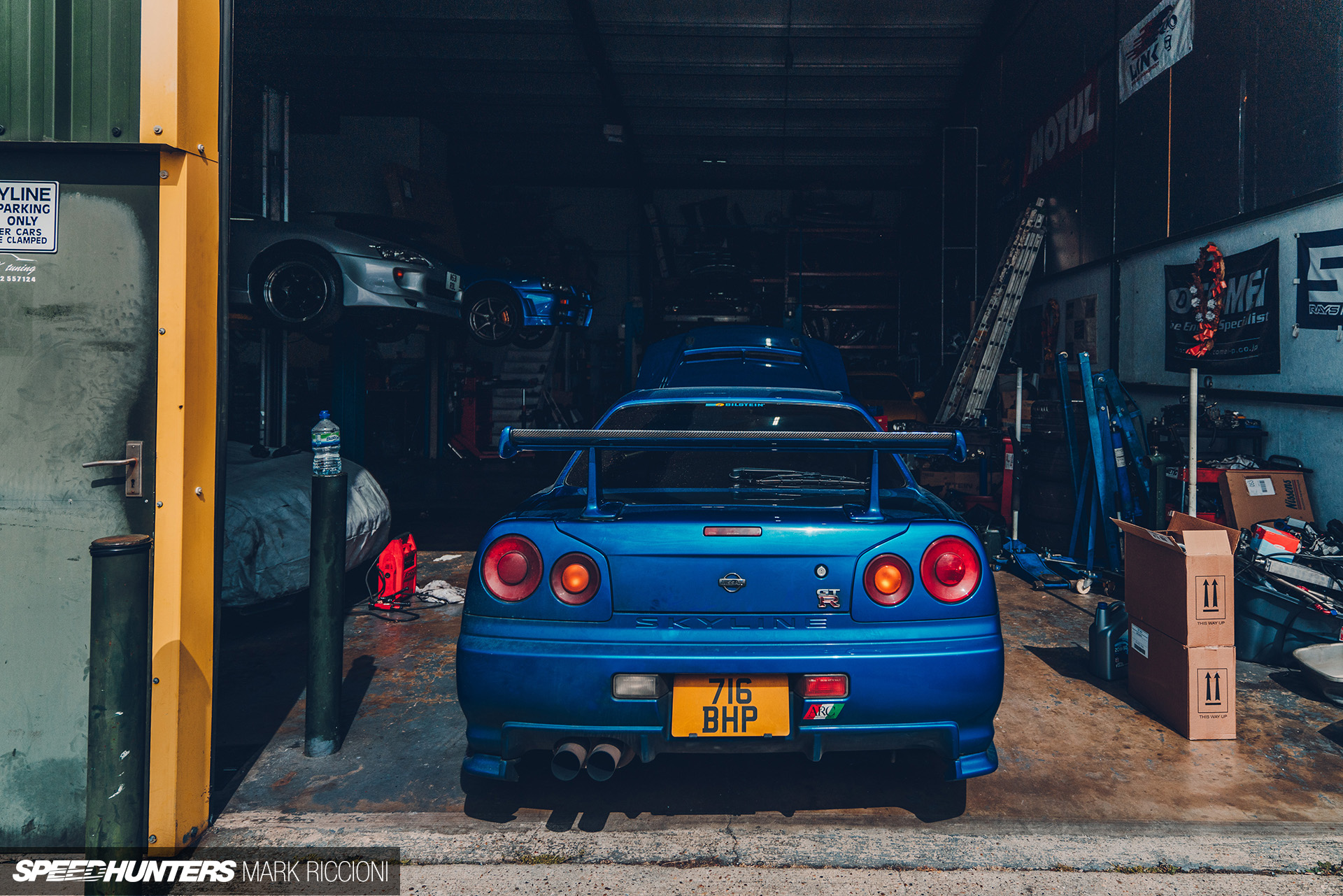
I think we’d all choose the best route if money wasn’t a factor. But it is, so after much number-crunching with Ron we opted for a solution in between the better and best options. That loosely translated as reusing the HKS crank and block (both thankfully fine) while replacing the rest for new or upgraded bits.
What will quickly become apparent in the next few chapters is how similar my behaviour is to that of a magpie. There is some underlying intelligence behind the decisions being made, but for the most part it’s dictated by the prospect of shiny things. Starting with the cylinder head.
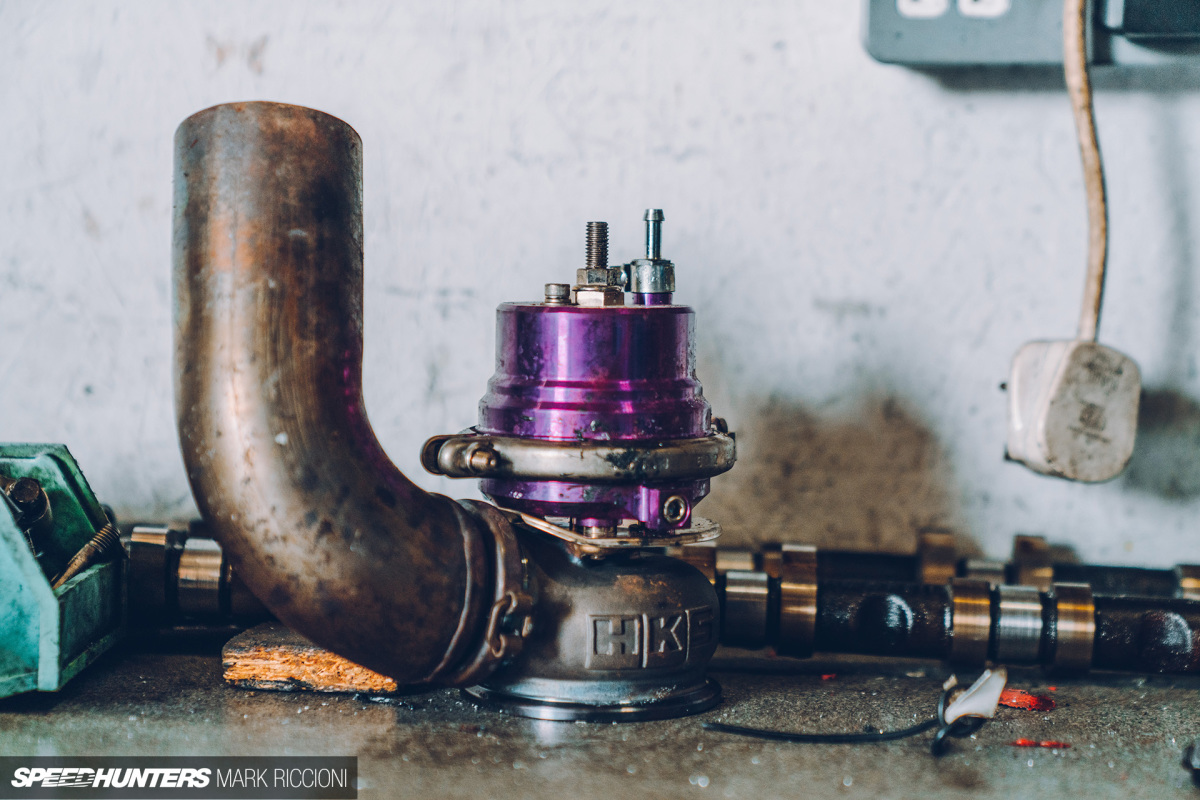

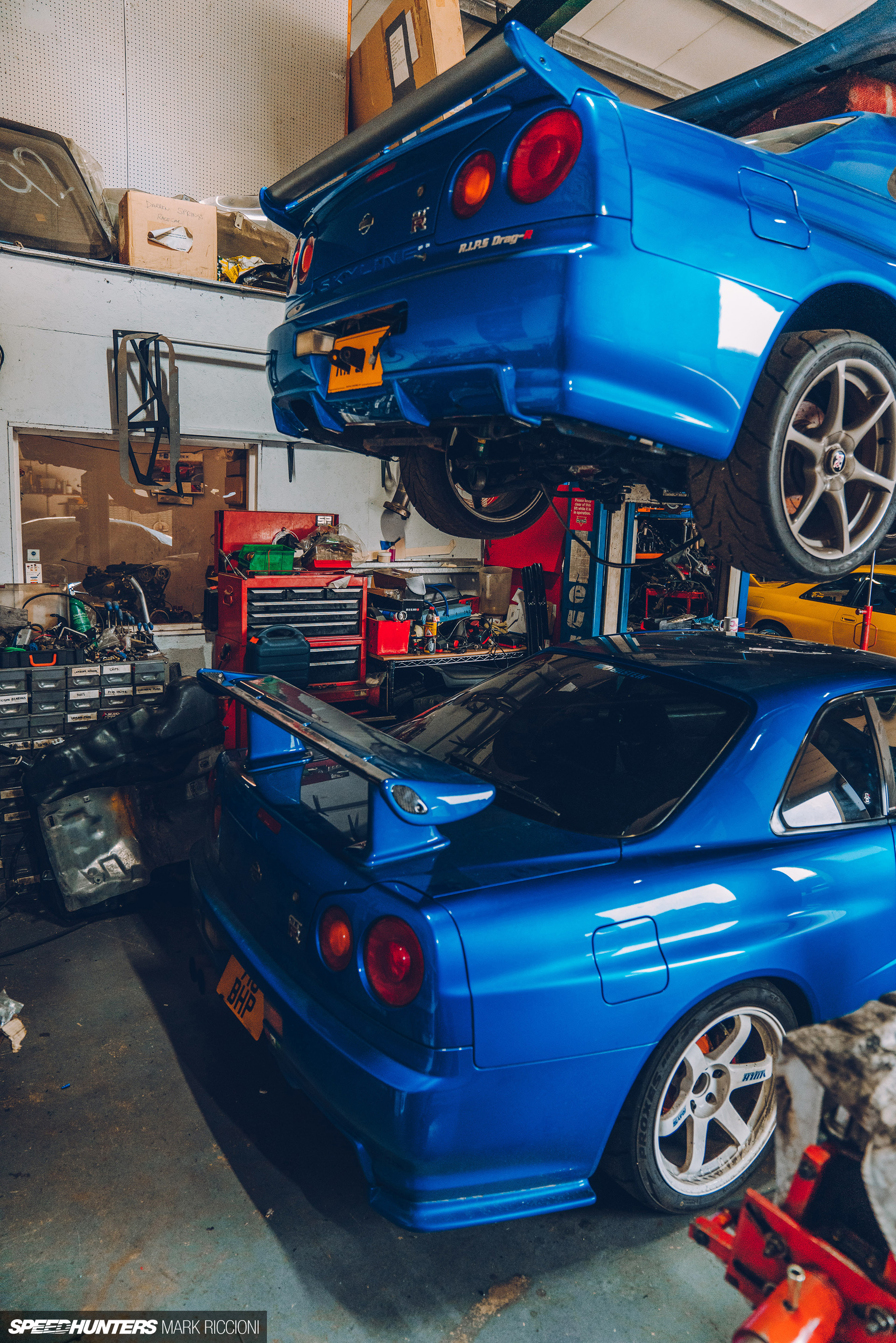
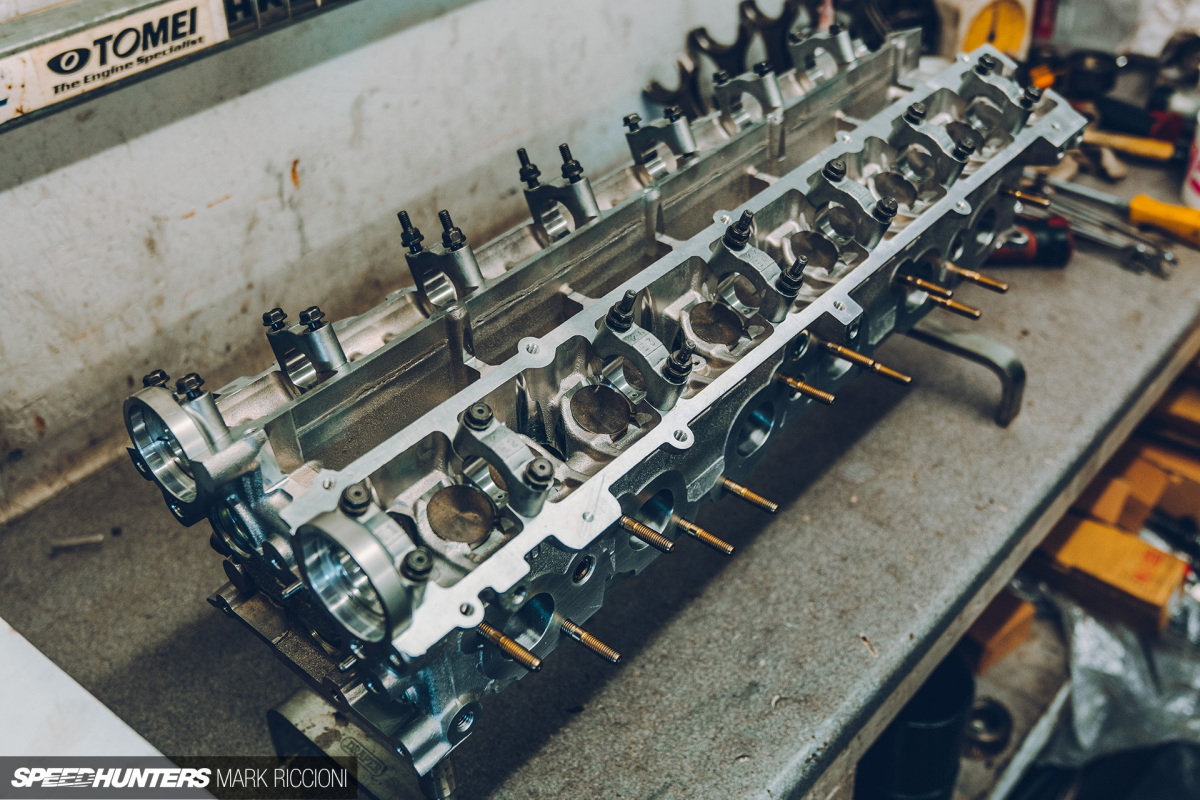
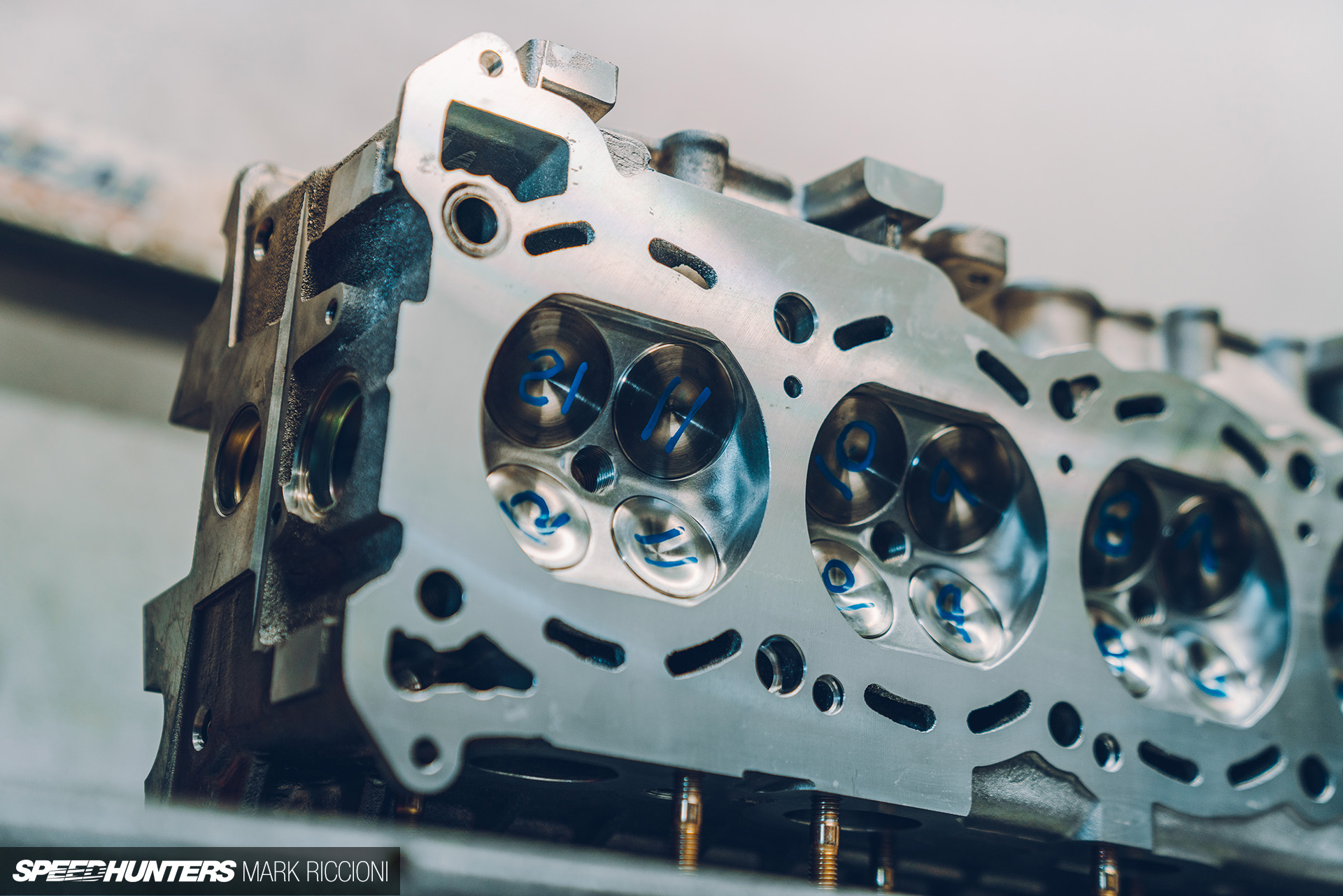
A simple route would’ve been to use a replacement (stock) RB26 head. The cams could be swapped out for my HKS items, and all the valves carried over with the addition of a not-so-snapped one. Quick and relatively affordable to do. The downside? It doesn’t prevent it from happening all over again, unless I’m prepared to limit the power and revs.
The problem with the word ‘limit’ is it has the same effect as when someone says you can’t have something. Suddenly that’s all you want, even if you weren’t particularly fussed in the first place. Admittedly, I’d also spent an evening on YouTube listening to RB26 engines scream past 9,000rpm which may have played a significant part too. Have a listen, they sound properly mental.
“Ron, what would we need to run it up to 9,000rpm?”
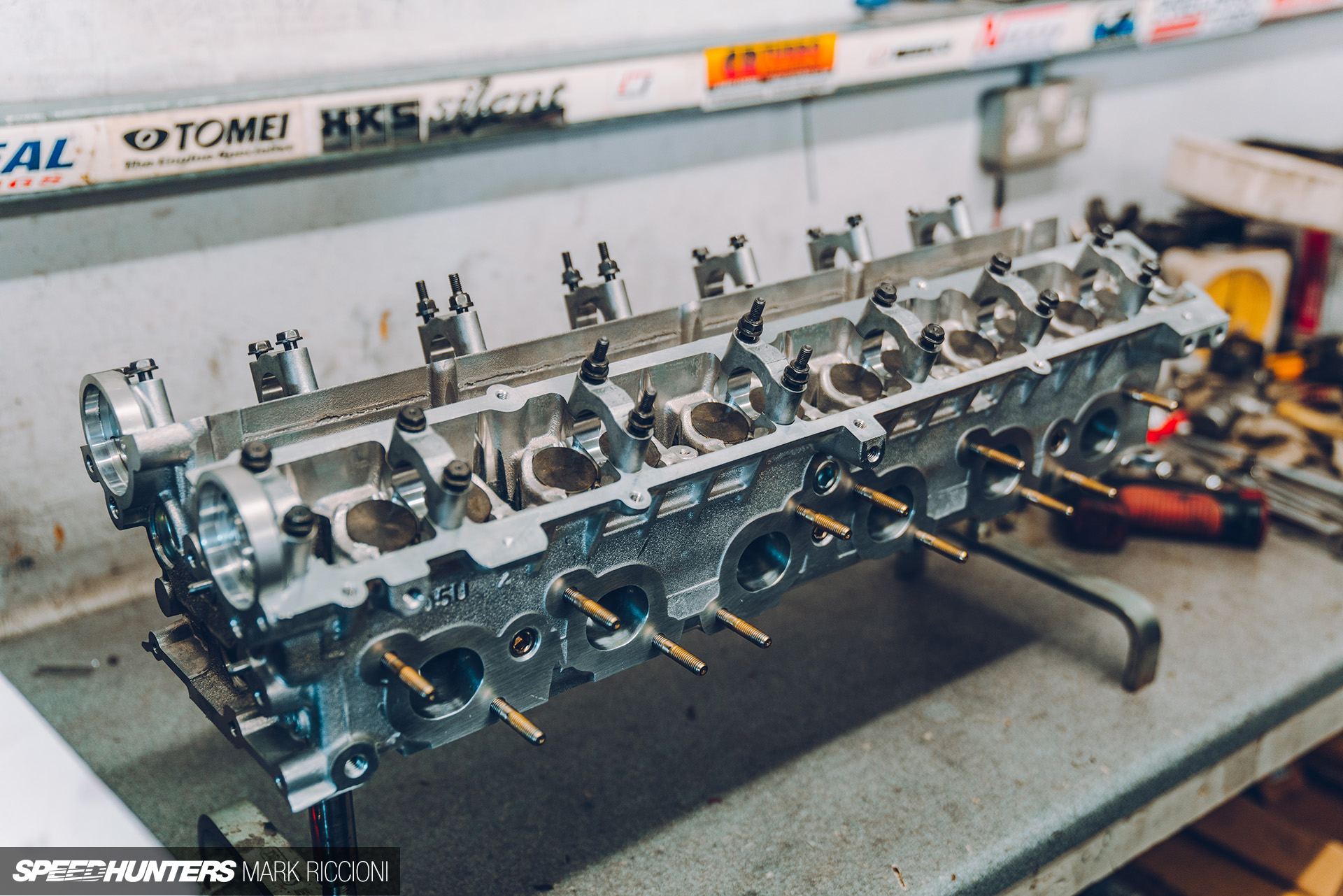
Part of me expected a shake of the head from Ron, or an audible sigh at the very least, but he’s known me long enough now to pre-empt this kind of enthusiasm. To the point he’d already found a brand-new cylinder head from Nissan as a potential option. Not ‘like new’ or ‘new-ish’ but actually new. It wouldn’t work out that much more expensive either – around £300 (US$375) I think it was – such is the price of used RB26 parts currently. Easiest decision ever made.
I’d imagine some of you will be keen to point out that by shifting the power-band higher brings with it several drawbacks such as drivability lower down the rev range. I’m inclined to agree, but what this doesn’t factor in is my skewed approach to what a big-power GT-R should drive like.

I want theatre and drama. I’m not fussed about a progressive power delivery – not for this car at least. It should be a fire-spitting, wheel-spinning monster that screams down the road with Japanese subtitles underneath it.
One of our readers made a good point in an earlier GT-R update; a standard Tesla would decimate it in a straight line right up to motorway speeds. But there’s no sense of occasion doing that in an electric car; you just hold on and go. There’s no lumpy idle, aggressive clutch or laggy turbo to try and build boost for the perfect launch. Get it wrong and something will probably break in the process. That’s my idea of a proper tuned GT-R. Who’d have thought this attitude could lead to so many reliability issues.
Anyway, as much as I obsess over Skyline and Japanese culture, there’s no escaping the fact that RB tuning has come on leaps and bounds thanks to tuners in New Zealand, Australia, America and beyond. What’s most refreshing about this is both the information readily available and how quickly parts can be turned around. That’s not a dig at Japanese tuners; you can’t compare a few people in a garage versus a giant machining plant. But the rest of the world has finished playing catch-up now, and we (unfortunately) expect things instantly.
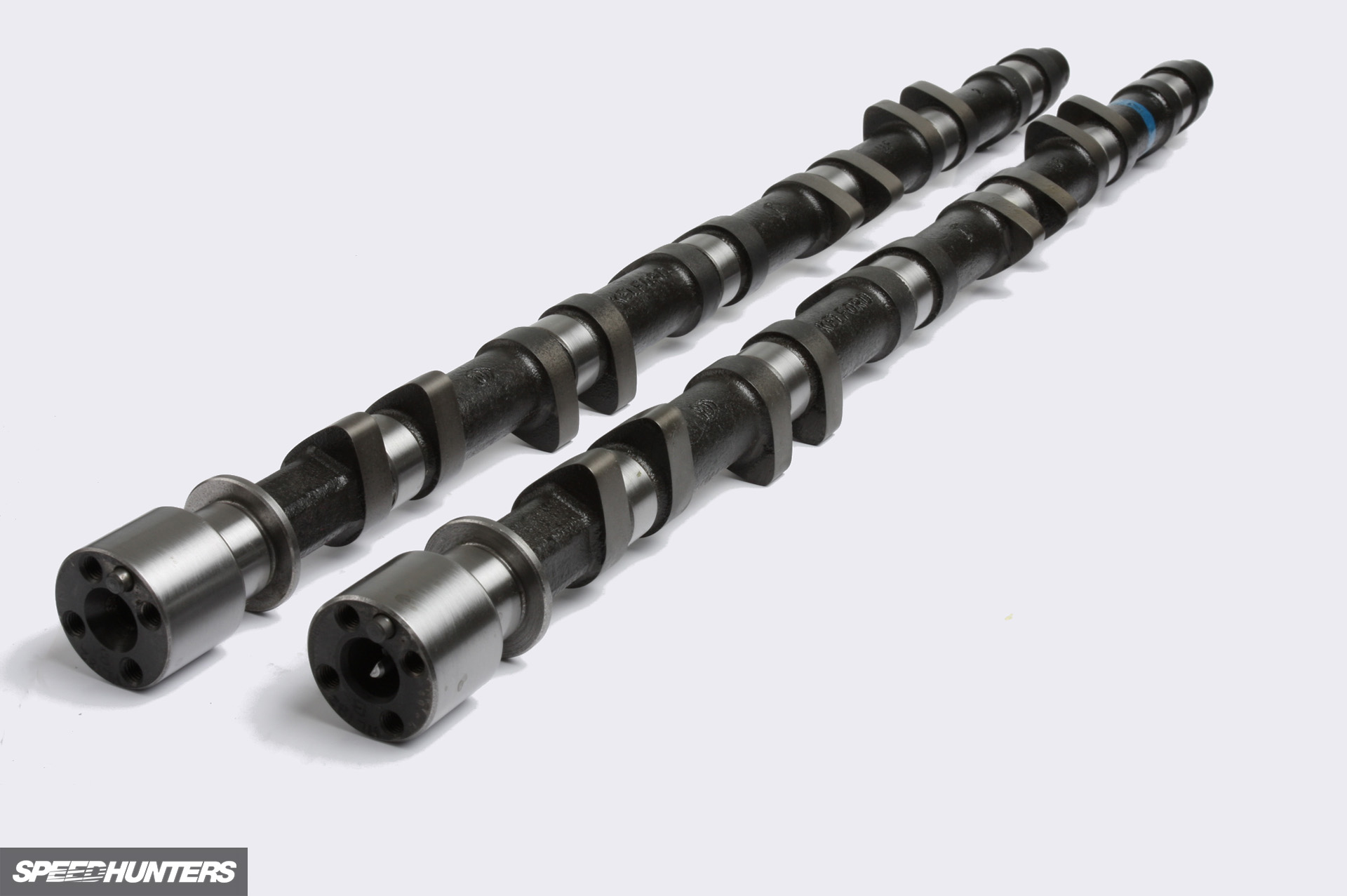
Trawling through the GTR.co.uk and Skylines Australia forums brought up Kelford Cams on multiple occasions, listing their 182-SE as a suitable upgrade from the HKS 264s currently fitted. With a 274/270-degree split intake lobe and 280-degree exhaust lobe, it’s a decent increase in cam duration without (reportedly) being too aggressive for street use. The problem with consulting forums for advice is that it’s not necessarily a case of what’s actually best, but rather who can shout loudest.
Wanting to know more, I emailed Kiel Rasmussen at Kelford in New Zealand asking for his recommendation, and while I didn’t expect him to suggest a rival’s product he did run through the pros and cons behind each RB26 cam they produce – from the mild 260-degree 182-B right through to the 292/300-degree 182-SG intended for drag racing. I’d upped my power goal to 800bhp rather than 650bhp, and as much as my brain secretly fancied the drag-spec cams common sense would (thankfully) prevail in the end.
“It’s kind of an experience thing for picking cams, one we have over 50-years of data and history to look back on which is a huge advantage,” Kiel explained. “We first look at the application and how it’s going to be used (along with power) so we can work out what sort of duration is needed. As the RPM increases so too does the requirement for more duration. The faster cycling the engine, the less time gases have to get in and out meaning we need to open the valves for longer.”
“In the case of forced induction cars, we also need to factor in the airflow and power potential of the charger. Same goes for engine size; the bigger you go the longer you need the valve open for to sustain power as RPM increases.”
Kiel backed the decision for the 182-SE cams having looked over the engine spec and power goals (2.8-litres, 9,000rpm and 800bhp) but was keen to stress the importance of matching the valve springs with the cams in the process – specifically the Kelford KVS1855-BT designed for the 182-SE’s profile.
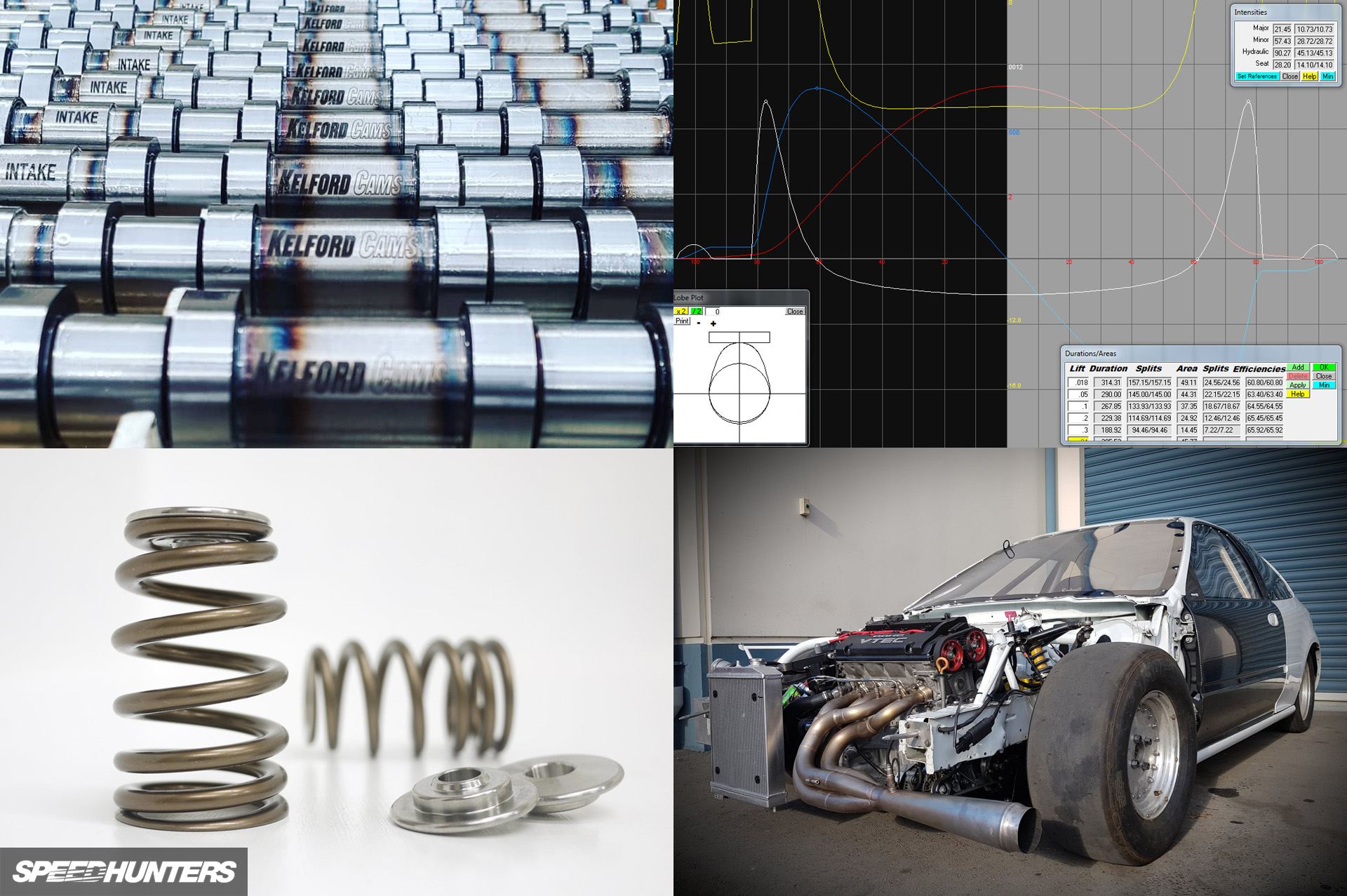
“Matching cams and springs together is absolutely crucial to valvetrain stability and ultimately engine performance. Having a cam that can open and close at the perfect time is pointless if the spring can’t actually control the valve. There’s more to springs than seated and open pressure; we’re fortunate to be in a position where we have the knowledge to design both. We can look at a particular valve lift curve and see exactly where a particular setup may start to lose control based on its measurements and weights. At this point, we can either tweak the cam design to be more stable, or in most cases make a spring specifically for the engine and cam profile.”

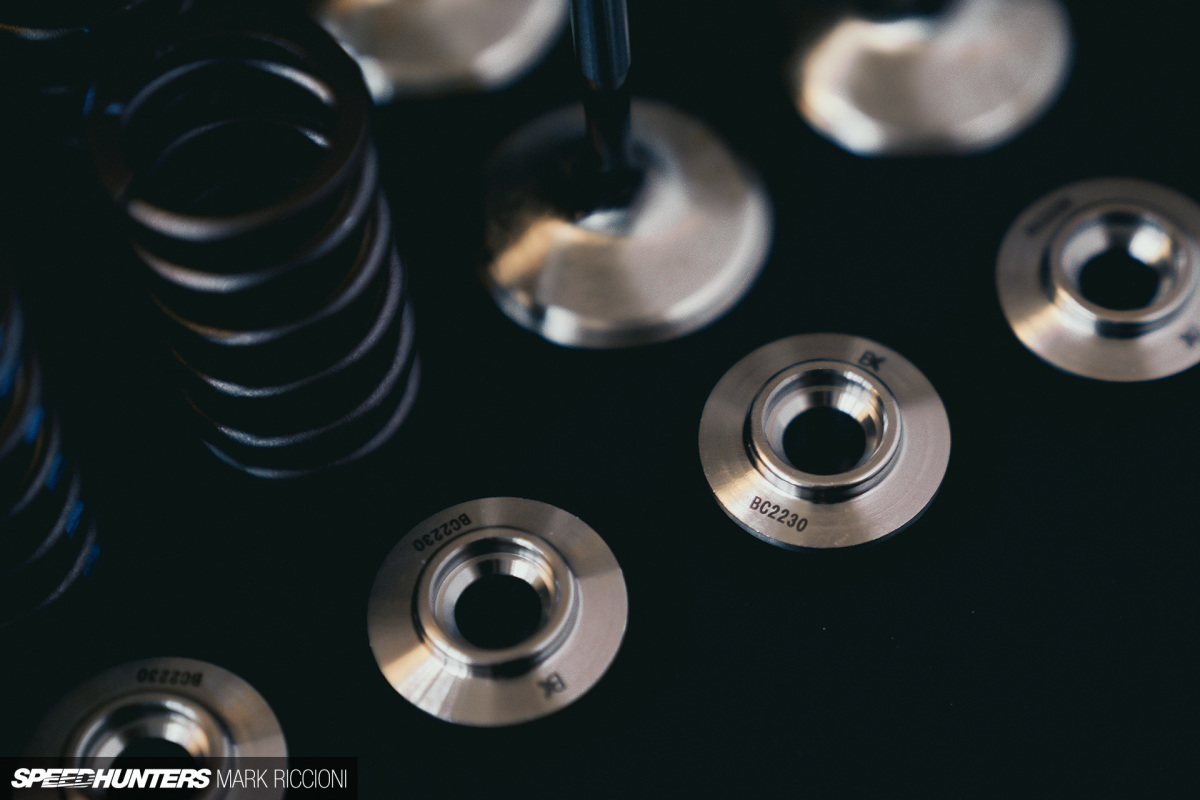
Both Ron and Kiel had asked whether or not the actual valves were going to be changed for larger items – something which seemed blindingly obvious in hindsight – and with the cams sorted I ordered a set of Brian Crower 1mm oversized items before sending the lot away for machining. Why the BC valves? Similar reasons to the cams; a good amount of forum builds recommend ‘em, they’re a fair price, and I was told they’d arrive in just a few days rather than weeks. I’ve never built an engine before, but from what I’ve learnt delaying the process with non-existent parts is a fantastic way to make your builder hate you.
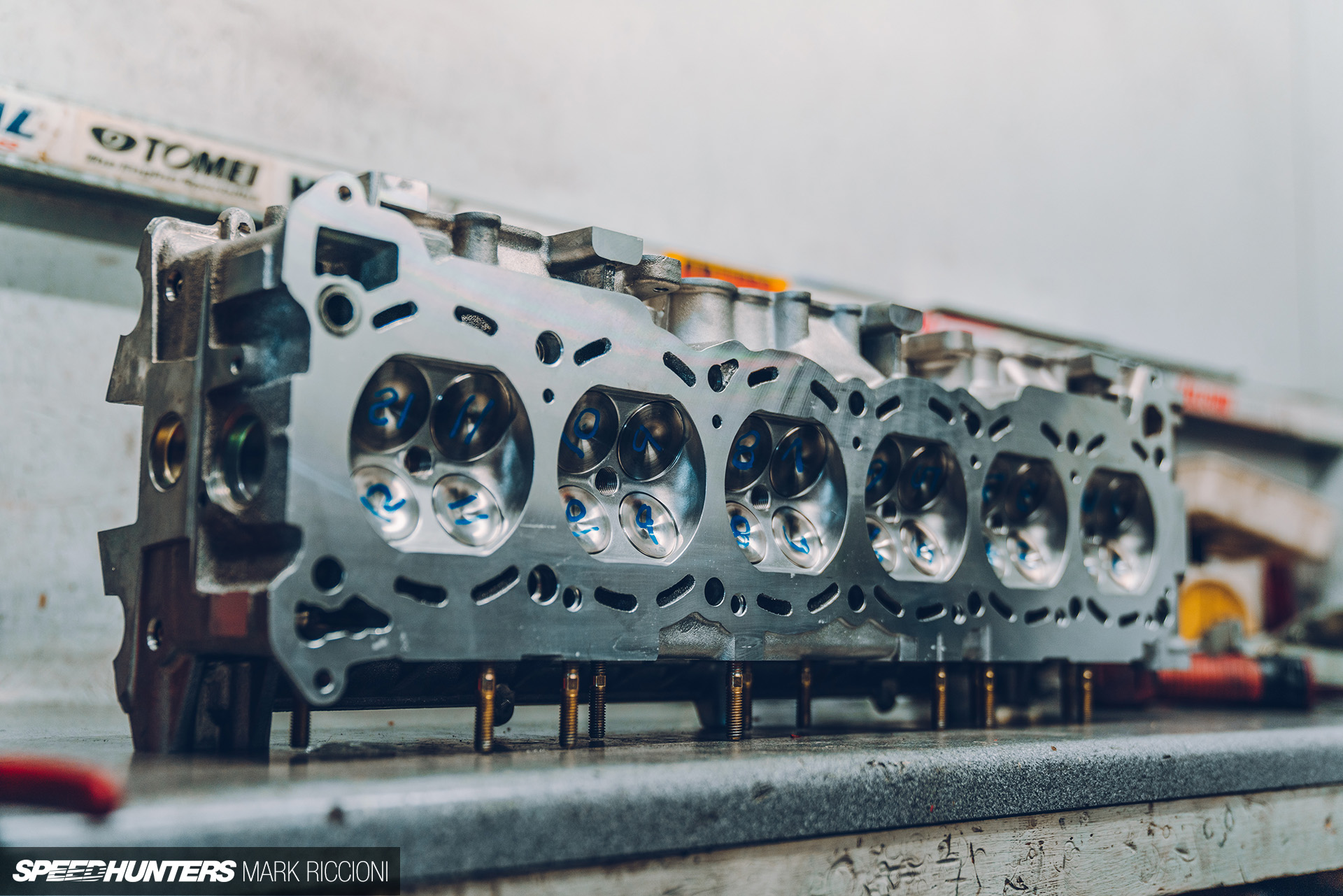

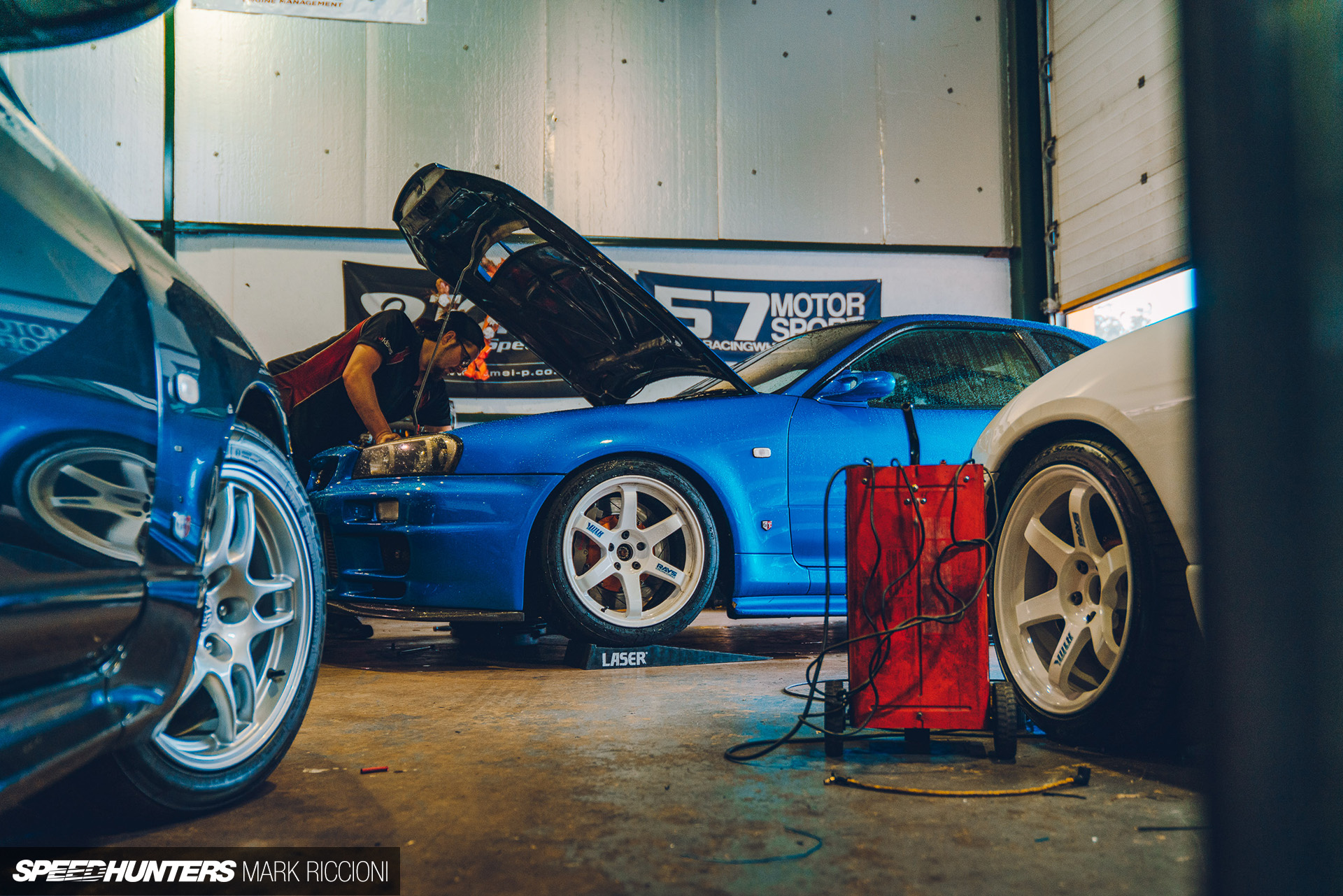
You’ll have to excuse the lack of pictures showing the physically work happening here. Ron’s a cool two-and-a-half-hour’s drive from me, so popping down for a quick visit usually ends up an entire day trip. That and, if Ron’s anything like me, he’s happiest when he’s left to his own devices rather than having a camera over his shoulder every five minutes.
I’d say my role within this build was chief parts bringer-downer, as well as giving Ron multiple migraines as I proceeded to order more bits the closer we got to finishing the build. We’ll cover that in Part 2, but the other component I wanted to focus on now was the bottom end. Specifically sourcing one that didn’t have a valve wedged in it.
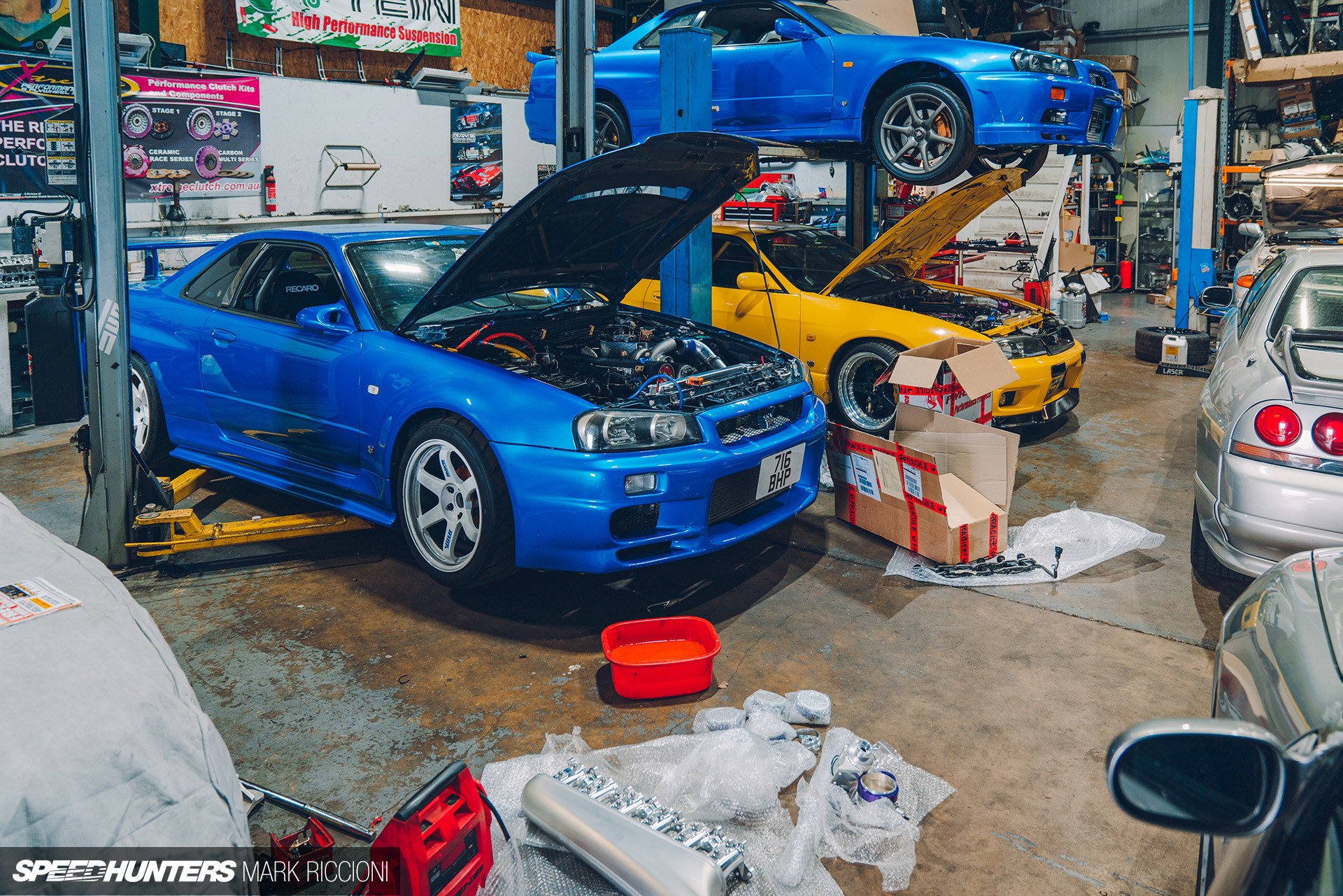
During its time in Japan, my R34 had been fitted with a HKS Step 2 kit which any Skyline obsessive will know is a pretty solid upgrade for silly horsepower. It’s also quite a spicy price and, until recently with the launch of HKS’s new 2.8 kit, a bit of a pig to get hold of. The failure had only taken out one of the pistons, but as the block had already been stripped it gave me two options: Replace the damaged bits with like-for-like and keep it cheap, or throw that aside for newer, stronger bits in case I try and chase a four-figure output in the future. You already know what happens next.
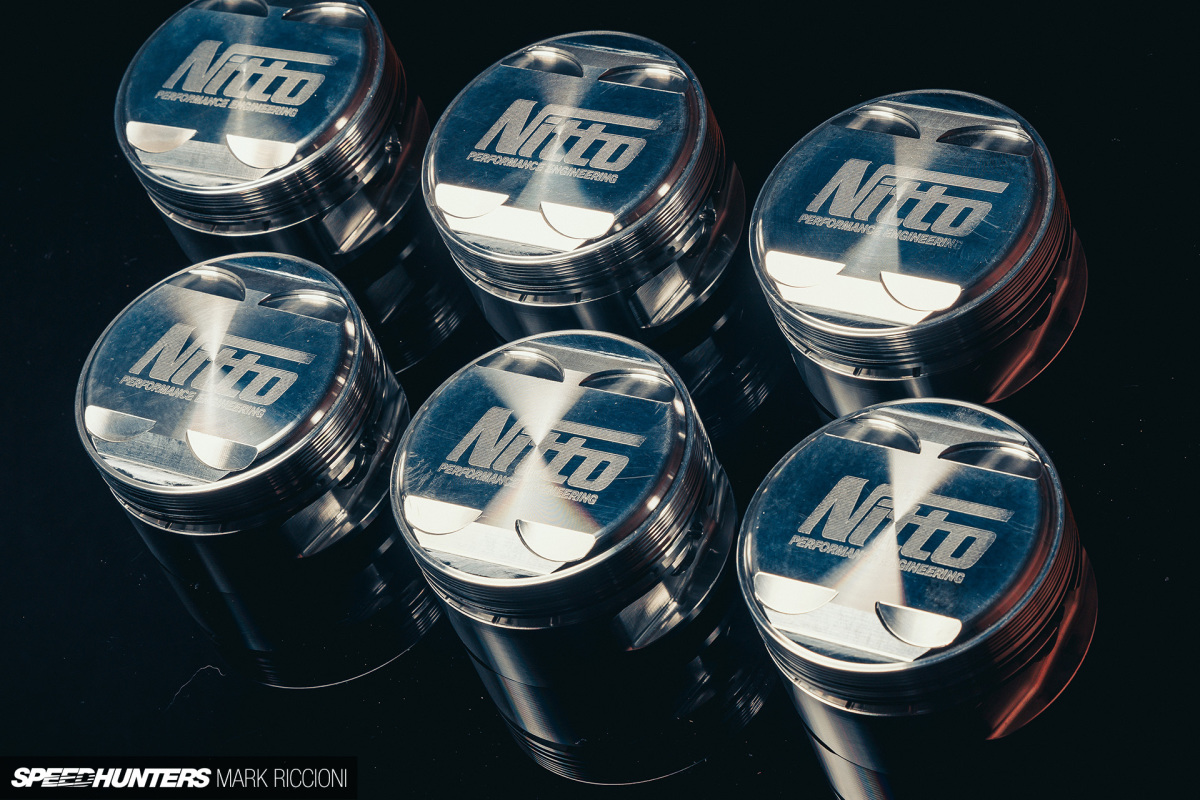
In the world of huge-power GT-Rs there seems to be one manufacturer associated (in some way) with all of the most ridiculous ones: Nitto Performance Engineering. I’ve known of Nitto for as long as I’ve known GT-Rs, and aside from their products looking the part you absolutely cannot argue with the results. Take the ‘JUN II’ R32 GT-R; the first into the 6-second and 200mph ¼-mile bracket while remaining 100% street legal. Ron had originally suggested HKS pistons to me but was keen to try out the Nitto equivalent as he’d been struggling with supply and wanted a long-term solution. Happy engine builder, happy engine.
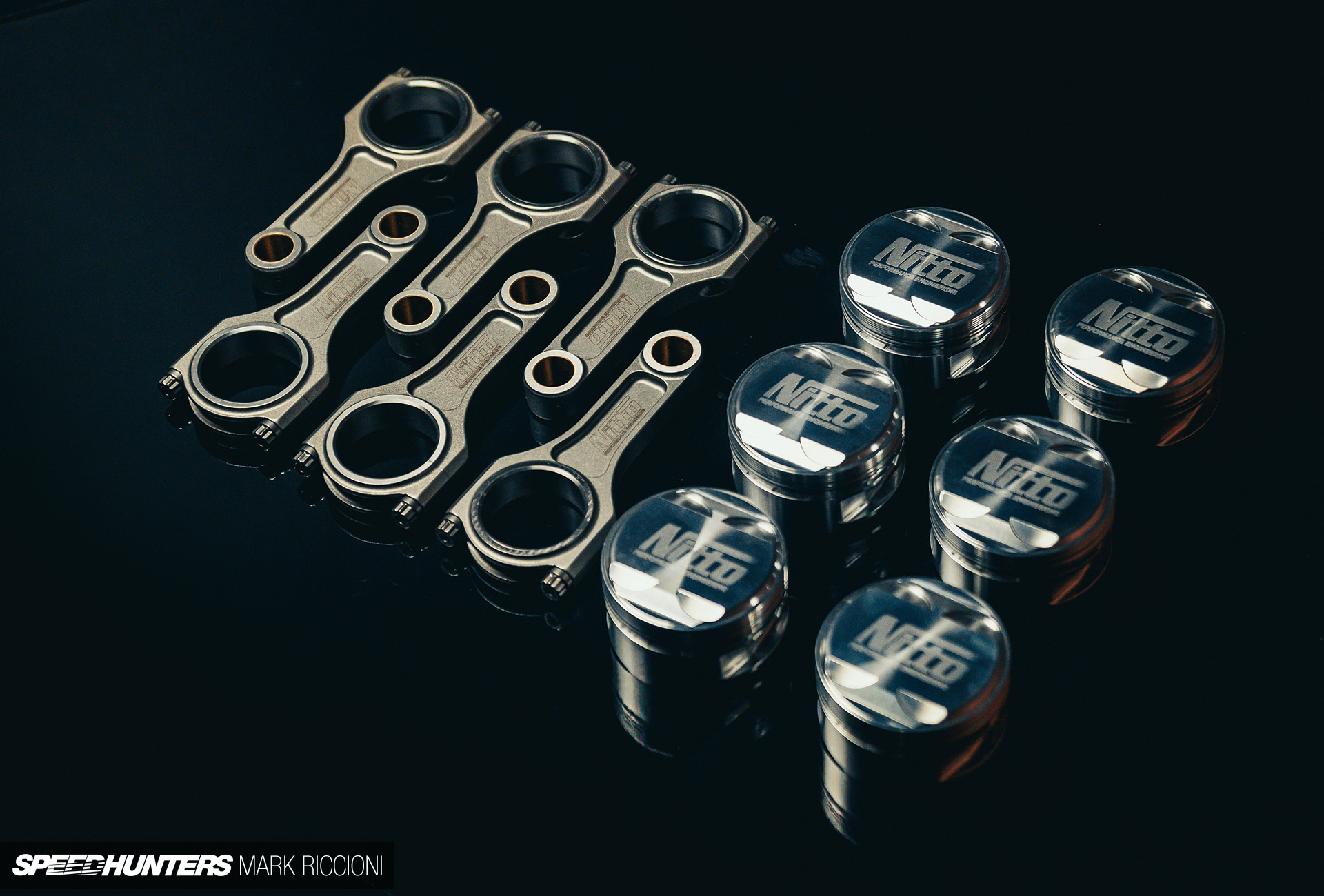

“I’ve been working with Skyline GT-Rs since 1996 but I’ve been an integral part of Croydon Racing Developments (current Skyline drag record holders) for close to 30 years,” explained Jim Souvaliotis, my point of contact at Nitto Performance Engineering lumbered with the task of talking to me from Australia.
“In the early days – or rather the late ’90s – Croydon Racing Developments had a close affiliation with JUN Auto. From there, I’ve had the good fortune to learn and intricately understand all the good and bad traits of Skylines, not to mention the tuning knowhow of the RB26 engine and drivetrain. That’s all been instrumental in the development of Nitto components specifically to cater for the demand of increased horsepower with bulletproof reliability. Don’t forget, it’s a much more demanding market now too.”
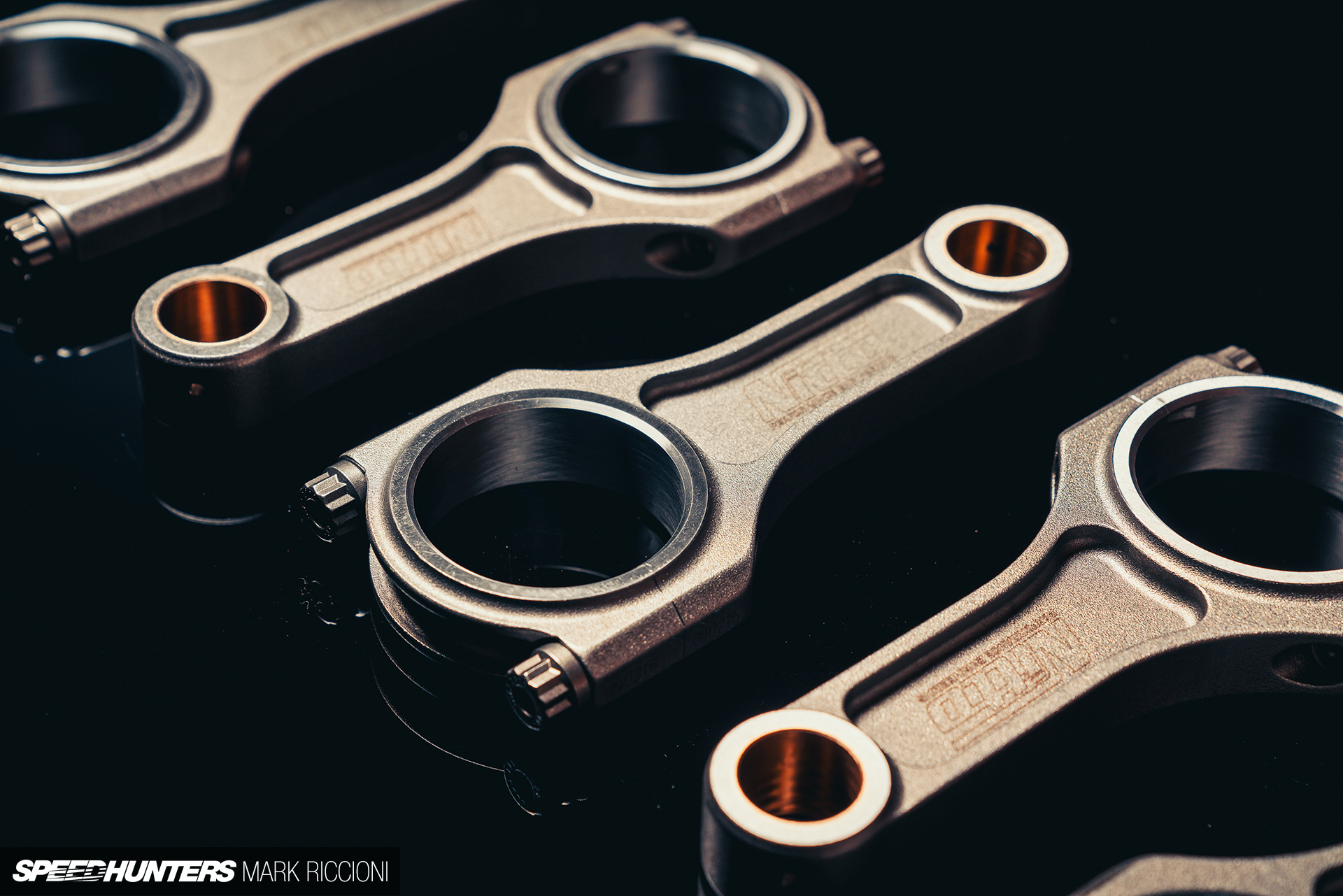
It’s a good point Jim makes about the current market. Back in the early days, certain upgrades were either limited or not available in some countries, so you had no choice but to make do with what you got. As tech has improved along with demand, it gives the market a ‘healthy’ saturation by where manufacturers can’t just churn out crap and get away with it. No longer are these cheap performance cars; they’re expensive to begin with. And those owners using ‘em as investments are prepared to spend the extra to protect that.
“From 3D drawing to a move into 3D printing, we use every means available to develop the best possible product,” Jim added. “When we finalise the design, we run it through an exhausting simulation process along with stress analysis. Once we’re happy, then we move to the testing phase.”


As much as I’m not bolting it together – and having very limited RB knowledge – I do enjoy learning about the various challenges and issues this engine suffers from, not to mention finding out how each upgrade rectifies it. It’s more fun than experiencing them first-hand, I know that much. I’ve never really understood why people will classify an engine based on ‘stages’ without knowing what’s actually involved. You might have a stage 3.5 with 450bhp, but what exactly goes into that other than a load of marketing?
With the standard RB26 bore being 86mm, the block had previously been increased to the 87mm required for the HKS 2.8-litre kit. Miraculously, the valve failure hadn’t damaged the block or bores meaning a larger piston wouldn’t be necessary, or an entirely new block either.
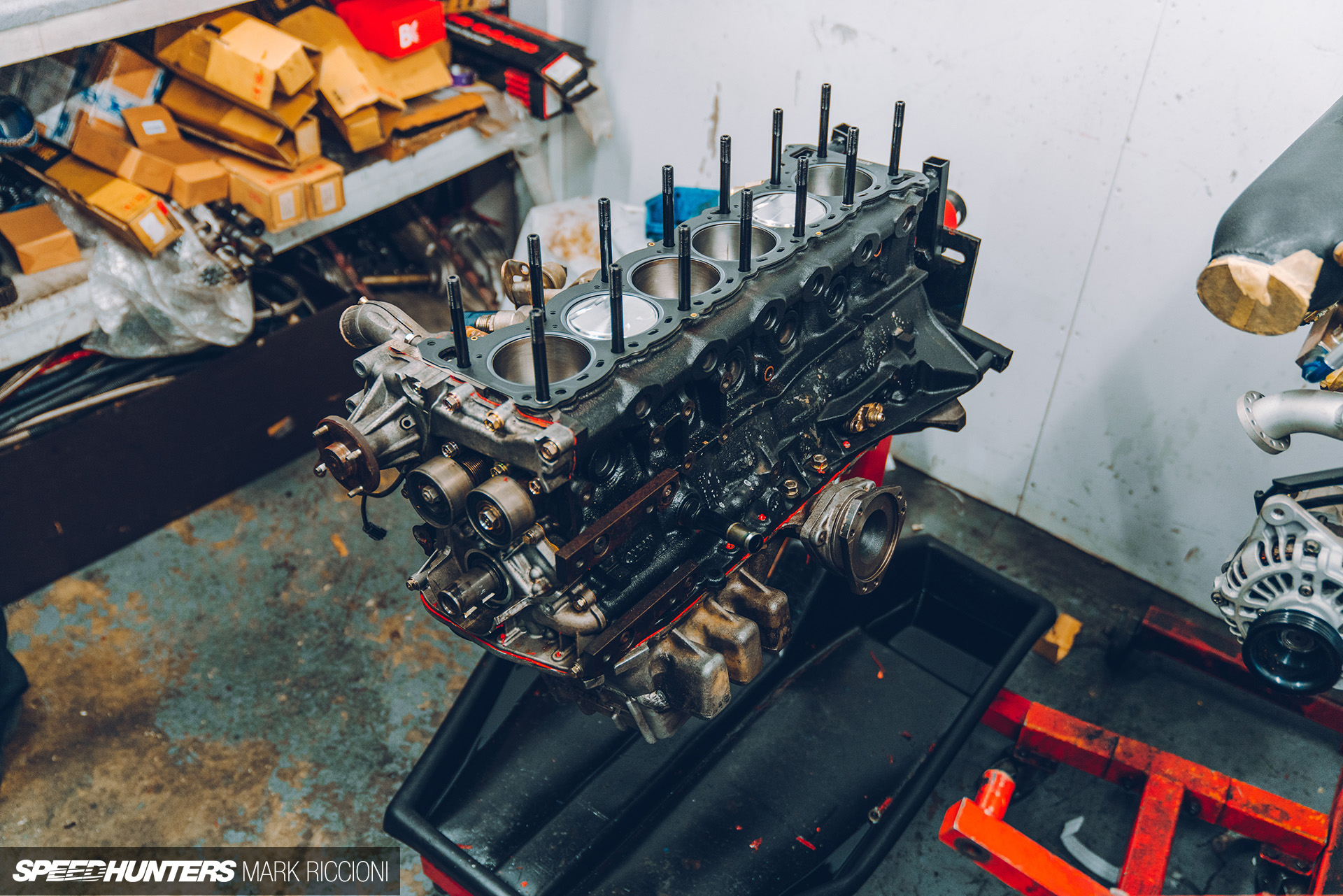
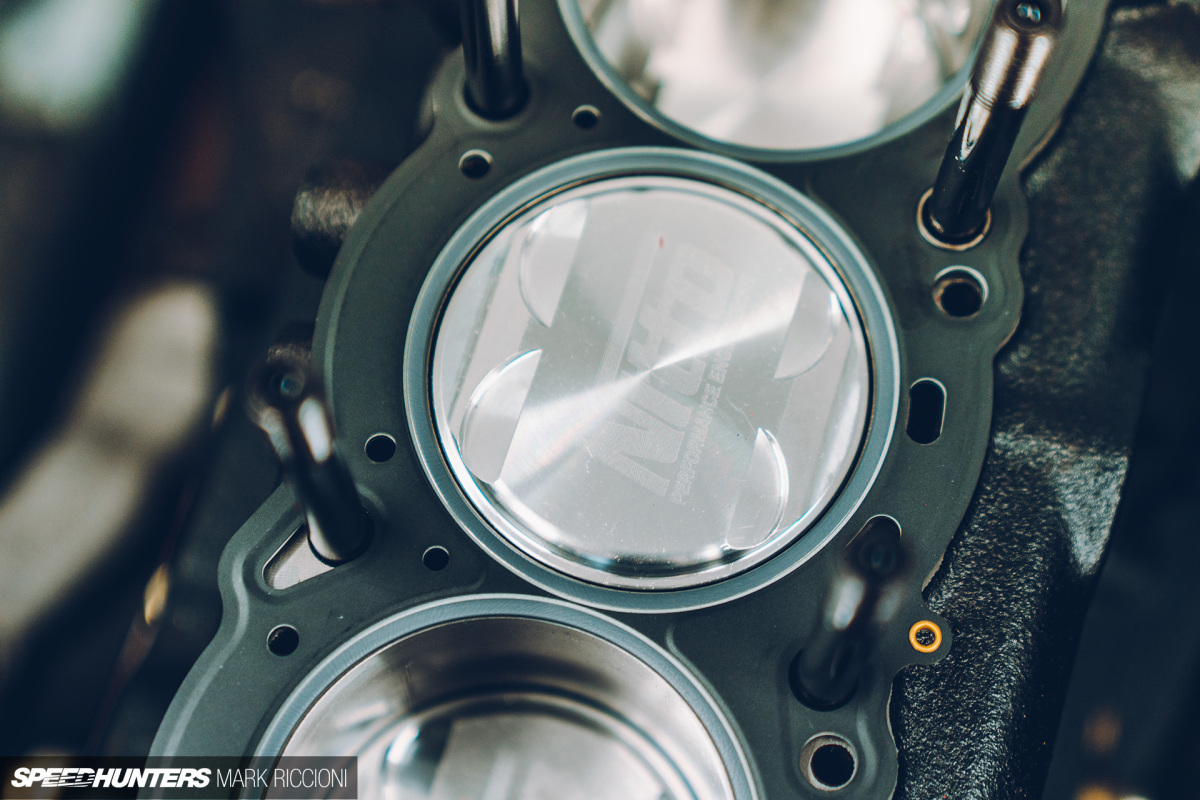
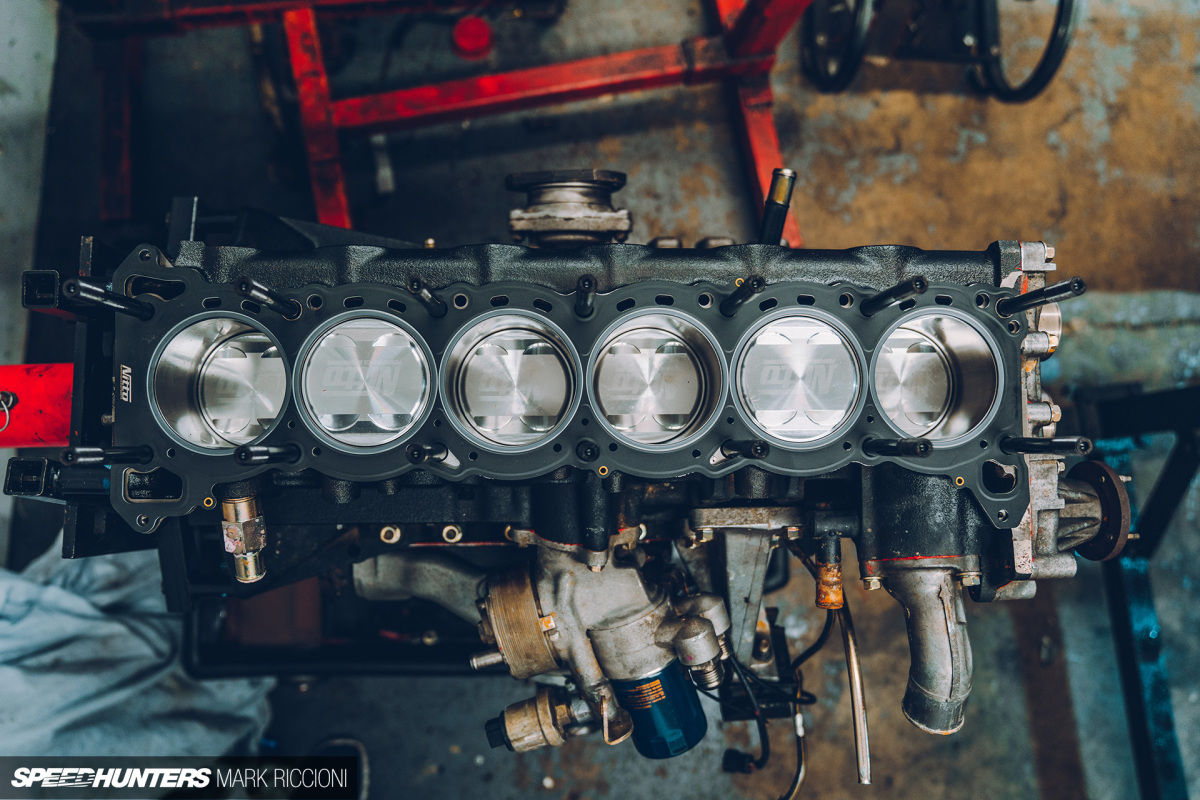
“Going to 87mm pistons for most RB applications is fine, although we don’t recommend or manufacturer anything larger than that,” Jim added. “We believe it will compromise the integrity and reliability by weakening the cylinder walls. Remember this is an engine block that (might) have been in service since the early ’90s after all.
“Apart from the additional strength of our components and improved ring sealing ability, one of the main benefits of Nitto components is they’re more forgiving if something is to go wrong – bad tuning, poor quality fuel, accidental over-rev, you name it. Compare that to the OE pistons which will fail with ring lands cracking almost immediately. The same goes with the OE connecting rod bolts which are prone to stretching from any over-rev resulting in big-end failure.”
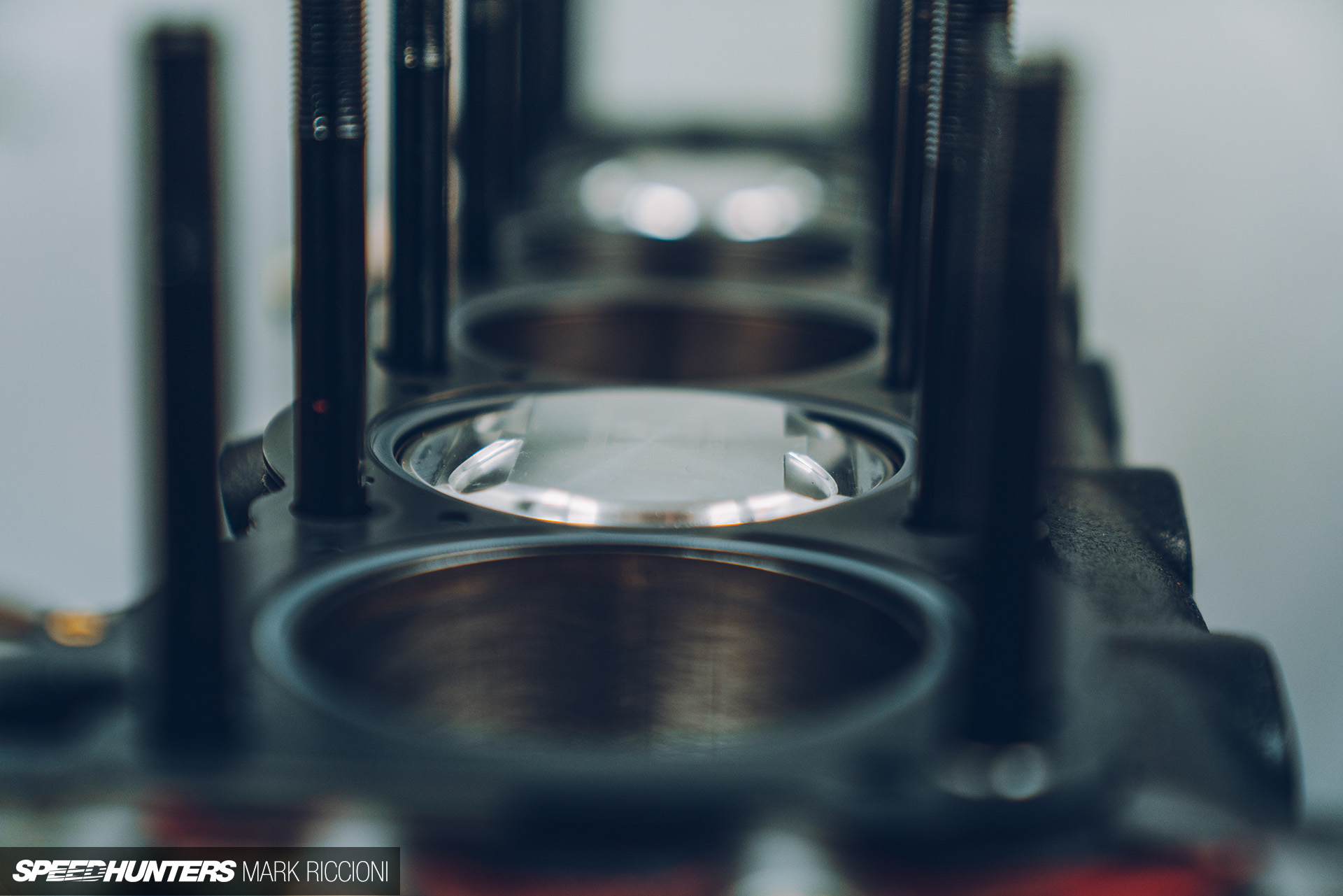
Just like the other components, the Nitto pistons, rods and gaskets arrived in a few days and – having spoken with Ron shortly after – fitted perfectly. So much so he’s now decided to use ‘em in future builds, too. No longer am I simply chief parts bringer-downer; I’ve progressed to marketing liaison manager.
From the outset, you could argue this has become a ‘chequebook’ build and I’d absolutely agree with you apart from bank transfers seeming to be a preferred payment. I’ve got the upmost respect for anyone who works on their cars – regardless of what level being undertaken – because quite honestly these things are a labour of love, absorbing every spare penny before you throw labour costs on top.
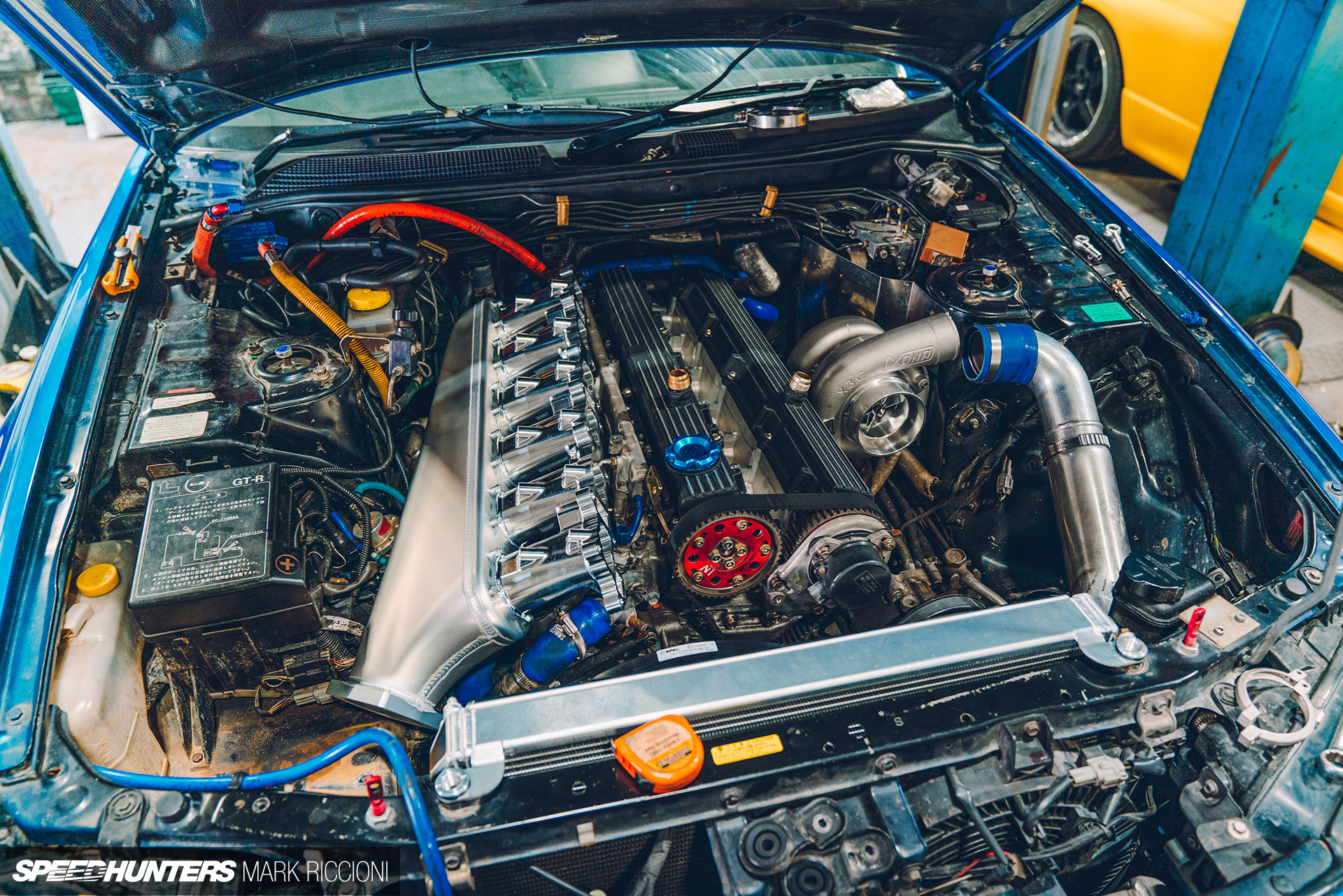
But for me, I’m mechanically inept. Actually, that might be a bit harsh. I’m mechanically lazy. I start off fairly enthusiastic but that rapidly declines the moment a bolt rounds off or I can’t reach a VAC hose. It doesn’t mean I don’t care about the mechanical aspect – it’s why I try and take in as much of the ‘build’ and decision-making process as possible. Because if Ron phoned and said ‘here’s your new engine, pay this’ it wouldn’t sit well with me. I want to know what’s gone into it, why it’s been chosen and how long I’ve got before I’m back at Ron’s for more work.
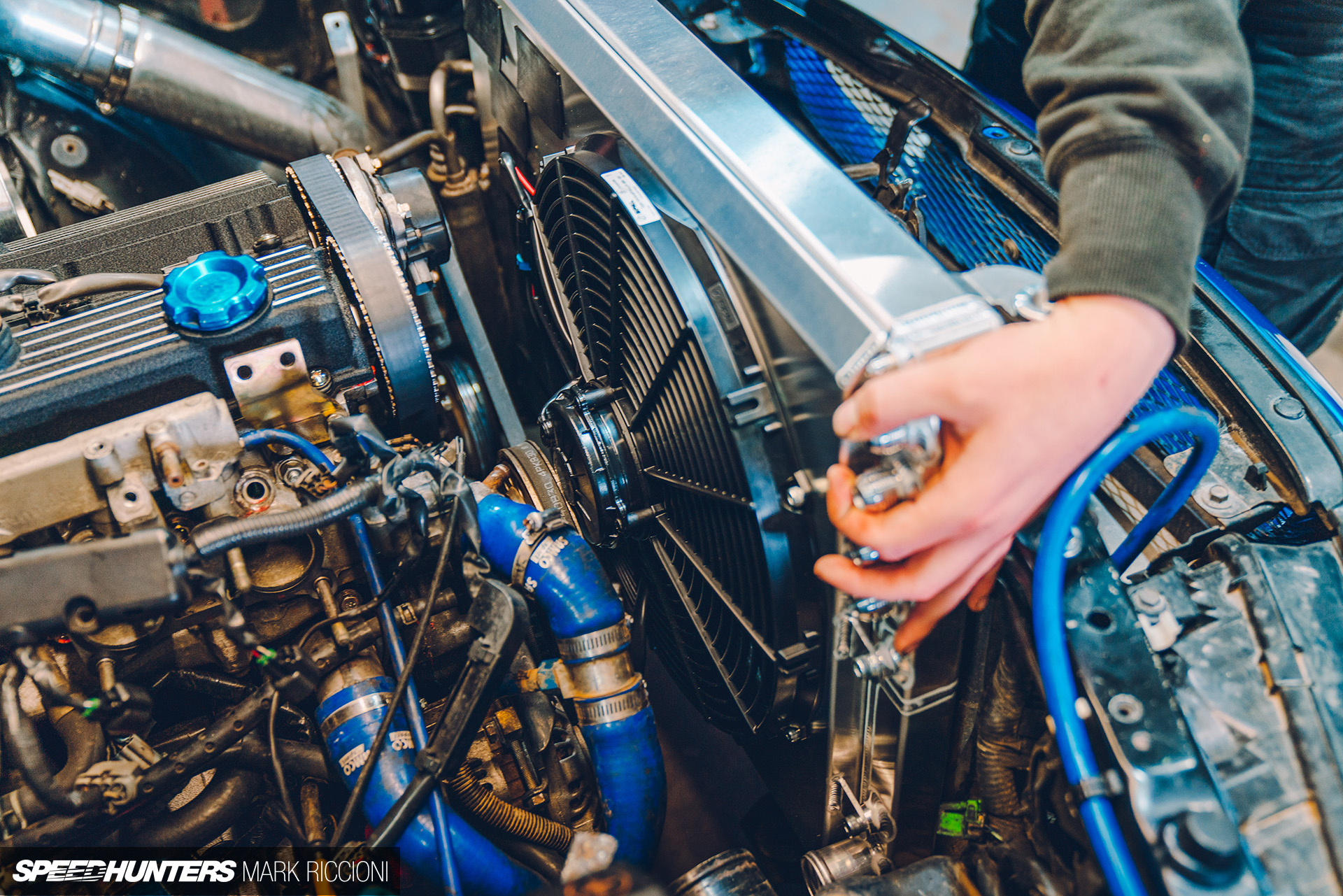
Am I any closer to being able to build an engine? Absolutely not. Do I know what’s inside my GT-R engine and if it’s any good? Absolutely right. Am I nearing the finish but about to ask Ron if we can change the turbo, inlet and cooling system? It’d have been a foolish move to call this Part 1 if there wasn’t another Project Thirty Four chapter incoming…
Mark Riccioni
Instagram: mark_scenemedia
Twitter: markriccioni
mark@scene-media.com